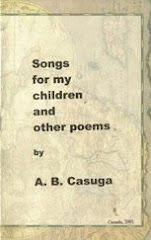
My photo
ALBERT B. CASUGA, a Philippine-born writer, lives in Mississauga, Ontario, Canada, where he continues to write poetry, fiction, and criticism after his retirement from teaching and serving as an elected member of his region's school board. He was nominated to the Mississauga Arts Council Literary Awards in 2007. A graduate of the Royal and Pontifical University of St. Thomas (now University of Santo Tomas, Manila. Literature and English, magna cum laude), he taught English and Literature (Criticism, Theory, and Creative Writing) at the Philippines' De La Salle University and San Beda College. He has authored books of poetry, short stories, literary theory and criticism. He has won awards for his works in Canada, the U.S.A., and the Philippines. His latest work, A Theory of Echoes and Other Poems was published February 2009 by the University of Santo Tomas Publishing House. His fiction and poetry were published by online literary journals Asia Writes and Coastal Poems recently. He was a Fellow at the 1972 Silliman University Writers Workshop, Philippines. As a journalist, he worked with the United Press International and wrote an art column for the defunct Philippines Herald.

Monday, March 16, 2009

WRITING ONE'S EPITAPH


Zero Point: Am Here

Am here where nothing is everything,
where the stillpoint of our exploration
is exploring beginnings
turned into navel gazing.

Where am I?

Am here where mornings crack
into a shiver of twilights breaking
into days and nights, songs and echoes –
whimpers of regret and frenzied halloing
achieved after couplings of living and dying,
of starting and ending, of suns and shadows.

Am in a circle at last
where the hole defines life’s next of kin.

I have come.

Am here where I am going.

Is anybody home?


--- A. B. Casuga


In his "Life and Death: The Burden of Proof", Deepak Chopra defines zero point: "At the moment of death the ingredients of your old body and old identity disappear... You do not acquire a new soul, because the soul doesn't have content. It's not "you" but the center around which "you" coalesces, time after time. It's your zero point."


What happens if the "center" does not hold? Will life and death still come from the same fibre? Will dying still be needed to extend the energy of living? Nothing is everything here.


"...The zero point provides the starting point from which everything in the universe springs. Since matter and energy are constantly emerging and then vanishing back into the void, the zero point serves as the switching station between existence and nothingness." Chopra invokes the principles of physics to locate this point as he postulates that life and death are from the same stream. He quotes Lord Krishna in the Bhagavad-Gita: "Folding back in on myself, I create again and again."

One does not die, therefore. One continues the journey. The homo viator cannot come home again.

If he must come home, is there anybody there to come home to?

It is questions like this that authors like Richard Dawkins (The God Delusion) exploit. Some of his fellow atheists have purchased ads in trams and transits to coyly admonish: "There probably is no God; go out an enjoy yourself tonight!" The critical word is "probably". They sound unsure about their certainty.

Because we have yet no certain way of knowing, we will maintain silence in our beds.

Wednesday, March 11, 2009

CESAR LEYCO AGUILA'S BETWEEN TWO WORLDS


" Between Two Worlds, a first novel by CESAR LEYCO AGUILA is a saga spanning four centuries and revolving around a family, the Monteros, whose roots are of the Old World, but whose successive generations are drawn into a maelstrom of anarchy, suffering, and death which usually follows colonization."


A Philippine-born Australian novelist, journalist, poet, Cesar Aguila is at work on his second novel, God's Other Children. His collected short fiction The Big River and Other Stories is due for publication by the UST Publishing House as part of the 400 books that the venerable Philippine Catholic University is publishing to commemorate its 400th anniversary in that country in 2011.


Aguila worked with the United Press International (Manila), the Philippines Free Press, the HK-based Asian News Service, the Asian newspaper, The Philippines Herald (defunct), and studied at the International Institute for Journalism in Berlin, and at the Asian Institute of Management. He was Literary Editor of the The Varsitarian, official student publication of the University of Santo Tomas in the 60s. His fiction was also included in Salu-Salo, a collection of Australian-Filipino writing in Australia. Published widely in Philippine magazines, Aguila's fiction explore his keen understanding and brave acceptance of the tensions of a clash of cultures endemic among colonized people.


His Between Two Worlds, well-received in the Australian literary scene, is "A timely, exciting first novel that explores the clash of cultures which began centuries ago and continues to this day. Not to be missed." Author Peter Fields (Heading for Cape Horn)said of book.


"It reminded me of Michael Ondaatje's often lyrical prose, and Gabriel Garcia Marquez's magical realism. A rare and richly-rewarding experience," Talking to Tess author Peter Howard describes Aguila's work. Ondaatje is one of Canada's best novelists and is multi-awarded. His English Patient is a Booker Prize winner. Nobel Laureate Marquez has had his Love in the Time of Cholera made into a film.


Aguila is a member of the historical Hakluyt Society, London. He lives in Sydney, Australia.

THE AESTHETICS OF LITERATURE

Philippine poet and National Artist nominee CIRILO F. BAUTISTA wrote the Introduction to my Aesthetics of Literature. A lot of what he said then, he could still say now because I intended the book to remain fundamental. Before I outline the contents of this book so one can appreciate it as an educational technology, let me mention what Dr. Bautista’s estimate of the book was when it was published at the De La Salle University where we both taught in the 70’s.

“The Aesthetics of Literature is both necessary and timely.

Necessary, for in the context of the curricular offerings in the College of Liberal Arts of De La Salle, the book will answer the need, so long unattended, for a comprehensive and practical text on the literary disciplines. Consequently, the students will be better equipped to relate art theories with actual art practice, and to test these theories by the application of aesthetic norms and principles. A look at the table of contents reveals the sequential tactics by which this can be achieved, with appendices that are important in the valuative analyses of the formal elements of fiction and poetry.”

Table of Contents

A Polemical Introduction

Argument for the Relevance of Literature, 5; Literature as a Humanistic Discipline, 9; the Rationale of Literature courses and Studies, 12; The Concept of Literary Appreciation, 15; Fundamental Ideas of Arts and Aesthetics, 24; Notes on the terms used in the Discussions, 29; Guide Questions for the Appreciation of Poetry, 47; Guide Questions for the Appreciation of Fiction (Short Story, Novel, and Drama), 57. Chart 1: Appreciation of the Different fine Arts, 41.

Chapter One: The concept of analysis in an Empirically-Based Appreciation of Literature, 59

Sensory-Impressionistic Level of Analysis, 67; Cognitive Level of Analysis, 73; The Associative Level of Analysis, 82; Poems for analysis, 109: (Carlos Angeles, 109; Cirilo Bautista, 110; Edith Tiempo, 111; Albert B. Casuga, 112; T.S. Eliot, 113; W. H. Auden, 112-113; Rita Gadi, 114; e.e. cummings, 115; Jose Garcia Villa, 116.

Chapter Two: The Concept of Criticism in an Empirically-Based Appreciation of Literature, 117

Nature of Formal and Technical (Empirical) Criticism, 119; Determining the Artistic Purpose, 125; The Nature and Elements of Style, 128; The Nature and Elements of Technique, 137; (Elements of Style Discussed: Use of language—diction, figures, symbols, linguistic devices, and selected details of objectification—in fiction. Elements of Technique in fiction: Point of view (with norms of qualified point of view); Order and Arrangement of actions in the Plot (with norms); Characterization (types, methods, qualities of functional characterization); Scale (arrangement of episodes, length of expository and narrative structures); and Other Techniques. Practicum, 157.

Criticism of Poetry, 185; Style, 190; Symbols, 195; Linguistic Devices, 197; Verbal, 198; Literary Devices, 203; Technique, 211; Selected Structural Parts, 211; Scale, 213; Order, 217;

Appendix A – Cask of Amontillado by Edgar Allan Poe, 225; Literary Trends that Influence Criticism (Realism, Naturalism, Impressionism, Stream-of-Consciousness, and Surrealism) 237.

Chapter Three: The Concept of Evaluation in an Empirically-Based Appreciation of Literature, 259

The Universal values, 265; The formal Values, 272; The Personal Values, and Approaches, 273: The Moral Approach, Sociological, Psychological, Philosophical, and Archetypal approaches, 275; Practicum for Poetry, 279; Practicum for the short Story, 316; Practicum for the Novel, 307; Practicum for the Drama, 327.

Chapter Four: Towards A Relevant Appreciation of Philippine Literature, 337.

Bibliography, 373.

Selected Bibliography for further reading, 376

Aesthetics, 376; Literary Criticism, 376; Poetry, 378; Fiction, 382; The short Story, 383; The Novel, 383; Drama, 386; Suggested Textbooks, 388.

Index of Authors, Titles, and Terms, 390

Essays Included (Illustrative Essays)

Edith Tiempo: The Flaming Heart by E.O. Constantino, 279
After the Quiver, Silence: The Poetry of G. Burce Bunao by Albert B. Casuga, 295
A Red-Blooded Literature by Salvador Lopez, 305
The Finitude of Our Watch: A Criticism of The Bamboo Dancers by Leonard Casper, 307
Bittter Country: An Illusion of Movement by Albert B. Casuga, 316
A Different Breed of Dog (On Calleja’s The Return) by Luis Teodoro Jr., 327

The Aesthetics of Literature is out of print, so this author may be reproducing these chapters in this blog or other websites. The author is also in the process of rewriting the book to include criticism of current literary trends.

Dr. Isagani R. Cruz wrote a chapter on this book in his Beyond Futility (a book on Philippine Literary Criticism and its directions.) --ALBERT B. CASUGA

Tuesday, March 10, 2009

THE TEXTBOOKS THAT NEEDED TO BE WRITTEN


In his blog, "Critic At Large," Dr. Isagani Cruz discusses institutional education without textbooks. Are textbooks really necessary when a student could access all sources of information relevant to his disciplines? Primary, Secondary, and Undergraduate courses might still need those textbooks to fulfill the requirements of a public education geared towards productive citizenship. Graduate studies would, of course, depend more upon syllabi that would serve the student's specialisation -- a broad range of expertise that might lend themselves to easier and faster access through the information technologies like the Internet. Why even surgeries are now being conducted via the computer-transmitted images and procedure across continents! Dr. Cruz, nevertheless, would be whistling in the dark if he wished this textbook-less education obtaining at this time, particularly in a education-technology-deficient country like the Philippines. What is probably more urgent is the demand of better-written textbooks by its many brilliant mentors who soldier on through conflicting and confusing educational policies that seem to be primarily geared now to employability.


I have been there. I started my academic career teaching in the secondary level at a Benedictine-run high school for boys. I taught Speech and Public Speaking to the seniors; expensive textbooks were prohibitive and scarce, so I ended up wiriting my own textbooks: A Primer in Speech and Public Speaking (SBC and Lourdes School, 18967) and Fundamentals of Speech Arts and Public Speaking (San Beda College, 1968). I even taped English-speaking lessons for the boys. The monks thought I should also teach them Journalism being at that time also a desker at the Manila branch of the United Press International, editor of the undergraduate Journal of Arts and Sciences (1961-63, Arts and Letters, University of Santo Tomas), and Graduate School Journal editor at the same Pontifical University. My journalism tutelage started in high school as editor of the La Union TAB (1958-59), the oldest high school newspaper in the Philippines, and serving as reporter, news editor, and literary editor of the UST's offical student publication, The Varsitarian (1959-63), and the Catholic community's Parish Postscript (founded by the late Rev. LoretoI Palafox, himself a nationally published fictionist.) I ended up writing Fundamentals of Journalism (SBC, 1965).


When the brothers of De La Salle hired me to teach at their (now) De La Salle University in 1970, I was drafted to teach Humanities courses, and I ended up editing a freshman textbook, Man in Search of Meaning: Literature (Humanities Series, Asia Foundation and De La Salle University, Manila), and a sophomore survey textbook Man and His Literary Past: The Classical Tradition. This textbook-writing "saga" culminated in my writing a senior BA textbook on literary theory and criticism, The Aesthetics of Literature (see image) under the Asia Foundation and through the scholarly egging of the late Bro. Andrew Gonzalez, FSC, then the academic vice president. To qualify me for the last textbook, I was perceived as capable having published Summer Suns (selected fiction, 1962), Narra Poems and Others (1968, The Spires, San Beda College Press), and Still Points (poetry collection, 1972), was a published serial magazine writer of poems, short stories, essays, feature articles, art criticism, book reviews, of stage plays, television series plays, and an erstwhile zarzuela (local vernacular plays) writer.
I left the Philippines during the martial law years, ended up teaching an Advanced English course in a Toronto college, and also wrote a manual published by the school as Writing Fundamentals .
Was I in the business of earning my keep by cranking up textbooks and manuals? I hope not. I simply realize at this point of my life that being a teacher also automatically made me a writer of my own textbooks. The Spanish cartilla adage, "Cada un maestro, un libro." (For each teacher, his own book.) seemed to suit me well.
But are teachers the most qualified textbook writers? If they are not, who could do better? What Dr. Cruz is concerned about at this point is the corruption-ridden Philippine textbook printing through the Department of Education patronage. And the typo errors, the errors! (which my Aesthetics was not exempt from -- the personnel at the De La Salle Textbook Development Committee at that time needed copy editors, proofreaders, and the like.)
Rather than get rid of textbooks, writing them for time-pressed and harassed students by the experts who teach the courses must be supported by the government education ministries and the academic institutions through their publishing houses. (The University of Santo tomas, University of the Philippines, Ateneo University, and De La Salle University are at the leading edge of this function).
What kind of Textbook was my Aesthetics of Literature?
It was a cry in the wilderness of teaching literature and the humanities during those turbulent times of the martial law regime quarterstorms. Students were in the streets burning tires, taunting the armed forces patrolling the streets of Manila. Teaching literary theory and criticism was a quixotic act of classroom geeks. It was futile, inutile, and then a waste of time. From excerpts of my Author's Preface, I wrote:
WHEN I began writing this book, I had in mind the fulfillment of several requirements that I demanded of myself as a teacher of literature: that before I would dare profess any idea on literary appreciation, I must first convince myself that I have a firm and reasonable idea of what literature is, why and how it is produced, and how it is appreciated as a work of art.
Subconsciously, perhaps, I was also thinking of how best I could reassure myself that -- as a practising writer of the literary forms -- I know what it means to write and that when I write, I am equipped with the proper artistic discipline peculiar to my craft. It was, therefore, an attempt to synthesize and systematize, as it were, the literary theory which has governed my efforts along the creative line.
More than anything else, however, I had deliberately dogged a very demanding ideal of providing my students with a manual which could guide them in their individual efforts of arriving at their own system of literary values -- an equipment that will serve them in good stead when they start appreciating literature on their own beyond the pale of the classroom and the often irritating pontifications of the teacher. More than anything else, I had wanted my students to be able to validly evaluate literature--with this book's aid--so that I could engage them in the course's most satisfying activity of discoursing on the diverse experiences brought to the reader's world by a motley of sensitive artists who have found it their calling to extend the limits of man's awareness and knowledge.
Indeed, I had wanted to impress upon my students that literature is one sure manner of beating physical limitations imposed naturally upon efforts to extend man's range of knowing.
A convinced devotee of the ontological approach to literary appreciation, I had also tried to chart out an avenue by which students and teachers alike could--in the words of an esteemed artist and teacher, Edith L. Tiempo--"evaluate a poem (short story, novel, drama) not as an instrument of some other discipline, but would judge it for itself, as an artistic object, meaning, an artistically created object."
Certainly, "understanding literature" are key concepts in a literature course. In fact, a nebulous idea of what they mean has always succeeded in derailing the efforts of a well-intentioned teacher of literature so that he invariably runs afoul with directionless lessons on literary appreciation.
"A real understanding of literary is an ability to state the intention of the work and to demonstrate the ways in which the various parts of the work contribute to the achievement of the work's intention. Understanding means comprehension of the purpose or end and the ways in which the parts are interrelated and work harmoniously in order to achieve that end." I subscribe to this competent exposition of P. Albert Duhamel and Richard Hughes (Literature: Form and Function).
Toward this end, this book (Aesthetics of Literature) is poised. In more ways than one, if this book succeeds in making the teacher and the student understand what it means to "understand" literature, then it shall have served its purpose.
If the teacher would like to egg his students on towards a creative expression of their appreciation of literary pieces, I have also seen to it that he would find enough excellent models of how this is done. When the student writes down his appreciation in a discriminating critical essay for purposes of publication, and without the teacher's prodding, the mentor can start congratulating himself..."
(I hope to include the table of contents in future blogs, to illustrate what my idea of a useful textbook is and how it should be fleshed. At this writing, my Aesthetics gathers dust in libraries in the Philippines, in Australia, in Indonesia, and elsewhere, and I am delighted to find out that this 1972 "textbook" is still being cited by e-libraries, amazon.ca, and ironically "rare book sellers" over the Internet. Is it still being read by students? How many of them have become writers? How many kept their copies of this monograph that did not get enough funding later to see its final print sans the errata included in the book's prefaces. De La Salle Textbook Development Committee is now being run by Dr. Isagani R. Cruz for the university where it first got published. Here's a textbook, Dr. Cruz.)

Monday, March 9, 2009

LOL Literatures in Other Languages: Filipino English

10 March 2009
Filipino English

Here's an interesting quote from American T. Inglis Moore, writing in 1930:

"The Filipino has to learn not only to write with English but to write against it. He has to write English without becoming an Englishman or American. This difficult task is necessary not because Filipino English is better than English, but because a Filipino literature must remain Filipino if it intends to be literature."

Filipino-American novelist Eric Gamalinda quotes this passage in his blog, as well as a similar statement in 1954 by Philippine National Artist Nick Joaquin:

"There are many young writers, and they are doing something to the English language: it is no longer simple English; not the English of America or England, but their English."

Writers have been using second languages for a long time, but literary critics are slow to realize that the use by a writer of a second language has major implications on how a literary text can and should be read.
Posted by Isagani R. Cruz at 4:09 AM


ALBERT B. CASUGA said...

Taglish. Spanglish. Indianglish. Chinglish. All "adapted" English for Filipinos, Spaniards, Indians, Chinese -- et alia.

Now, a Frenchman (irony of ironies), Jean-Paul Nerriere, is working hard to systematize and codify another "English" which he has introduced as "English-lite" for users of "limited English." He calls this global dialect of the global village, "Globish" (Global English).

Last Saturday, Lynda Hurst of the Toronto Star (quoted him in a feature article on Language as saying: "Anglophones no longer own English...It's now owned by people in Singapore, Ulan Bator, Montevideo, Beijing, and elsewhere." She hastened to add that he came out with a ready disclaimer, "Globish is strictly utilitarian, not a cultural triumph for English."

Nerriere, she said, considers this type of English as evolving, "one used by people as a means to an end, rather than a second language."

(For more of Globish, read Parlez Vous Globish? lhurst@thestar.ca)

In 2004 Nerriere published "Don't Speak English, Parlez Globish" and a year later, "Discover Globish" which have been translated from the original French into Korean, Italian, Spanish, but not yet English.

The Frenchman, nevertheless, thinks that Globish is not a language, but simply a tool to communicate in the global village (business, tourism, text, email, etc.), and "it will never have a literature, nor does it aim to."

Whew! For the nonce, we will not worry yet about a global language which laid-back literary critics could not make heads or tails about. When that time comes (thanks to the preponderance of Information Technology --- cellphones, IPODs, laptops, email, text etcetera..., -- a new linguistic discipline systematizing "call centre English, text-messaging English, cellphone gibberish, rap lingo, and the like would rise from the ashes of belle lettres like the Great Leveler who has come to slay the monster of Babel.

It may be sooner or later. Literary denizens of the world, UNITE! Keep a part-time outside of literature or academic pursuit. Who will need objective correlatives, similes, metaphors, conceits, then?

Ah, but did not the postwar, post modern literary world survive the onslaughts of Ginsberg, e.e.cummings, or even James Joyce "Ulysses" or "Finnegan's Wake". Has anybody finished reading these and remained sane? Will anyone continue to want to read poetry like this:

"Anyone lived in a pretty how town/(with up so floating many bells down)/spring summer autumn winter/he sang his didn't he danced his did."

That's "Globish" even before Nerriere "discovered" it. That's called the "power" of the humble day-to-day words.

Well, there's always the positive tiding of the Filipino writing in utilitarian English (as opposed to elegant English) and concentrate on "content". Will the literary critic thrive then?--ALBERT B. CASUGA

10 March, 2009 09:49

LOL Literatures in Other Languages: Example of Multilingual Criticism?

09 March 2009
Example of Multilingual Criticism?

I don't have enough money to subscribe to online journals (not to mention that I am an advocate of Open Access), so I have read only the abstract and not the full article of "Bilingual creativity in Chinese English: Ha Jin's In the Pond" (2003) by Hang Zhang.

This is the abstract: "This paper addresses issues related to bilingual creativity in Chinese English and their implications for world Englishes in the Chinese context. The language examined in this paper is drawn from Ha Jin's novella, In the Pond, in which the author's use of English is 'nativized' to the Chinese context in order to recast the cultural meanings of the language. Rooted in social realism, cultural authenticity, and historical accuracy, Ha Jin describes the lives of ordinary people against the larger political backdrop of China. His skilful use of English successfully transcreates his native Chinese experience to form an indigenized narrative style. In this paper, I employ a theoretical framework derived from Kachru (1982, 1986, etc.) to show how Ha Jin's work expresses a distinct Chinese cultural identity. Ha Jin's use of creative innovations in English reflect the texture of Chinese ideological, political and socio–cultural representations. The linguistic exponents of such creativity range from the use of address terms, curse words, to metaphors, proverbs, political expressions, and other aspects of the contemporary Chinese lexicon. Despite a central concern with universal themes in his fiction, Ha Jin simultaneously conveys a distinct sense of 'Chineseness' through the use of nativized discourse patterns, rhetorical strategies, speech acts, and a range of other linguistic devices."

This looks like a promising step from purely linguistic analysis to real literary criticism.
Posted by Isagani R. Cruz at 4:54 AM


09 March, 2009 22:31
Albert B. Casuga said...

Keywords in the abstract are: "indigenized narrative style" and "nativized to the Chinese context."

Assuming that Ha Jin's novella "In the Pond" accomplishes all those literary strategies analised by critic Hang Jiang as palpable in the novella's style and technique, and achieves the "distinct sense of Chinese-ness" (contextual structure), the criticism of his work is, indeed, valid and relevant "literary criticism."

This appears to me as the kind of "literary criticism" Dr. Cruz has been looking for. One does not have to write and speak the Chinese language (or at least a lingua franca) to analise, criticise, and evaluate a Chinese author's work in English.

The de facto "literariness" of the Han Jin's novella qualifies it for a competent literary criticism that guides the reader to its ultimate aesthetic value.

Writers using the second language as a creative medium understand that socio-cultural, ethnic, political, existential underpinings of a fictive or poetic material could be expressed and "objectified" by "nativised" discourse patterns, speech acts, and all types of linguistic devices like the figures of thought, speech, and language. and some such linguistic tools that form part of the energies of the English language as a literary medium.

Of course, misunderstanding "Chinese-ness" is a caveat the critic must be sensitive to. A curse, an address, or even proverbs could easily be misinterpreted so they could become "mnemonic irrelevancies" that would eventually confuse and muddle what would otherwise be a valid analysis, criticism, or evaluation of the work.

When a Chinese fiction character says, "Aiee-yahh", (spelling here creates a speech act) say, would he be expressing disgust, surprise, resignation, disbelief? Would "Ni hao" necessarily mean "Hello", or would include the sarcasm of a "hello?" as an expression of exasperation in urban Detroit, say. Are they enough to establish "Chinese-ness"? Beware, therefore, the errant "nativised" speech act or metaphor.

I just wrote a short story (now published in my Blog Ambit's Gambit http://ambitsgambit.blogspot.com/ which utilises narrative strategies that define the ethnic-ness of the characters in the fiction that revolves around the world of "immigrant senior citizens". Can one appreciate the "Filipino-ness" of the context from the story?--ALBERT B. CASUGA

10 March, 2009 04:34

Saturday, March 7, 2009

LOL Literatures in Other Languages: Rolando Tinio's Valediction sa Hillcrest

07 March 2009
Rolando Tinio's Valediction sa Hillcrest

It's not exactly a hot topic on the Web (with only 134 entries on Google), but Rolando Tinio's poem "Valediction sa Hillcrest" (1958) has been baffling students when given as a standard text in literature classes in the Philippines. The poem is written in Taglish, the code-switching dialect of Tagalog that uses many words, phrases, and even sentences from English. (Taglish should not be confused with Philippine English, which is the object of much study by linguists). Most students find the work opaque because of (a) the situation, and (b) the language.

The situation is easy to understand if you studied outside your home country and deluded yourself during those years of study that you are a native of the foreign country. When you are forced to return home by your student visa restrictions, you don't quite know where your home is. Once pointed out to students, this situation (which students can relate to, since many of them live away from home to go to university even in their own country) becomes easier to appreciate.

The choice of language raises questions because hardly anyone wrote or writes poetry in Taglish. Considered subliterate by most university professors, Taglish (a pidgin, technically speaking) is used mostly in popular romance novels (which, btw, sells in the millions of copies in the Philippines) but not in Literature (with the capital L).

Tinio (posthumously declared a National Artist of the Philippines), with unimpeachable credentials earned in the USA and the UK, made Taglish respectable as a literary language in this one poem. (He later moved away from pidgin and into classic literary Tagalog.)

Taglish as a language neither here nor there is a perfect objective correlative or symbol of the identity crisis of the young man in the autobiographical poem. The shifts from English to Tagalog to something not quite English nor quite Tagalog mirror the conflict inside the young man as he easily recalls the happy recent moments spent in Iowa and tries valiantly to recall the happier earlier moments spent in his native Tondo (a district in the city of Manila in the Philippines). At the end of the poem, he sheds tears unabashedly, in a striking image of water falling from his eyes into snow melting on the ground as he walks towards the bus station.

For non-Tagalog readers, here is a taste of the linguistic beauty of the poem:

There’s a flurry, ang gentle-gentle.
Pagwhoosh-whoosh ng paa ko,
The snow melts right under.

Ang is a marker, like so; pag- is a marker for the onomatopeia; ng means of; paa means feet; ko means my.
Posted by Isagani R. Cruz at 5:31 AM


ALBERT B. CASUGA said...

Rolando Tinio captured the peculiar nuance of Taglish, a dialect that might have sprung willy-nilly out of the various campuses of the Greater Manila Area. It is, indeed, how an erstwhile university habitue would banter while walking through the streets of Manila -- Azcarraga, Espana, going to Aleng Mameng in Dapitan...

Indeed, the Iowa Writer's Workshop alumnus would find going home to the old Manila hometown rather "sentimental". Relationships developed among attendees in writers' workshops like this are particularly deep however briefly they last. From those no-holds-barred seminars to soirees at night which even breed romances, one wakes up to some jolting reality -- one must go home. One must now write the great Filipino Novel, the great poems inspired by the reputation of Iowa, the Engels, the Filipinos who have attended the world-class workshop ahead of one who would rather carouse in the halls of the great university of Iowa...

Would Taglish have prospered as the Filipino English for poetry like Tinio's? It is still the lingua franca of the student districts of Manila and elsewhere. It is the virtual Pilipino now called the national language.

Tinio and I graduated from the University of Santo Tomas. I admired his work in the Aquinas Dramatic Guild where he wrote, directed, and acted in his own plays. We met again at the Ateneo Graduate School where I enrolled in his Modern Poetry course some years later (we were "encouraged" to finish our Master of Arts degree in order to get promoted to professorship). I was annoyed about having to commute to Ateneo from my domicile; I dropped out, and last saw Tinio at a Poetry Award ceremony for "Parnaso Philippines" (sponsored by a company where poet Cesar Mella worked as a PR grunt). I won the Parnaso Poetry Award that year over Tinio and a second-placer Dumaguete poet, the late Artemio Tadena.

I wonder now if Rolando Tinio might have won that national poetry award had he continued using his Taglish. I like his "Valediction..." Then again, the judges then like Godofredo Burce Bunao and Cirilo Bautista might not have considered Taglish worth the trouble.

I did not quite have the same sentiment though after attending the vaunted Dumaguete Writers Workshop in the 70's. (But that was only for several weeks. I cherished the carousing and native-wine-"tuba"-drinking I had with Poet Wilfredo Pascua Sanchez, now a US resident, and a Cebu priest, Rudy Villanueva (a.ka. Renato Madrid) whose fiction the late Nick Joaquin thought "marvelous, dahling." I wrote a poem on the late gay poet Franklin Osorio ("Village Poet" in my "Theory of Echoes and Other Poems" (UST Publishing 2009) who was also at that workshop.

Recherche du temps perdu.

08 March, 2009 14:09

Friday, March 6, 2009

LOL Literatures in Other Languages: English as today's French?

05 March 2009
English as today's French?
From the pro-English website antimoon.com comes this 14 February 2009 post by one of its followers:

"Do you believe that bilingual novels are coming back into fashion? I have seen quite a few foreign books with passages, often quite long, left in the original English, usually with a footnote translation but sometimes without. Are writers beginning to assume everyone knows English? I wonder if it will get to such an extreme point as, for example, War and Peace in which huge chunks of dialogue were written in French."

I think that the world is becoming at least bilingual. Even in the United States, Spanish is getting to make inroads in the monolingualism of most Americans. Outside the Commonwealth and the USA, English has become de facto a second or a third language. There is nothing wrong with that, since monolinguals, everything else being equal, surely know much less about the world than bilinguals or multilinguals (from the weak interpretation of the Sapir-Whorf hypothesis).

What should be examined, however, is how the use of a second language by a literary writer adds to or subtracts from the literariness of a work.

This is a question from my ignorance of scholarship on Russian literature: has anyone figured out if War and Peace (1869) would have achieved the same effect on Russian readers had the French passages been in Russian? I am told that, from the critical point of view, the French language is used as a metaphor for the decadence of Russian aristocracy. (See Orlando Figes' 2007 review in The New York Review of Books and the subsequent discussions on the Web, such as the one in the New York Times.)

Has any writer whose mother tongue is not English used English in the same way that Leo Tolstoy apparently used French, to condemn a country's elite as betraying their country by speaking a foreign language?
Posted by Isagani R. Cruz at 5:36 AM


ALBERT B. CASUGA said...

Dr. Jose P. Rizal did it in Spanish in his "Noli Me Tangere" and "El Filibusterismo."

He may not have used the Castilian he had learned from cradle to higher learning as a son of an "ilustrado" (upper class) to subvert a colonizing cultural influence, but he had consistently used the pidgin grasp of the language by his social-climbing characters to cast aspersion on a Philippine middle class getting comfortable with mouthing Castilian colloquy however illiterate and pretentious it became.

One recalls that market scene in "Fili" (or is "Noli?") where a Spanish aristocrat-manque haggled with a grovelling vendor over his ware:

The buyer: "Cuanto vale todo eso?" (How much for all of this?) Pointing to all the fruit and vegetable he had greedily piled on his side of the haggle. He almost wiped out the stall.

The vendor summoning all his courage to respond in the little Castillian he knew: "Todo por un real, Senor." (All for one silver coin, Sir.)

The buyer: He gave the peon his silver coin for all the practical loot.

The vendor protested, but he did not have the proper Spanish to say "that was not enough for all the goods and services" He proceeded to take back the produce. "Todo por un real, Senor!" With his own native noises and curses (maybe), he protested, meaning precious little but to say, that was not enough.

Affronted, the buyer pushed the vendor to retrieve his steal-of-a-purchase. Angered beyond feigned civility, he pounced on the struggling vendor with his cane.

A fellow vendor, trying to pacify the buyer, implored: "Dale mas palos, Senor." (Give him more wallops, Sir.) Of course, he meant for the buyer to give the vendor more reales, more money, please. The Good Lord knew he meant for the assailant to stop! "Dale mas palos, dale mas palos!" He added with a more pronounced imploring plea.

Whereupon the buyer heeded his advice and hit the recalcitrant vendor some more. The outrageous scene continued, but hardly a native intervened.

From out of the melee, a stranger held the cane and said: "Basta ya, Senor." (Enough already, Good sir!)

"Enough already" should have been a caveat for the colonized Filipino. But he stood by, and history saw him learn from colonizers not the "language of his blood," and got subsumed in the cultural dominance of Spanish, American, then Japanese, now the call-centre English of supplicant vendors.

A saving grace, of course, was when he learned the language of "conquistadores," he learned them well, and wrote the adopted/ adapted languages even better. The late Filipino senator Don Claro Recto bested them with his "Bajo de los Cocoteros," Cirilo Bautista with his epic poems in English, and the late Vice President Salvador Laurel with his eloquence in Nippongo.

We had a handsome professor of philosophy who had an impressive European mien, spoke British English, wrote and spoke true Castilian, and was forceful in lambent Pilipino -- Dr. Ariston Estrada -- but he is dead now. (One time of the other, he presented to a benighted Congress of the Philippines his arguments against making the teaching of Rizal's novels mandatory in college. He lost to Congress, of course. Rizal's novels were taught, then ultimately repealed much later. I read my Noli and Fili in English, though. He said then that this Act of Congress was a true inverse version of book burning and the imposition of the "Index." Rizal would have preferred that his countrymen read his novels without coercion. After all, Rizal meant them to be literature. They became propaganda. In 1898, when the Spaniards condemned him to die for insurrection, he wrote his fond farewell "Mi Ultimo Adios" (My Last Farewell) in Spanish.

If no Philippine Writer in English will use English to condemn a "betraying elite by speaking a foreign language," leave the call centres to do it. "Hellooo, Ma'am, Sirrr...We have a bargayne to affer yooo...yadedayadedah..."

Ars longa, vita brevis...Primum est vivere. (Art is forever, life is brief...Life/living comes first." If Filipino English is what the call centres need, so be it.

In desperate remembrances like this one, I hear my late grandmother Sotera Buenaventura y Martinez admonish: "Hijo, habla en Espanol, Frances, Ingles, o Ilocano. No hay importa. Para mi, si habla con sinceridad, tu hablas con todo fuerza de corazon! Oye, Ingles es la lengua de commercio, Frances de diplomacia, Espanol de Dios, pero Ilocano es la lengua de su alma." (My son, it is of no consequence if you spoke Spanish, French, English, or Ilocano. For me, if you speak with sincerity, you speak with the heart's fervour. Listen, English is the language of commerce, French of diplomacy, Spanish of God, but Ilocano is of your soul.)

'Nuff said. Basta! Basta!

Am I now far removed from my soul because I speak and write English as virtually my first language now? Pity.

07 March, 2009 06:44

Thursday, March 5, 2009

THE FIRST REPORT

A Short Story


THE FIRST REPORT


He came in from the cold.

She asked the usual questions when he came in to help her with her youngest daughter’s children: was it cold out there? Still minus-minus? Did we get some mail? He kissed her hello and said, Yes, it is cold. Yes it is still minus 12 Celsius. Yes, I got your mail – bills and statements from our banks. Junk mail. One for me, though. Reader’s Digest’s announcement that I am finally a contender for the million dollar jackpot, and another, I think, from Old Age Security, or pension, or something, he mumbled. He tried to be cheerful, but he mumbled.

His 30-minute walk through the chilling streets from their townhouse left him breathing hard. Like a wheezing old man. Like the wheezing old man he has become, really. He called it his “constitutional”, but everybody knew (his family in Canada) that he had to be there before lunch so could eat with her, and be off with her car to the other daughter’s house to sit for still another set of grade school girls. Saucy ones who were always fighting.

He did not have his own car, and he must depend on the functional Japanese car parked where she left it, coming in earlier to relieve her youngest-teacher-daughter who must run to her class. She’s late. The engineer-husband had to commute. Bad traffic. He’s late.

The walk did him good, though. He needed the long, daily walk, to cut through his enervating depression. Or to take his mind off his ageing ailments, his aches, his IBS, his occasional chest pains, tingling left arm, crinkly fingers, forgetfulness, and obsessive compulsive symptoms of Alzheimer’s, etcetera. He goes through this list with his bemused physician, the Chinese family doctor at the mall, every time he consulted him. It was often, of course, because it was free. Won’t get this in the old country, “un ventaje, hombre!”, his wife would drill this health-care advantage into his head – if she was lucky to say it to a good ear. He did not wish to immigrate to this cold country, in any case. Nor dreamt of it.

He said he also needed it to think. To keep his porcine heart valve working, he must do all that walking, his only son would tell his kibitzing sisters.

He coughed. He came in from the cold. He will be fine.

His “tesoro”, the one he calls Nicky 2, stopped her “Dora the Explorer” TV session, and ran into his arms” ‘Lolo! ‘Lolo! I’m watching “Dora”! She ran back as quickly as she appeared at the door. Where’s, the big, bad boy, he asked, pretending to look for the younger sibling, his “assignment” in this babysitting partnership.

The chubby boy remained motionless in front of the idiot box, ignored his inquiring abuelo (No ‘Lolo!-‘Lolo!- yelled-greeting this time. No hugs, no kisses. Just a mindless act of ignorance that felt like a freezing icicle between his testicles. Watching Dora, he protested when the old man made his mock-call: O, Louie, whey ah youoooo?

Have you had your merienda, he asked the reception line, now transformed into a puttering woman rushing through the preparation of a pot of chicken stew. Not yet, not yet, was the harried response. She called out to the boy: go kiss your abuelo or no cookies for you! No! was the prompt retort from the motionless boy in front of the idiot box.

He saw she saved some of the crispy fried chicken skin for a snack. She plunked the saucer of skin on the table, muttered for him to sit down for his snack, and, with an unctuous tone she said, after lunch, let’s talk. Let’s talk. That was like stalactites shoved up his frozen ass. It occurred to him that she was issuing another warning: Let’s talk, asshole!

He knew this was coming. One of those “fearsome” ones. She lay sleepless last night, fuming that he had this talent of taking the joy out of everything, even out of the late television show. I know it’s late! I know I’d be sleepless. But do you have to harass me? He promised that they would not go to sleep fighting. Well, she hated him, she said last night.

Let’s talk. He did come in from the cold.

After a perfunctory, ominously silent lunch, he quickly washed the pots and pans, dishes, utensils, the children’s’ bibs, and anything she thought should be in the sink. Gary’s job, he muttered. Huh? She challenged. He snickered, snorted really, and said, that’s the South Afrikaner’s name, remember? The Disney Cruise waiter, remember? He hastened to explain lest she fly the handle for his insolence. Huh! The guy who did not do a good job, she said. I’d get that label as his second fiddle, she said, she being the Mario, the main waiter on table 137 at the cruise. Some baby waiters, he said. Caregivers, hombre! She shot back. Besides, don’t you love your grandchildren?

Let’s talk. She said, we should get it over with before the children woke up from their mandatory naps. (A downtime for the sitters, uh, caregivers, all right?) It was going to be a long, painful one, he suspected. The last time she required this communication, she demanded that the almost 50-year marriage be done with, over – kaput. She said she could not take the moods anymore. Why are you so unhappy? Why have you become a hermit? You would not even want to socialize with your children. We have no friends in this country at all!

As soon as he slumped on the leather sofa which doubled as her napping bed, she asked the same questions again. This time, however, they were surprisingly doleful. What, no fury, he thought and got confused. The last time those questions were asked, he thought he lost his keys to the house. He was left twisting in the wind. She did not see the keys, she harrumphed. Was she getting ready to kick me out? If she changed her mind in his favour that time, she did not let on. A homeless husband is harder to explain to the children and grandchildren. Maybe.

He felt so ineffectual. In the old country, he was a brilliant academic, a writer, a journalist, and author of books and scholarly papers. Now, I could not even write my epitaph! He sighed.

Even the children make fun of me. They speak to me like I was out-of-it, dumb. Or suspect that I only choose to listen to what or who I wanted to pay attention to.

And do we still touch each other?

He felt a tug at his sleeve. Are you sad, ‘lolo? Are you crying? I will protect you. The little girl’s voice was gentle and strangely solicitous. Those were words he whispered to her one summer when she wept over a dead bird in the now snow-bound yard. Then, she went back to her strewn toys, books, cups, saucers, plastic things. She was singing a French ditty. She was counting in Spanish. She was saying “mahal kita, mahal kita” to her rag doll. A quadrilingual delinquent one day? She must be listening. Little ears. But at three, she will remember. Why is she not napping yet, he asked the woman who had just wrapped an arm around him.

You have to move on, darling. Past is past. What you have achieved then is a large part of your life. But move on. There are more poems to write, more stories to tell. What about children’s books? She surprised herself with her mellow coaxing.

The tears were there. There were affairs. But they got back together. In this new country, she promised to build a new life for both of them. This was his covenant, he pledged likewise.

Why don’t we get you occupied with something you have always loved? Write me something everyday or every moment you get. It does not have to be a poem, a story, or play. Remember your notebooks? What about journals. Why don’t you start a memoir? Or just get into the business of writing once again. I’ll tell you what…Do your writing. Send me a copy of anything you have done. One click on the computer. Every day. You know, like writing a report. She stroked his wrinkled temple.

Because he could read the plea in her conches-like eyes, and the old ardent faith she would tell him about when his blocks would torture him no end, he asked: What could I give you in return for this kindness?

What about a 10-minute massage before we go to sleep? That should help me go to sleep. I do not sleep well, darling. I need to sleep.

The little girl kneeling by the fireplace let out a sudden shriek: I am not tired, ‘lola. I don’t want to sleep.

She took her little hands into hers and said: Go kiss your lolo, nighty-night. When you wake up after your nap, we will have hot chocolate. Deal?

Nicky 2 moved hesitantly to the wheezing old man and said: Beso beso, abuelo.

He came in from the cold again the next day.

From the curve, he could see her and the little bobbing heads. They were waving at him. Blowing him kisses.

When he got to the door, she did not ask for the mail. Nor the weather. She wanted to know if he had the “report.” See your email, he said.

When they sat down for a snack, precious minutes before the tandem feeding of the children, he asked: Do you know that the first time I saw your undies was when we were chatting in the living room of your old San Juan house ? You were wearing a striped pair of grandma panties. Your thighs were silken white, my mestiza!

She gasped. Aiee, loco de cabeza! The children will hear you. She snickered.

He knew she blushed, but he continued: And my most cherished moment was that time you asked me while we kissed saying our stolen, endless goodnights, before your father would come down those stairs to signal my leaving, it’s midnight-you-know…was when you asked me if what you felt down there was a hard-on, and I said: it was a tumescence. You asked to see it. But it was dark, and we heard your father’s footsteps.

But that’s for another “report.”


--- ALBERT B. CASUGA
March 4, 2009
Mississauga, Ontario, Canada


Monday, March 2, 2009

LOL Literatures in Other Languages: Pronunciation: A TRADITION OF ORAL POETRY

03 March 2009
Pronunciation

To my comment on 19 December 2008 that "One of the most difficult aspects of English for those not born to the language is pronunciation," Albert B. Casuga replies, "Somewhere along the way, ineptitude in spoken language (corrupted intonations, pronunciations, accentuations etc.) killed the aural/oral tradition of poetry. Second languages as media for poets who have not mastered the 'adopted and adapted' language contributed to this aberration." (1 March 2009)

In reciting poetry, a key question is which variety of the language should be chosen? When reciting a poem written in English by a Filipino poet whose first language is Tagalog, for instance, should the reader (who may or may not be the poet) pronounce the words the way a British person or an American would pronounce them?

Cirilo F. Bautista is, if awards are to be believed, the foremost Filipino poet writing in English (he also writes in Tagalog). In one of my favorite poems of his, entitled "Pedagogic," he rhymes men with mien. Paulino Lim, commenting on my post of 20 December 2008 about that poem, asks, "Isn't there such a concept as 'visual rhyme' to account for men and mien?" (10 January 2009)

Yes, there is visual rhyme, but when we are talking of reciting a poem, visual rhyme doesn't figure in. Most Filipinos pronounce mien as mi-en, justifying Bautista's rhyme, but only if you recite the poem using Philippine English rather than British or American English. How can Bautista's choice of Philippine English when it comes to rhyme be an "aberration"? (Incidentally, before he had his heart bypass, Bautista was very visible in poetry readings and, in fact, co-founded the Philippine Literary Arts Council, one of the objectives of which was to return to pre-print poetry, that is, poetry recited rather than read. Bautista has always regarded print as something bad that happened to poetry.)
Posted by Isagani R. Cruz at 4:34 AM

03 March, 2009 11:03
ALBERT B. CASUGA said...

When we use rhyme as a sound unit to organize poetic meter and stanzaic structure, it could take the form of either masculine or feminine rhyme. The words "men" and "mien" cannot qualify as either. More adventurous versifiers have introduced rhymes like assonance and reverse assonance. "Men" and "mien" might qualify as "reverse assonance" (the former with a short e sound--as in "ken" and the latter with a long e sound as in "keen"). The question is: Was this rhyme purposeful? Did it contribute to "shaping up" the context in which they are being used?

Oh, if by "visual rhyme" here is a term for structurally-organizing "similar spelling" (or close) in the stanzas, then maybe the sound-that-makes-sense should not be alluded to. Rhyme is a system of sounds primarily.

Even assuming that Filipino English does not recognize the difference between the long e and short e sounds, of what use is it to create this type of rhyme? Did it mean to create an objective correlative between the human bearing/attitude and the personified bearing of the tree?

Philippine English will have to create a whole system of sounds and meaning to supplant the American or British English. The use of "Filipino English" cannot be a justification for what could ultimately be a confusing usage of a second language based on either the American or British model.

English derivatives like Jamaican patois have not gone far in the world of literary art. The best Indian writers (Naipaul, Vassanji, for instance) have persevered with the British English they have "adapted".

The danger of supplanting original English sounds with disparate Filipino dialect sounds will not serve Philippine Literature in English (particularly poetry) well. Can one imagine listening to a Romeo and Juliet line thus in the Filipino English (pronunciation supplied):

"Et es da Est, an Joolyate es da san,
Arays pir san, an kell da enbyos mon!"

(It is the East, and Juliet is the sun,
Arise fair sun, and kill the envious moon.)

A dialect in the Southern Philippines offers a sound system (exemplified above) that could mangle the romance out of the Bard's lines. The dialect does not have the American or British short I sound in "kill", the th sound can become a "d", long o sounds become short o's. etcetera. Disastrous! A graduate student's thesis could be written about this. Has anybody done that yet?

There is a long tradition of oral poetry in the Philippines (in almost all of the dialects -- Tagalog, Ilocano, Visayan, Pampangan, Pangasinan, Ibaloy, Cebuano, even the indigenous languages of the Igolots, the Ibanags, the Hiligaynons, etc. The energies of this oral poetry could be translated into Pilipino (the national language). By all means, recite Pilipino poetry in Plaza Miranda -- Filipino poetry in English may not have the same vigour nor mass appeal. I dread to realize from this distance, and time, that poetry readings in English have been confined to the coteries, the soirees, the mutual-admiration societies of wannabe's...

Is it the better part of valour (national honour)at this point to abandon Philippine Writing in English? Or, does it make better sense to improve the use of English since the country has chosen it as its medium of instruction, government, and commerce?--ALBERT B. CASUGA

03 March, 2009 11:24