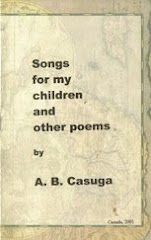
My photo
ALBERT B. CASUGA, a Philippine-born writer, lives in Mississauga, Ontario, Canada, where he continues to write poetry, fiction, and criticism after his retirement from teaching and serving as an elected member of his region's school board. He was nominated to the Mississauga Arts Council Literary Awards in 2007. A graduate of the Royal and Pontifical University of St. Thomas (now University of Santo Tomas, Manila. Literature and English, magna cum laude), he taught English and Literature (Criticism, Theory, and Creative Writing) at the Philippines' De La Salle University and San Beda College. He has authored books of poetry, short stories, literary theory and criticism. He has won awards for his works in Canada, the U.S.A., and the Philippines. His latest work, A Theory of Echoes and Other Poems was published February 2009 by the University of Santo Tomas Publishing House. His fiction and poetry were published by online literary journals Asia Writes and Coastal Poems recently. He was a Fellow at the 1972 Silliman University Writers Workshop, Philippines. As a journalist, he worked with the United Press International and wrote an art column for the defunct Philippines Herald.

Wednesday, April 29, 2009

I ALSO DISTURB THE UNIVERSE


If every birth anniversary were a "summing up", how would I sum this life up so far? What criterion would I use?

I subscribe to one measure -- not by coffee cups -- but how I also disturb a moribund universe whenever I tap my fingers.

Did I make a difference? Did that pebble I cast in the pond create a ripple that would -- unimpeded -- find itself on myriad shores?

Mother said I was born in an almost empty hospital (when all the doctors and nurses were ordered to attend the Session Road parade honoring the late Nippon Emperor Hirohito in the Mountain Province city of Baguio in the northern Philippines). In defiance of that edict from the occupying Japanese military government, I lived. 1943 was a good year.

Have all the years been good thereafter? How often did I disturb the universe?
I borrow lines from poems I have written to spell this measure by:

MY DESIDERATA

Halfway, between this riverstone and many rocks after,
Nara shall have gone from our echoes-call.
We have wandered into a sunken mangrove and wonder:
Is it as silent there? Are there crabs there?

Ah, to be old and a mariner come upon that restful cove,
where the final weapon is a chair not love;
to be old is a gallant slouching on that chair –
some porch of the heart grown insensitive to care.

Nara must be the reverie of a changing season;
we never knew quite well how far we had traveled
before we ceased to chant our rising songs:

O we have blanched at the rustle of dried leaves
O we have quaked at the fullness of a street’s silence
O we have hushed at the coyness of echoing eves
O we have known the crag flower’s quintessence!

It is no longer Nara beyond this echo-call.
Where am I? Where are we?
If the morning never becomes an afternoon,
will it always be a waking into a moment of
disfigured song, a dawn of perpetual clocking?

I have earned my anger.
I have earned my madness.
I have earned my loneliness.
I have not knelt nor extinguished my brain.

I have positioned my chair where,
when I tap my fingers,
I also disturb the universe.

"Bonne Fete, Grand-pere! Cumpleanos feliz, abuelo! Happy Birthday, Lolo! Maligayang Bati, Lolo!" My polyglotted family chorused in a cacophony that made my day. When the littlest one wrapped his little arms around my legs, and mumbled "happi bedday, wowo," I knew I have learned to pray.

I pray for more moments of love and wisdom. I pray that all those I love will measure their lives according to how they, too, will disturb the universe whenever they tap their fingers.

Monday, April 27, 2009

OPHELIA A. DIMALANTA: POET AS ARTIST


OPHELIA A. DIMALANTA, poet, critic, playwright, professor, writing workshop director, writer-in-residence, and multi-awarded author, is my nominee for the Philippine National Artist Award. If she is not recognized at this point of her literary life, I shall continue nominating her until she wins a well-deserved title: National Artist.

An exile from the current literary scene of that country, however, I am afraid I will not qualify as a nominator. Neither would I have a voter’s card.

Will my being a life-long literary creature give me some credentials?

As a critic and a reader of Philippine literature for decades now, I believe Dr. Dimalanta should already have been proclaimed national artist. Not that she would need it. Of course, that would even be superfluous. A tautology.

Dr. Dimalanta is an important poet. An author of unassailable credentials, she is by definition an artist who would lend her reputation to that award.

But that would all be prattle if her art would not bear her out. The following poems illustrate the range of her style and content.


MONTAGE

Monday jolts and she bogs down, a ragbag
Splayed off at tangents. Windows
To the outside and flecks of faces
Spring the morning clear at her
To set her into her old dimensions.
Piece by piece she puts on eight o'clock;
Pillows and bedcovers in a tumble pat
Her in place. The clearest cutglass
Of grapefruit juice teetering on a silver
Tray for breakfast-in-bed exigencies
(Both for effect and effectivity)
Is for a fact but fictive in the mind
Which holds the fleeing moment longer,
Stalls the stupor of the previous spree,
Images of her beautiful in blank spaces
Wandering truantlike in private regions
Of the night, wisps of clouds jammed
In one wicked corner of sleep. She hoards
Them like a child at play, triumphantly
Pieces them into a single total perspective:
Splayed off tatters of Sunday, a dark
Undiscipline of clouds settled right
Into this alarming set-up environing
Her Monday-world, jolted suddenly
Into the teeth of everyday people
And cluttering sounds of slapdash.

She exudes it now becomingly
As she glides and putters about
By turns, spreads it as a scent
Ambiguously enwombing her, her form
Dissolved in semi-tones, nameless jewel
Durably ensphered in mist, constantly reborn,
Solid, whole in ever renewing shades.


Montage is the title poem of her first collection which won her first prize in the Philippine Palanca Memorial Literary Award and the best poem in the Poet and Critic Award at the Iowa State University in the USA.

Montage was the “given” central image of a short story I wrote which was published in the student magazine, The Varsitarian – “Monday Morning in a Bus.”


PASSIONAL

Wakes conjure in an uncanny pall,
A kind of sepulchral air evoking
Tombstones turned trysting chambers
For romancing late lovers freed
From life’s containing vaults.
How she hates funerals,
This communal show
Of makeshift grief, as leaden
Feet shove mourners in, deader
Than the mourned dead,
The pale gloss of sympathy
Plastered on thicker than the
Expert’s swab of simulated smile
Upon her own bemused face.

Here she flits around hovering
Over all, once and for all,
Up and about to watch them
Finally mourn her, (miss her?)
For once and then,
Be done, begone!
She is there, and not there,
In the box and everywhere else,
On the wing, her stilled heart
Sprung into the rhythm
Of muted life, a sentence
As purging as real grief,
And as forbearing, and life-giving.

II

They say this is the last to go,
This inward craze, this needling
Ache that starts below, and just
As soon mounts to breast to soul
In a ghostly spiritual surge;
This passion that fires the frame
In mighty thrusts of faith.
Residual spasms and spurts
Have not yet dissipated even
After the last throes, recalling body
As passional, pastoral site
In that sanctifying time out of time,
That one blessed space at once
Uplifted and emancipated.

The last to go they say,
These stirrings in the blood,
Going, going full force
And peaking into theFinal come.

God how she hates funerals
Except her own, that is,
For how exquisitely life’s
Raging now attenuate
Into a warmer crave
That holds a universe.
The body shaken
Into prayer before it
Resurrects ecstatic
Into a longed for
Perfect calm.


Passional is the title poem of Dr. Dimalanta’s sixth poetry collection. Her juxtaposition of a funeral wake and rather “erotic” description of the energy that “is last to go” is striking. Death throes as passion throes are supreme conceits of life, love, and dying. Part II of the poem is certainly one of the best descriptions of how the final death is truly the death of passion, the rigour mortis of the final separation between body and spirit, the final release of a “final come.” The perfect calm and the supreme emancipation of passional release and death release – the poetic juxtaposition is startling and truly poetic.


READ ME

whenever my voice flings arrows
your way at a fiery pace,
read, discover, there is that
something in me
that dies to go gentle.
for when i viciously tangle
with you trying to throw
you off course, inside, i am raring
to cover you, take you, become
all of me fire and water,
flowing, all soft and fluid.
when i try to lord it over, empowered,
it is because inside i am already
slave grovelling, ready to heed your bidding,
crawling waves lapping you up
sea shore hillocks sky
all the way up all drool and drivel,
and when i insolently seek out
pulpits to mount my gospel truths,
i am really one humped question mark
thrashing about for your steadying hand,
and when i try to light you up whole,
there is in fact a part of your flame hence
i would want extinguished
to die rekindled in me alone.
and when i am wind taking roots
in your solid ground, i am roots as well
ready to take flight upon your wings.
when i prance about proud in times square,
i am a child carousing in the greener fringes
of the heart's final roosting.
read this idiolect,
read well, decode, detect,
and love me when i seem to hate.


Read Me as a love poem thrives on the tension built around a love/hate syndrome which becomes the vigorous thrusting, grovelling, thrashing, flowing, crawling, drooling that culminates in the “heart’s final roosting.” This love poem is a superior to Jose Garcia Villa’s Poem 40 (Centipede Poem) as an erotic exercise.


A FEASTING

Stalking hunger takes on varied
Shades and voices; worst is that
Of a child’s whimper in the dark,
An imprisoned cry, voiceless,
Struggling for release, for the open;
Three meals a day, a warming touch,
Sunspace, one’s personal corner
In the most chilling night.

Here they are, all twelve,
Deprivations in all shapes,
Gathered in His bosom,
His Presence, core of light,
As fragile limbs draw strength
And faith from that reaching out,
One magnificent Host in one
Glorious feasting, on a table
Specially laid out for children
And all, in their direst need,
Hungry in more than body,
For more than food, and soon,
Hunger takes on the glow
Of a glorious brightening…
Sunwarm, vibrant against
A backdrop of sheerest dark,
Beyond the deepest blues
And the somber browns
Beyond that hovering gloom,
A grand feasting here, on a table
Laid out for all… each child
A part in us, us children all,
Partaking now of life of love,
Around his radiant presence,
A bounteous feasting
Of faith and ever abiding hope.


The Last Supper does not usually get celebrated in poetry; not even Gerard Manley Hopkins tried. But here is a sublime but altogether real “feasting” for the children “gathered in His bosom”. Here is the Host of the supper that is “laid our for all…each child a part in us, us children all, partaking now of life and love…a bounteous feasting of faith and ever abiding hope.” The Last Supper is, indeed, to this Catholic poet, the First and Everlasting supper: a Eucharist of hope where delicately the poet uses the word “eucharist” without using it.

--oOo--

Ophelia A. Dimalanta was my creative writing professor in my graduate studies at the University of Santo Tomas, in Manila. In one of those classes, she took the podium, read Montage (to perhaps establish her credentials?), and I thought I would write my first submission based on this “performance.” It was written for O. A. Dimalanta:

HOW A POET EXPLAINED HER POETRY
WHILE EUNUCHS SAT DOWN GAPING

(For O.A. Dimalanta)


Eros finds us eunuched and gaping
At hedony begging for Pentecost
Shower the bellydance with fire –
Fire it is makes metaphors frantic
For bedfellows who, stripping bare
The bone of speech, fulfill hollow
Fantasies where moans deliver silences
Deep as the frog’s arrested croak.
“Forgive my bright conceits, Ophelia.”
Conceits are cockfight’s lances
One’s instant mercies, if you may,
Delights rupturing voice-boxes -–
So, bleeding may yet intone unsaid
Music in threnodies clotted
On cockers’ fingers, ganglia garbling
The crow violated on the rooster’s throat.

I don’t remember now what on earth I was trying to say, but the creative writing teacher thought, “there was hardly a dull line.” She was being kind.


Sunday, April 26, 2009

JOSE, GARCIA,VILLA'S, BRIGHT,CENTIPEDE


Poem 40

The, bright, Centipede,
Begins, his, stampede!
O, celestial, Engine, from,
What, celestial province!
His, spiritual, might,
Golding, the, night, --
His, spiritual, eyes,
Foretelling, my, Size;
His, spiritual, feel,
Stamping, in, heat,
The, radium, brain,
To, spiritual, imagination.


--JOSE GARCIA VILLA (1908-1997)
(From Poems 55)


This is a love poem. It hardens the image of physical love, and love-making. It is tantric.

But why a bright centipede on a stampede? Why a celestial engine? Why does it have spiritual might? Why does it “gold” the night? Are these metaphors the objective correlative?

Why does the centipede have spiritual eyes that foretell “my size?” Whose size? What size? Is Villa using a pun here as a figure of thought?

Does the centipede register a spiritual feel? What feel? What kind of feel is spiritual feel? How does it feel?

How does it stamp in heat a “radium” brain to spiritual imagination? Why does it stamp the luminous brain in heat? Why radium? Does it have anything to do with the image of radius (Latin) which is “a thicker and shorter bone in forearm on the same side as the thumb (Oxford Dictionary of Current English). What does this have to do with a “bone”?

Of what use are the commas? As a sensory-impressionistic device (the comma as an ideographic, orthographic medium), does it perhaps suggest the motion of sexual congress, the rhythm of coitus that has just commenced?

How does one reach the conclusion that this is a love (love-making) poem? Through the different levels of Analysis (viz., the abstraction of meaning from formal elements --articulated medium and distinguishable content), one arrives at “a provable meaning.”

Analysis requires that the reader abstract meaning from the empirical base of artistic significance—the articulated medium and content combined in the form. In the formal approach to appreciation, it is always the first step. In fact, T.S. Eliot mentions it as one of the chief tools of the critic (whose critical occupation is moored in analyzed material. –T.S. Eliot, “Criticism” Selected Prose, pg. 19 Faber & Faber, London, 1963. Peregrine Book, John Hayward, ed.)

The preceding requires that the poem as an objective result must preferably be confronted as a physical structure capable of suggesting meaning from its visual appearance. The sensory-impressionistic level in analysis, therefore, is the appreciator’s concession to the oft-neglected premiss that the work of art is itself an independent entity with a structure defining (physically) its “being.” It is a formal appearance. Just as the physical appearance of a man can exude all types of impressions about his character, so can the poem which appears on the page (assuming that the artist has shaped his structure to functionally concretize the experience of reality he is creating).

Villa wrote erotic poetry. He was good at it. Very few poets can write love poems, and those that do can teach the student a thing or two about the human being’s most urgent biological function as a province of art.

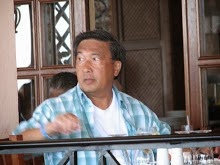
The last time I saw the late Villa was at the Tagaytay Vista Lodge, in the Philippines, during a respite from the International Writers Conference organized by the late Adrian E. Cristobal as a project of the Presidential Special Services Centre. He showed me a brass ring. It was embossed with two words: On the side that he shows to the polite world is inscribed LOVE, and on the opposite side, when he twirls it around his finger, is the word F- - -.

Then he said: “My prowess.” Nick Joaquin, overhearing our conversation, guffawed. “Your Abstinence, spare this man’s innocence.” I said: “The ring is functional.” Then I went to show them how to mount a carabao. The beast was part of the Lodge’s ambient décor. My picture, mounting the beast, with Villa and Joaquin gawking with envy at my provinciano prowess was later published by the defunct Women’s Journal by its editor Teresita Rodriguez. The city boys trumped. Recherché du temps perdu.

This helped me understand his poems on love, his comma poems, and even period poems that sought to limn love in all its shapes, forms, motions, and energies that recall the spiritual functions of this human prowess.

When Villa said, “In my desire to be Nude/ I clothed myself in Fire”, was he merely proclaiming his sexuality, his being comfortable in his skin, or was he talking also about this “spiritual imagination reached by the bright centipede now tumescent in its power of golding the night.” And all is well with the emperor in his new clothes. (The Villa poem of this title is a blank page.) In more distant, more circumspect times, one does not talk about sex or coitus flagrante. In his time, Villa outside of the Philippines where he was expelled from school for writing erotic poems (“I shall kiss the coconuts/ they are nipples of a woman!”), decreed that sex is truth, everything else can be questioned, but sex is truth. In his desire to be truthful, he clothed himself in fire.

Down under, one would say: Good on ye, mate! In his old country today, Villa’s poem would excite the canto yelp: Hala bira!

In the daring words of National Artist Bien Lumbera in one of those Silliman University Writers Workshops (one I attended in the 70s) when, as a panellist, he was discussing how sex is treated in Philippine literature, “What the hell is wrong with using the word f- - - when describing the act?”

Après Villa and Lumbera, Philippine Literature in English would never be the same again.

Thursday, April 23, 2009

EDITH L. TIEMPO


EDITH L. TIEMPO, poet and teacher, turned 90 yesterday, April 22. Honoured by her country as one of its National Artists, she continues to devote her life to the Literary Arts -- looking after the development of writers through her internationally acclaimed Silliman University Writer’s Workshop in Dumaguete City, in the southern Philippines.

If the yardstick of a useful artistic life is the crop of writers she has nurtured throughout the island republic, she has lived a sterling life, indeed. I was one of those she selected to go through her Workshop in the 70’s. To this day, being awarded a fellowship at that writers workshop remains to be a recognition of talent and artistic achievement.

Edith Tiempo leaves an indelible stamp of excellence on the SUWW. To her, a hearty toast: Viva, Maestra!

One Tiempo poem I treasure is her What Distance Gives (from her Tracks of Babylon)


WHAT DISTANCE GIVES

When you reach for me in that obscure
World where like ashes of the air
Your eyes and hands and voice batter
With a stark and ghostly urgency
The transparent doors of my closed lids,
I struggle to confine the precarious grace,
The force, the impulse of this fantasy;
Yes, I grieve. But in its sure
Wise way it is this grief that bids
The ghost to go.
This is the reality we stand to lose:
That the push of muscle strength
Is also the dear enfolding brute embrace
Of reason shocking all our length,
The loss is gain for the will to choose
The distance-given right to know.

In my Aesthetics of Literature (1972), I cited Edith Tiempo’s use of figures (of thought, speech, and language) in the course of discussing what makes a figure appropriate, necessary, and effective.

“A figure is appropriate when it earns the meaning by making it assume an exact, concrete, and clear picture. It suits the idea in that its use does not steal away attention from the meaning. For example: “Like ashes in the eyes, the memory of the one being addressed intrudes: the eyes, sensing, become doors forced open by the memory, by the ashes.”

A student’s affection and gratitude are further expressed in this last part of Houses Are Better Off Without Porches Here, a group of poems I dedicated to Edith Tiempo, National Artist. The poem is included in my A Theory of Echoes and Other Poems (2009, UST Publishing House, Manila):

For Edith Tiempo, Teacher, National Artist


I guess it is "a distance-given right to know” as Edith Tiempo described it once in a poem. How is she? “Edith now lives on a ridge about half an hour from the city…the house is long, low, and airy – a single bedroom, a kitchen, and a huge space in the center for parties and conferences. The wall overlooking the sea is all glass…” -- E-mail from Lakambini Sitoy


6.
Poet on the Ridge, hermana Maestra, pray for me,
as I would you, that the dusk catches us still swearing
by the rhyme, perishing on the rhyme, convulsing
on the sudden quiver that comes on a stealth
when rhyme and rhythm become the sound of the sea,
the pulsing river, cupping you in time for that
peremptory dive off your perch into that devouring sea,
betting life, love, and limb, surfacing again
to challenge Him with your nakedness,
(because you were always gentle and pure),
basking under Lo-oc’s sky, waves laving now brittle
haunches and God your sole voyeur.


-- ALBERT B. CASUGA


In our native Ilocano, Maestra: Naragsak nga siyam nga pulo nga tawen yo! Agbiag kayo! Agbiag kayo ditoy puso ken dardarepdep mi! Saan nga mapukaw iti panagdayaw ken panagayat mi.

(Photo by Ian Casocot)


Wednesday, April 22, 2009

TEN INCONVENIENT TRUTHS VS. THE TABLETS OF MOSES


The Sixth Day

…and fill the earth and subdue it.
--Genesis


Scamper of rain softens the break
of thunder bringing quiver to the groin
that all along has known him from the quake
as fire in the bowels of the earth
as lime in the residue of water
churning days of wrath into a gravid day of birth:
and he was good:
Good for the rain, the touch of grass,
the lap of breaking water salving eyes come
from the night into the hurt of light,
for their good was indeed their knowing
what they know (a touch of grass, a deja vu)
a rousing into a gentle shock of knowing
what he knew:
and the Earth was good.

He knew the shape of clouds, the edict of weather
sharp on loins where loins sharpen some urgency
design pristine Undesign of mutual consummation
by consumption – often his way of knowing
what Art or undoing bids the flowers do when beasts
don’t eat them: they, consuming the earth,
the earth submitting, he conjuring the doubt
that turns trees from green to grey.
-- ALBERT B. CASUGA
If man was created to have dominion over the Earth, then he can do whatever he wants to do with this planet. First inconvenient truth.
But he was precisely stripped of this privilege when he lost Paradise. He lost it by default, though, because he was pre-empted by his companion, Eve, who quickly bit of the fruit from the Tree of Knowledge. Hence, the Fall of Man. Second inconvenient truth.
But with the Crucifixion and subsequent Resurrection of the Son of Man, the Redeemer called Christ, brought back man's ascendancy in this Paradise regained. Third inconvenient truth.
The Earth was good. Man knew that. Good for what? For his discovery and use to complete this journey from Genesis to the end of his exploration -- which is "to go on exploring, until he comes back to his beginning, and know it only for the first time (paraphrasing T. S. Eliot in Little Gidding). In his beginning is his end; in his end, his Beginning. Fourth inconvenient truth.
As a homo viator, has he not indeed gone on with his journey? In this journey, has he not created his path to his destination? He has chipped on the stones to create his caves that became, at some time or the other, grand repositories of his ancient primordial art in the Caves of Lascaux. He has also carved the sides of mountains for his dams, and burnt the rainforests to make way for viaducts and the like to feed his energy-generating turbines, engines, machines, and even the wind mills that no modern Quixote could slay. Fifth inconvenient truth.
He has sown seeds so he could reap the grains for his table. He has planted, and discovered he could also make a lot of money from poppies to marijuana, from the joints to the cocaine, and ruin even the youngest and the brightest. Sixth inconvenient truth.
His hunt for the boar as feast for the banquet has turned him into a carnivore. His salmon hunt has escalated to whale hunts, to seal hunts, to harvesting of sealife through trawlers that leave the ocean bottoms lifeless and the reefs unrestored. He has pursued the fossil fuels from prairies to oceans. He has contaminated the waterways with dumped waste from giant sealiners. He has poisoned the sea's habitats with oil slicks. Seventh inconvenient truth.
He has cut a hole through the ozone layers, hence making deserts of greenlands. Oh, but of course, he has also resuscitated the sands of Las Vegas with airconditioned casinos and grand hotels. It sustained the flesh industry and the spurious hope of the roulettes in Nevada and wherever we find the modern Sodom and Gomorrah. Eighth inconvenient truth.
Global warming has put more water into the oceans. Floods, tsunamis, perfect sea storms have become common place. If the Philippine Archipelago has about 7,000 islands, how many still remain after the oceans keep on reclaiming the lands? The Artic tundra will soon be under the currents. Ninth inconvenient truth.
Man has reshaped world sharing of the bounty into geopolitical powersharing. Or no sharing at all. He has created boundaries of nationalism (jingoism), totalitarianism (socialism), terrorism (in name of Jihad or the Allah who is Good. He has waged wars from the time of David and Goliath, to Masada, to the Hundred Years War, to the wars to restore the majesty of the Church, to Dunkirk, Dachau, and Auchwitz, to Hiroshima, to Viet Nam, to Iraq, and who knows, China or Iran? Tenth inconvenient truth. Ad nauseam.
And man shall have dominion over the Earth. If he must "fill the earth and subdue it," polygamy must be in style. If he must subdue the forces and energies of the planet, he must likewise be able to replicate the hydrogen bombs that could obliterate the whole planet ten times over.
Inconvenient truths have been obscured somewhat in the name of God and country. Suicide bombings are preceded by outcries of "Allah is Good", and the Vatican appears helpless in reigning in molesters among its clerics, or even a Bishop who becomes President of his country only to be charged by hapless parishioners who were in their teens with siring recondite children while holy and stiff in his holy habit or habits. The Commandments have been breached so that not only strange Gods are before humanity, but also the false gods of money, power, and oil.
Is it time for Noah's Ark II? Will man also say: Apres moi, Le Deluge?
The Sixth Day was a good day, and after that the Creator rested. Our inconvenient truth now is that it is no longer His watch, but ours.
That's why I wrote this poem.

Monday, April 20, 2009

EARLY POEMS 1: ANOTHER LOVE POEM


When University of Santo Tomas Publishing Director John Wigley suggested that I add more poems to A Theory of Echoes and Other Poems so my 2009 selection won't look like a "manual", I thanked him for his remark that being "one of the big names in Philipine poetry (I know, I also teach Literature)", I should really come out with a bigger volume. I said I will send him some that "would no longer embarrass me". One of those was an "early poem", which turns out to be a "love poem" (those which I avowedly said in this blog are "difficult" to write.). It looks like I wrote more of them than I thought I could or would shudder about if attributed back to me.


This "early poem" is early, all right. It goes back to Adam and Eve.


The Final Temptation

…and from his rib sprung Eve to ease his loneliness.
--Sunday school tale.


Adam names grass whatever they may be,
but does he feel their caress on the navel gently
pressed where pressed they ought not
on afternoons like this? This afternoon is hot.
Blue skies have virtues all their own seen through leaves.
O, blue skies, what new birds bring you? What eves
bring you when evenings are soft wind on my cheek?
Twitter of unnamed birds, tremor of eel in some creek?
If I only knew what Adam is abroad about all day,
I would not ask you, black boughs, which way
To Adam, O which way? Afternoons darken
Like this and soon it will rain.
He will have new tales tonight. I know that;
But that tale about the Tree, I will get him tell me again.


At Sunday school (I attended a Lutheran Church's outreach mission where an aunt taught), Adam and Eve was our first lesson. Eve seemed to have been blamed for their expulsion from Paradise (hence, Paradise Lost), because she bit of the fruit of the Tree of Knowledge.


In hindsight, now that Sunday School is a century away from where I am now "protected from dottage", I agree with the Feminist Movement and the women-libbers that the female of the species is truly the spunky one.


The First Temptation is truly the Final Temptation. Man will never be the same again. She was not a rib; she was the Creator's finer creation. Wherever she makes her move, Paradise is always regained!


Sunday school should have emphasized that had it not been for Eve, we would not have the Information Age paradigm: Knowledge is Power.


So, where does the expression "carnal knowledge" come from?

Thursday, April 16, 2009

WRITER'S NOTEBOOK 4: A Portfolio of Sketches

Don Pablo Picasso


Street Scene below
the Frontenac

Mme. Isabel on the
train back to Toronto

The lady was
crying. Baldy
explaining?

Le Ile de Notre
Dame


Montreal Orpheus:
El Guitarista


Gorda waiting for bus.


Men wondering why
blackbirds were dying
in the City Square.


These sketches were part of the Notebook for a Vacation in Montreal, Quebec, 1985.
When one cannot write, one draws. Or Paint. Fingerpaint. The writer's block thrives on sloth and inactivity. Better still, get to the bistros and exercise your arm muscles by lifting those mugs of beer and glasses of wine. Cheers! Salud! Salut! Kampai!
Turn down an empty cup.


WRITER'S NOTEBOOK 3: A "New" Old Poem


A Writer's Notebook is a booby trap. This works both ways: one could find an embarrassing entry to ruin your day or days to come; another could be a an edifying, soul-lifting discovery of an old poem, never been published, pristine, unedited, un-molested by human hands and anxiety.


I found another love poem from my Notebook of a Vacation. This was not difficult to write. Its ligne donne "the river runs its course" came to me during a lazy cruise down the River Lachine in Quebec. Using the image of river-sea, tributary-destination as an emotional correlative, I wrote the poem quickly as soon as my wife and I got back to our hotel suite. I like its original form; the revisions you see here are cosmetic in that they are minuscule.


THE CRUISE ALONG LACHINE


It is the river as mother to the sea
Entraps us into this womblike feeling of ease;
It is the river draws us to this discovery
Of need, our quiet helplessness.
We are the river ran its course
Into an engulfment of restless sea.
How far have we gone from our rivered Nara?
Or how long have we gone astray?
Does the river current come full circle
From the breaking waves of sea?
Do we meet each other, dreamlike,
In the endless stream of the world’s Lachines?
When do we come back as rivulets
In some hidden rock spring?
The river runs full circle, and we discover
We have not even halfway met.
When will my currents break into your rocks,
You distant sea, you entrapment of need
And engulfment of ease?
When will the sea create the river?
When will the river create the sea?
Where they meet in the trickle of a little garden,
Who laves the riverstones?
Who laps the greening shores?
The river’s rush is also our question.


--ALBERT B. CASUGA
From the Notebook of a Vacation, 1985
I hope I will no longer revise this poem. I like its flow. Its rhythm and sound system objectify the river current and the restlessness of a turbulent sea.
Beware the entries that have suffered a helter-skelter of criss-crossing lines to hide the embarrassing boners.

WRITER'S NOTEBOOK 2


At the Union Station, Toronto

From a Notebook of a Vacation, August 1985, Montreal


Apparitions of these faces in the crowd,
Petals on a wet, black bough.
--Ezra Pound, Station in the Metro


Something about a journey requires
goodbyes to mean “Come home!”
The train ride runs only up to where
the heart seeks its last station: Come Home.
Tentative, the curt handwaves will also plead:
this distance-given right to know
must also mean, “you will always be welcome
to a portion of our lives – not all of it,
But a good part of it – so, come home.”
“Come home” are the eyes’ manner
of saying goodbye, the mouthed sounds
not half as eloquent; the quiver on the throat
is also an arrested cry – “come home.”
Going away is truly an endless returning.
You waved me away to begin life’s cycle
of leaving and returning, really love’s ritual.
You are my home, my children, my lover.
And yet, away from you, I always feel
this ache, this grip of fear:
Could I also plead goodbye to you one day,
But also mean, “Come home”?
This is one of those love poems that I found difficult to write. I would never want to go through that feeling again of having to say goodbye and not knowing how I would come back. Some time or the other, I would rather have said: Bring them home. But Come Home is a cry from one's heart; always the "lonely hunter."

Whispers at the Palais du Artes


Conversation with Don Pablo Ruiz Picásso

Su arte es el arte del mundo
Arte del sangre y de génio unico.
Senor Don Pablo, porque se preocupar
Con los ojos de las mujeres?

“Los, ojos, amigo, no pueden méntira.
Los ojos son las puertas del amor
Y las preguntas de infinidad.
Porque pregunta usted sobre la verdad?
La verdad es la sustancia de todos artes
Y de todos nuestros amores. La verdad
Es el arte de un niño. Estoy un niño, amigo
Y finalmente, con su permiso,
hacerse un niño viejo, un niño otra vez.
Si, un niño nuevo!”


With Rameses II

Bon jour, Monsieur Rameses,
And I presume, Mademoiselle Isis?
How lovely are these ashes.
The notes I kept about Picasso's exhibit at the Museum of Fine Arts in Montreal came in handy when I wrote a series of art articles for a Mississauga News Arts and Living supplement called SMILE in the 80s. I edited the supplement which had a brief life of four issues. A bedroom community had little need for it. Today, almost 40 years later, this community has a Living Arts Centre that has to beg and borrow to sustain it.
From this notebook, I also found some sketches of sights and scenes in Montreal and Acapulco where I spent two successive vacations to "win my wife back". At Acapulco, we stayed in a honeymoon suite overlooking the Quirinale where local divers would dive the "jump of death" into the swirling waves below from a cliff about 34 storeys above.
Writers' notebooks are booby traps.

From a Notebook of a Vacation, August 1985, Montreal

LOL Literatures in Other Languages: "A Flea" by Anne Tardos

16 April 2009
"A Flea" by Anne Tardos

On her website (as of today), Anne Tardos presents seven poems, all of which except for one are in English. Reading the English poems, one can easily grasp her sensibility (an exquisite one). The exception in terms of language is "A Flea," a poem made up of lines in various languages. I have to admit that I do not know most of the languages used and, therefore, can enjoy only the music of the lines when I read them as spelled (hopefully, some of the languages do not behave like French, where spelling and pronunciation are not exactly identical twins!). In the manner of New Critics focusing only on a line instead of tackling a whole work, let me write a little bit about the following stanza:

When we exit a room we make room
Walking distance après-vous resistance

The first line is straightforward: by leaving a room, we cause space to be created inside the room, since we vacate the space that we used to occupy. The second line takes us a few minutes later, when some distance (walking distance) away from the room, resistance (a French word here, not an English word) appears in the room, because the space created both expands and contracts, not knowing what to do because we are no longer there. Of course, there is an allusion to "apres moi, le deluge," or more precisely, this is a commentary on that well-known quote (which, btw, is itself poetically ambiguous, since people still wonder if it was King Louis XV or his lover Madame de Pompadour who said it first). The sense (we don't know if our leaving makes any difference or not) complements the sound (internal rhyme, both aural and visual), since the clash between aural rhyme (room / room) and visual rhyme (distance / French resistance which has a different sound) mirrors the indecision of those we left behind. Truly, apres nous, le deluge. (Let's not forget that the poem is entitled "A Flea," with an undertone of the same sound flee, as in flee the scene.)
Posted by Isagani R. Cruz at 5:34 AM


Albert B. Casuga said...

Anne Tadros seems to be speaking in tongues. Of course, rational psychology has come up with evidence that the linguisic center of the brain is indeed capable of multiple language skills. Hence, the polyglot. Will this lead to a "global brain"? The brain has always had this capability -- it is what extends man's grasp beyond his reach. It may make for a cosmopolitan citizen of the world.

A multilingual poem will take a long time in gaining currency, nevertheless. I cannot appreciate even the sound system claimed to be its main asset. It is creating a babel of sounds and truncated expressions that in the end will fail to communicate. Of what use is language then, if its medium fails to communicate?

Better to master the traditional use of language and the energies of poetry and the various forms of literature first, before forcing a melange of interlaced languages to form communication lines that are probably not there in the first place.

Of course, nomadic people are forced by necessity to learn the language of the places they immigrate to. Tadros is no exception.

This is not to debunk the legitimate experimentation inherent in word formation. So far, however, only miming has succeeded in making a universal language of body movement. If the body can do it (something we share with the rest of the animal kingdom), can linguistic/verbal/glottal faculties do the same? Too time consuming for a mode of communication, don't you think? One can do better than lose precious life time on it. How useful is the effort on yoking several languages together in an ostensive effort to convey more truth and palpably configure reality as "reality"?

Ultimately, how effective is multilingualism in the realms of phenomenology and epistemology?

By the way, I can always tell that the fellow I meet in the street is a Filipino when he smiles and raises his eyebrows, or when he points to something or someone with his lips (pointing to someone with your index is not polite, remember?) Abuelo is doing the Filipino again!, my grandchildren would chorus when they espy on me doing these during family gatherings.

I am happy with that capability. -- ALBERT B. CASUGA

16 April, 2009 21:01