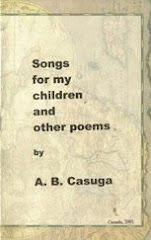
My photo
ALBERT B. CASUGA, a Philippine-born writer, lives in Mississauga, Ontario, Canada, where he continues to write poetry, fiction, and criticism after his retirement from teaching and serving as an elected member of his region's school board. He was nominated to the Mississauga Arts Council Literary Awards in 2007. A graduate of the Royal and Pontifical University of St. Thomas (now University of Santo Tomas, Manila. Literature and English, magna cum laude), he taught English and Literature (Criticism, Theory, and Creative Writing) at the Philippines' De La Salle University and San Beda College. He has authored books of poetry, short stories, literary theory and criticism. He has won awards for his works in Canada, the U.S.A., and the Philippines. His latest work, A Theory of Echoes and Other Poems was published February 2009 by the University of Santo Tomas Publishing House. His fiction and poetry were published by online literary journals Asia Writes and Coastal Poems recently. He was a Fellow at the 1972 Silliman University Writers Workshop, Philippines. As a journalist, he worked with the United Press International and wrote an art column for the defunct Philippines Herald.

Monday, October 24, 2011

COME AWAY: POEMS ON WHERE AWAY IS


COME AWAY: THREE POEMS


Throw it away, / we say, but where/ does this directive/ lead. Where is/ away. We know it/ suggests distance/ and removal, that/ the thrown thing/is no longer visible/ or retrievable. --- From “Away” by Hannah Stephenson, The Storialist, 1—20-11

1. Away

It does haunt one’s reverie
like an old melody’s refrain,
it is a way but not away. But
where is away? A memory,
perchance a lingering pain? 

Distance-given right to know
erases world’s away, rebuilds
them only as far as a pebble
skips and skims over eddies
on roiled water: See old faces? 

Etched on beach sand, away
is a heart pierced through
by an arrant arrow called Luv
and a spray of trickling angst
named Will or blood bubbles. 

Or a nodding gran chanting
on her beads wishing shadows
on her walls at sundown might
jump out where they grow tall
and call out: Granny, I’m back! 

Maybe an unreachable land,
then, endlessly dark, no sun
creating rainbows, no showers
lads and lasses run through
naked and free, cold but happy.


2. Monologues

When are you coming back
from the front, son? Sometime
soon, before mom fades away?
Where is this Viet Nam? Iraq?
Afghanistan, Pakistan? Somalia? 

Will you take the midnight train,
Betty, and be home Christmas?
Me and the gang, we will throw
a party at the Metro, wait for you,
gulp suds for every train whistle. 

I guess he will not be around
for my umpteenth birthday, mom.
You invited him, did you not, he
and that woman in Denver? I
just have to wait by the window. 

Is grandpa going fishing with me?
Like last summer, he will drive in
on his old Studebaker, clanking
with a loose tail pipe over cobbles
on our street. Will he? Won’t he? 

I will not be away for a long time,
not too long. Before you know it,
some 10,000 sleeps from now, we
will be bowling again in St. Peter’s
Alley, cracking lightning and thunder.


3. Overture

Come away then, come away, while
we can, let’s run through valleys,
swim the rivers with the catfish,
slalom down those snowbound hills.
Come away, Love, to some place away.


--- Albert B. Casuga
10-24-11


A Photo by Bobby Wong Jr.


Sunday, October 23, 2011

CANONS FOR THE CIPHER

CANONS FOR THE CIPHER

(Poems for my Father)


(For Francisco F. Casuga+)


O, Father. Time overtakes us, and/ We cower in our darkened rooms.  


RETURNING TO THE ROOT


“Will courage Redeem stupidity?” -- Nick Joaquin


There is a manner of returning to the root
that explains the virtue of a hole,
its quietness the petering circle:
the canon of the cipher indicts us all. 

And you, rocking yourself to an eddy,
drown the death wish: O that grief
on sons’ faces could tell you all.
“Will courage be visited upon my children?” 

It is this cut whittles the tree down,
not of consumption but of fright
that bereaving is one’s splintering
of children’s bones. Death is our betrayal. 

They are sons gaping as grandfathers die
shapes the gloom of the breaking circle.
They who knew the frenzy of the bloodcry
must never return to find sons become spittle. 


ONCE UPON A SUMMER SOLSTICE


There is a scampering of grace in the dry woods
and a pulse upon some soliloquy:
it is the rain come as a smooth and forbidding lace
upon the cup of the dead and dying weather.

It is past the season of the grub.

The flirt of the monsoon upon the arid lap of Nara
is caked on the thick napes of children
dancing naked in the mire of the fields,
gaping to catch the fingers of the rain,
slithering like parched serpents guzzling raindrops
cupped in the hollow of gnarled father’s palms.

There will be no songs, for the ritual is not of birth
but of death as summer dies in Nara
and with it every titter bursting from a child’s mouth.

The rain becomes a bloody plot.


A HOMECOMING


Tanqui’s supreme conceit is its dread
of withering grass in the month of the frogs
when rain, like fingers in the night, tread
the lesions gangrened on a hillock’s carrion,
carcass of a season mourned
as the briefest of them all.

“The rain is on the hill, the dry pond
is red with clay, the gods are back!
And so must I --- shadow of a past long gone ---
weeping, running through these deserted streets,
crouching now in mud pools of childhood fun
when songs were chanted as songs for the dance.
A dance for the grass! My limbs for the grass!
I must dance for Tanqui’s singed grass!”

He dances hard, his body clean and gleaming,
but Tanqui’s rain is on the ashen hill.
Neither his dancing nor his lusty screaming
will stop this dreaded withering.
Tanqui’s conceit is stranger still
when songs are sung not for her lads and lasses
but for this stranger who, dying, has come back
to dance for black grass, dance naked
for Tanqui’s withered pantheon grass.


THE NIGHTMARE


1. 

Halfway, between this river stone and many rocks
after, Nara shall have gone from our echoes-call.
We have wandered into a sunken mangrove

and wonder: Is it as silent there? Are there crabs there?
What quiet mood is pinching bloodless our spleens?
This is another pool –-- navel upon the earth.
Always, always, we cannot be grown men here.


After the white rocks, after the riverbend,
Nara becomes the dreaded dream.
We have put off many plans of soulful revisiting ---
we will go on re-stepping beyond the white stones,
each step becoming the startled rising
into a darkened city farther downstream
where we once resolved never to die in.


2.

Do we wake up then afraid of Nara?
But rising here is the nightmare come so soon,
treason in the daytime, maelstrom at night: 

The nightmare was of cackling frogs
and serpents rending skulls and cerebrae
of kitemakers who sing while termite logs
burn and children, chanting the Dies Irae,
mush brainmatter, pulling out allegory
like unwanted white hair, stuffing black grass
where brain was, casting tired similes
into dirty tin cans where earthworm wastage was: 

River swells drown us where, surfacing,
we wake up knowing our days have become
termite nights and decaying metaphors. 


--- ALBERT B. CASUGA
Revised and reposted October 22, 2011, Mississauga


Saturday, October 22, 2011

THE CLOTH STAINER


THE CLOTH STAINER

The shirt I’m wearing/ is made in Bangladesh, Turkey, or the Philippines,/ where clotheslines crisscross sky: sleeves and bodices/flail in salt-laced wind— weft of signatures whose/ facing edges I’ll button and wear against my skin.--- From “Shirtwaist Elegy” by Luisa A. Igloria, Via Negativa, 10-22-11


Two of her ten children drowned in that river
retrieving rolls of cloth grabbed by current
swollen by monsoon rains; rescuers found
them upstream near the Bay wrapped snugly
in the newly coloured sheets as if they simply
stole sleep and took a nap when they could. 

 
When the Giant Tiger supplier from the city
asked for his stained raw materials that day,
he found the old woman starting to colour some
new rolls all over again. He said he would not
wait, and paid another gaunt stainer, bundled
his purchase, and threw it hurriedly into his truck. 

Laundry day today. The shirt I am throwing into
the hamper, could it be from that roll in Bangladesh?


--- Albert B. Casuga
10-22-11


Friday, October 21, 2011

THE GHOST TOWN


THE GHOST TOWN

Now that the birch closest to the porch is bare, I notice a large hornets’ nest: a ghost town, a wino’s abandoned bottle in a paper sack. --- Dave Bonta, The Morning Porch, 10-19-11 


The last ghost town was the one I left
when I grew up—strange requirement
to abscond when one is no longer needed,
 

like that bare birch tree, shorn of its foliage,
is no longer the sanctuary for that dotard
who left his empty rum bottle under the tree.
 

Cheek-by-jowl with the porch, it was the Ritz
with free coffee or tea doled out by a host
who talked funny with his metaphors: Hornets.
 

They, too, create ghost towns of hives on trees.
No point staying when leafless trees no longer
need them, no flowers to touch, no bees to kill.
 

I have outlived my usefulness, haven’t I? I asked.
She said: Verily. How else respond to this curt
snort, when all I really had or have is only a pack —
 

not even of beer, nor cheer, not even care? Zero.
Nada. End of the line. Really, all I had was a pack
of wornout metaphors, lost love, lost coin wallet.
 

and a wayward heart too needy to want to betray
its anguish, its plea, to come home soon where
there is nothing but a ghost house in a ghost town.


— Albert B. Casuga
10-20-11


Thursday, October 20, 2011

THE STILL POINT


THE STILL POINT


Where should I go/ so the wind can reach through me,/ so I can rifle through life while/ living it.---From “Great Plains” by Hannah Stephenson, The Storialist, 10-19-11 


Stand still. Find your still point.
You will find a sanctuary there. 

All the wind you can whistle for
will run through you like spirits 

hovering, pulling you through
all the small boxes keeping you 

your own unshackled prisoner,
moored to fears fencing you in 

like the pages of a book bound
to a rind, like a caged sparrow 

perched on a bar will hop down
rather than fly in narrow air. 

When you get there, that place
will not be there till you find it. 

Build it from fondest dreams,
house them in open chambers. 

Let the winds of everywhere
and everything rifle through 

its corridors to find you free,
unafraid to roam elsewhere 

because you know there is always
this still point to go home to. 


--- Albert B. Casuga
10-19-11


Wednesday, October 19, 2011

PAINTING RUINS


PAINTING RUINS 


The spicy smell of moldering leaves. On the barn roof, the shadow of a blue jay lands on the shadow of a limb.---Dave Bonta, The Morning Porch, 10-17-11 

Camouflaged in the trees, the shadow of a bird that looks upon the scene and sees the worm’s dark squiggle vanish into the dirt. And there are always ruins— the remnants of a bell tower in the foreground, the dark sweep of a volcano’s skirts steepling away in the distance…From “Composition” by Luisa A. Igloria, Via Negativa, 10-17-11 


That I might smell, that I might see:
was a measure of how good my painting
would have to be before I kept or framed
it for a ready gift I did not need to wrap;  

or before I burned it with leftover oil like
the posturing madman I was more often
than not, when scented chiaroscuro was
a poem’s altered form as long stretches
of babbling babel plagued my wordhouse.  

A dab of sienna would be mouldering
leaves, a worm’s dark squiggle in the dirt,
a shadow of a bird on rotting barn roof,
bundled twigs left askew on burnt grass:
always, always a riot of ruins on canvas. 

Why would the stump of a crumpled bell
tower find itself the fulcrum of colour
pasted, splashed, whirled into whorls
of pastel fading into a stray of gossamer
at the bastidor’s edges? How does it smell? 

Dark. Dark. Like a gaping eyeless socket,
the belfry where the bell hung is empty
save for a blackened rope whipped by wind
that must have driven the bats that have
long absconded, leaving their putrid dung. 

Dread. Dread. Like the threat of volcanic
mayhem, seen now from a distance
of quite hues, a shadow upon a shadow,
a hurt poised by razor-edged memories
of other ruins, other  woeful vanishings. 

On the tip of my ashen grey is sulphuric
stench that would always be redolent
of lacerating betrayals, carrion of love’s
cadavers forever embalmed, forever
alive, forever recent, endlessly rising
from ruins of ruins flooding my senses.


--- Albert B. Casuga
10-18-11


Monday, October 17, 2011

HER EMPTY NEST


HER EMPTY NEST

By Albert B. Casuga

Far away, farther than the sights of a bird perched on some craggy roost, I follow her every move in the falling-down house: my lips touching the rim of her coffee cup, my fingers opening and closing on the shapes of bread and cheese and fruit I want to heap upon her plate; the rings of silver and gold and pearl I want to slide back, lovingly, upon those thin, arthritic fingers which once sewed every seam of my world neatly into place. --- From “Aerogramme” by Luisa A. Igloria, Via Negativa, 10-16-11


EL NIDO DESOLADO
(Español, versión original)

(Para mi Madre)


Los pajaritos
están dejando su nido;
el invierno de su vida ha venido
tan muy temprano!

Madre mia. ¡Mira! ¡Mira!

Tan fuerte ahora, sus pájaros
están volando a puertas desconocidas;
están volando tan lejos para que
nunca jamas devolver y quedar en la casa
de
corazón triste, ahora casa abandonada,
nido desolado, madre mia.
O mi madre querida!

NAPANAWAN NGA UMOK
(Ilocano Version)

(Para ken ni Nanang ko)


Pinanawan dan ti umokda,
nagtayab da aminen;
kasla ti naapa unay nga
isasangpet iti lam-ek ken
panag-uyos ti biag.

Kitaem man, Nanang! Kitaem!

Napigsadan dagiti bil-lit;
pimmanawdan --- agtaytayab da
payen nga agturong iti saan nga
ammo nga pagkamangan ---
adayo dan, adayo unay iti
pinagtayabanda tapno saan dan
nga agsubli sadiay umok
nga pinanawanda --- balay kano
iti naled-daang nga puso,
napanawan ken ub-baw nga biag,
umok kan iti angin-nen.

Ay, Nanang! Inak nga dungdungwen!

NILISANG PUGAD
(Filipino version)

(Para kay Inang)

Nagliparan na ang mga ibon,
at iniwanan na ang kanilang pugad,
tulad ng maagang pagdating
ng tag-lamig sa iyong buhay.

Tignan ninyo, Inang! Masdan ninyo!

Malalakas na ang mga ibong kamakaila’y
sisiw pa lamang --- sila’y nagliparan na
patungong kung saang isang dipang langit
at di malamang malayong sulok
upang di na muling magbalik sa pugad
ng kalungkutan, pugad na nilisan,
isang bahay na wala nang laman.

O Inang. Pinakamamahal kong Ina!

AN EMPTY NEST
(English version)

(For my Mother)

The birds are leaving their nest;
quite like an early winter that arrives
too soon proroguing your quest.

Look at them, Mother! Look!

Now grown strong, these agile birds
are flying to unknown havens,
far-flung places, never ever
to return or stay in a house
of gloom, an abandoned home,
a desolate nest. O my mother.

O my dear, mother!

--- Albert B. Casuga
Revised 10-16-11


Saturday, October 15, 2011

A WRITER'S CRAFT


A WRITER’S CRAFT


Crevices flourish with signatures of moss. / They might not know it, but even they/ have stories to tell. All is elegy, / departing or gone; incessant rain, /language the earth understands. --- From “How I Came to Writing” by Luisa A. Igloria, Via Negativa, 10-14-11


Even the crevices will be covered with moss,
and grass before it. Cracks on these memorials
are stories told and retold where burial grounds
are salons of the lingering undead, memory
hounds like incessant rain. Nothing is ever lost. 

Only elegies stay, a language of remembrance
for all who would care anyway. Like tombs,
they have embellished narratives of kindness,
gentleness, rectitude, abiding flames of love.
Like Taj Mahal, these remain unextinguished. 

Stones or pillars, marble markers, or epitaphs
recall these lost lives and loves from crevices
covered with moss and grass before it, but all
will sprout from mute and scorched earth
like words cranked out of pain in an empty heart. 


--- Albert B. Casuga
10-14-11


Friday, October 14, 2011

RAIN DANCES


RAIN DANCES


Rain. And in the woods, a continual downward flight of leaves, meandering from side to side like all lost things. The rain falls harder.---From The Morning Porch by Dave Bonta, 10-14-11


Lluvia! Lluvia! It was a chant
sung at the top of our voices,
croaking like frogs hopping
from the rice paddies. Rain! Rain!
 

Naked, our hallooing was no match
for our scrawny bodies carousing,
running through the monsoon
downpour like scampering chicken.
 

The rain at the edge of the woods
is not the same rain where we got
lost like cascading lilies rushing
through boulders at the field’s edge.
 

Rain rips foliages off their branches
like surly gardeners cutting off twigs
from blackened trees and bushes
to prepare for a long, dreary winter.
 

Lost in autumn’s mayhem, yellow
leaves reel in a wild wind dance
pitching them off to unseen crannies
to rot in the rain like all things must.
 

But it is not this dying we rue. Lost,
gone in the fall of discarded days,
we scarcely remember rain dances
where we were naked, free, and happy.


— Albert B. Casuga
10-14-11


Wednesday, October 12, 2011

OCCUPATION


OCCUPATION

There are sparrows occupying Wall Street,
as we speak, their quavering notes, grown
angry and provoked, scream their mantra:
“Revolt!” In a sparrow’s time, will this last?
 

A curtain of gold leaves have not yet fallen
off their trembling branches, quite like
the price of gold shooting through Dow Jones
roofs; behind them, a hawk flexes its wings.
 

Will this march through the wind tunnels
of Manhattan rouse vultures perched on bank
ledges to swoop down on twittering sparrows,
race the predator to wads of foreclosure notes?
 

The CEO of Chase cackles in lieu of a fiddle,
watching the fire below behind a barricade
of gold bullions stacked against a molten door,
no match, indeed, for the twittering sparrows.


—Albert B. Casuga
10-12-11

Prompt: White-throated sparrows in the meadow—their quavery notes. Behind the curtain of gold leaves, a split-second glimpse of a hawk’s wing.---Dave Bonta, The Morning Porch, 10-12-11