My photo
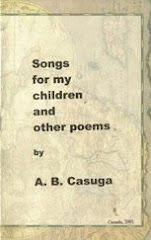
ALBERT B. CASUGA, a Philippine-born writer, lives in Mississauga, Ontario, Canada, where he continues to write poetry, fiction, and criticism after his retirement from teaching and serving as an elected member of his region's school board. He was nominated to the Mississauga Arts Council Literary Awards in 2007. A graduate of the Royal and Pontifical University of St. Thomas (now University of Santo Tomas, Manila. Literature and English, magna cum laude), he taught English and Literature (Criticism, Theory, and Creative Writing) at the Philippines' De La Salle University and San Beda College. He has authored books of poetry, short stories, literary theory and criticism. He has won awards for his works in Canada, the U.S.A., and the Philippines. His latest work, A Theory of Echoes and Other Poems was published February 2009 by the University of Santo Tomas Publishing House. His fiction and poetry were published by online literary journals Asia Writes and Coastal Poems recently. He was a Fellow at the 1972 Silliman University Writers Workshop, Philippines. As a journalist, he worked with the United Press International and wrote an art column for the defunct Philippines Herald.

Sunday, December 11, 2011

HER BAPTISM


HER BAPTISM


(For Marie Clementine)*


Was it cold water poured on your head
that jolted you into a cranky howl?
Who dared break your noontime sleep? 

A kindly old man with a blank cowl
said he has simply prepared for one
not there who would bring fire instead. 

I baptize only with water, but he for whom
I cry in this wilderness, whose shoe straps
I am unworthy to untie, he will use fire. 

Was it this fire from the fireless fount
that roused you then from your slumber,
where you must have giggled and played 

with the elves that sang you a lullaby?
It is the flame of my father’s spirit I burn
you with, sear you with his eternal love! 

Was it his ardent caress then that woke
you up to a quick cry of surprise not pain,
was it his outstretched hand on your head? 

Did he touch you, Marie, on your brow,
and asked: Will you be my lamb and follow
me, build the campfire to warm my flock? 

It will be very cold tonight at the stable.
Was it his gentle palm on your face then,
that eased your angry yell into a tender sob? 

Was he there, Marie? Did he smile at you?


---Albert B. Casuga
12-11-11


*Baptised as a follower of Jesus Christ at St. Francis of Assisi Parish Church, Mississauga, Ontario, Canada, December 11, 2011, in the presence of her parents, Martin Lalonde and Adele Frances Casuga, her godparents, Alvin Kwan and April Veronica Casuga-Kwan, her grandparents  Albert and Veronica Casuga and Roger and  Therese Lalonde, nine Casuga-clan cousins, aunts and uncles, and family friends. Deacon Rev. Mr. Don Roberts, on behalf of Parish Pastor Rev. Joseph Grima, officicated.


Saturday, December 10, 2011

THE UNWRITTEN SONG


THE UNWRITTEN SONG

You are learning/ to call to what you love, to see it returning.---Hannah Stephenson, “You Can do It”, The Storialist, 12-07-11

When the going is good, I would like to go
quickly and quietly like the kettle’s whistle
at tea time, hunched over a writing desk
daring to write that still unwritten song: 

The one that gets arrested in my dry throat
when I sing you to sleep, and you could not
or would not, afraid you would find me gone
in the morning, like most mornings we had
before we grew too old to stay longer in bed,
snuggling, counting the rings on the phone
before the children, now the grandchildren,
would put the intruder down and wonder
how we are waddling along, bum knees on
your right and mine on the left. Would you
want us to buy your croissants today? What
about the bok choy, and the other greens? 

This is as good as it gets, cold keys to pound
on, little words, cathedrals of thought,
wind on the pane, a houseful of memories,
quiet pictures to talk to on the walls, tunes
tinkling on the piano sans rhyme or reason
except to dust the keys off from imagined
dirt stuck by sticky children’s fingers who
raid the shelves of uneaten brittle cookies
and marmalade. Aiee, cochino, por Dios!* 

She would wail in her pained stentorian
dirge, mourning over violated piano keys
that remain untouched, unplayed, silenced
perhaps when arthritic fingers coupled
rheumatic knees, backs that recall pangs
of Calvary, and those kaleidoscopic visions
of ghostly shadows peopling porch walls,
bouncing, dancing, trembling like puppets
on a string, undefined, indefinable, strangers
come to visit us, and we do not know their
names. When the going is good, I will go
quickly and quietly, humming that song
I said I will write for you before I go.

--- Albert B. Casuga
12-10-11

*God, how filthy!

Friday, December 9, 2011

WHEN GOD CALLS: A BOOK OF MEDITATIONS BY POET-PHILOSOPHER ALEJO VILLANUEVA JR.

WHEN GOD CALLS---AN EARLY CHRISTMAS GIFT

My family received an early Christmas gift today from Rev. Francisco Albano. All the way from Ilagan, Isabela, Northern Philippines, where he is Rector of the National Shrine of Our Lady of the Visitation of Guibang, Guibang, Gamu, Isabela. A book wrtitten by my compadre, Poet-Philosopher Alejo Villanueva, Jr.!

I am beside myself with joy to receive this from a friend who was always in our Christmas list since we left the old country some 33 years ago. A book from a dear compadre, godfather of my daughter, April Veronica.

I plan to review the book subsequently to share Alejo's reflections on a "journey to the heart of Jesus." Also appended here is a repost of my April 9, 2009 post on Alex and I, and how deeply he has influenced my manner of looking at the warmer things of the heart and the finer things of the mind and spirit.


(Click on image to Zoom in on Text)


Published by St. Paul's Philippines, (c) 2011, www.stpauls.ph


A PHILOSOPHER'S SMALL TALK

(Reposted from my April 9, 2009 blog entry)


Small Talk at a Coffee
Shop in Montparnasse


Io non mori, e non rimasi vivo.
--
Dante Alighieri, Divina Commedia


Black coffee, Alejo, has its way of distinguishing
anguish from angostura now that prattle
of Sartre, Camus, and Berdyaev has stopped
on a pin’s head: the blackness is proof of the battle
come as the gadfly disturbing the teacups
where they, unthinking, rattle; we, unfeeling, bleed.

“Me? I take mine with cream.” It is this need
makes one prefer a dash of milk to a dash of pity.
Fancy the hole on the doughnut where the hole
lasts only where the dough surrounds it. Fancy,
what makes you think you’re not a doughnut?
“Ontological dimensions of fear, I say.”
Fear of the bole whose business it is to stand tall?
Or of some blank wall?

With the hole there and the coffee black,
where begins the trembling for the clock?
Time in. Time out. Man becomes, then runs out.
What makes you think you’re not a man? Doubt?
“I suffer; therefore, I am alive.” But when life ran out,
one did not die, yet nothing of life remained!
One takes coffee with cream, an empirical scheme
of distinctions between man, doughnut, and dream.

A cup ennobles indignities; the fact is it empties
what makes itself itself into a hole not unlike the
doughnut’s, waiting to be filled, but filled with pain.
To be metaphysical, like the sky empties itself of rain!
Like it was afternoons and the coffee guests absent,
No prattle here of Heidegger nor even of Kierkegaard.
The tables have not remained silent
since then, Alejo. The cups have even trembled.

-- ALBERT B. CASUGA
(1968, 1972, 1990, 2009)

Why all the dates under my byline? The poem has reincarnated in quite a number of forms, I have had to re-write it until I was happy with it. In my A Theory of Echoes and Other Poems UST Publishing, 2009), I said I finally liked its last rewrite. I will not be embarrassed by it.

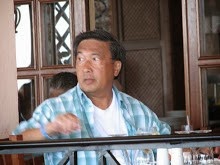
It was a languid afternoon, after classes at the Benedictine college where we taught -- Alejo Villanueva Jr., chairman of the Philosophy Department, and I dropped by a coffee shop at Ermita in the art district of Manila. Would I want to sit in as a revalida panelist for his philosophy majors who were taking their oral examinations? Why not? I accepted his invitation, flattered that a literature major/philosophy minor baccalaureate would qualify me to pass or flunk Philo majors. That tied down, he engaged me in his usual "small talk" -- Camus and existentialism, Heidegger, Kierkegaard. Alejo spouted insight after insight, and I felt like these venerable philosophers and writers were with us sipping coffee.

What does it mean to be human? Why do we exist? What do we exist for? What makes one think one is alive? Gripped by despair that there were more moronic philosophy students in his classes than in our time when we would shoot the breeze with parnassian thoughts, he would bite into his endless doughnuts and I would remark that it took him only one bite to get to the hole of the doughnut and three others to finish it off. Relax. It's only philosophy.

But you have poetry to wax eloquently about in your lit classes, he would remonstrate. Dialectics in mine are as lethal as cyanide to my bums! They would rather march in the streets. But Betrand Russell did that, too, I would placate him.

It was past suppertime when I got home, the children in bed. Seeing the missus already in her slumbrous Parnassus, I sat down to compose the first version of Small Talk. I submitted this first form to fulfill a graduate school writing assignment in Prof. Ophelia A. Dimalanta's Creative Writing class. One of the Philippines' finest poets writing in English, Prof. Dimalanta's good rating of your submission would be a treasure -- she thought my poem, A Philosopher' Attempt at Small Talk at an Ermita Coffee Shop, was good, "except for words like ontological -- not as "magical as seagull."

I ran off with the poem, got it published by Sunday Times editor Gloria Garchitorena Goloy, and the poem's life would never be the same again.

Small Talk was one of the poems I collected in Narra Poems and Others, a book that got me through the graduate class despite my almost zero attendance (I would be there only when I would read a submission to poet Dimalanta's class). She subseqently wrote the introduction of the book together with my fellow Ilocano, University of the Philippines Poet-in-residence , the late Alejandrino G. Hufana.

At the 1972 Dumaguete Writer's Workshop in Silliman University, I was asked by Dr. Edith L. Tiempo, workshop director now Philippine National Artist, to present the poem for discussion. What did it mean, all this prattle?

It was poet Wilfredo Pascua Sanchez who ventured: "It's small talk. You know, namedropping of filosopos and talk about holes and doughnuts, life and dying, coffee and rain. Nice afternoon merienda." Giggles.

He smirked as he got himself involved in poetic hermeneutics. Cavalier, I thought, but that was it! Life as a doughnut. To make up for what was considered smart-ass interpretation, Pascua Sanchez offered to lend me money when I ran out of beer allowance during the workshop. I don't remember if I paid him back.

I revisited Small Talk in Canada when I got In a Sparrow's Time (1990) published. The lines were all flushed left and all started with capital letters. Like most poems at that time.

At that workshop, a priest attendee, Rev. Frank Fernandez, spoke about lines determined by "breath span" (what you could say aloud without losing wind) -- I thought I would use that measure and rhythm (including internal rhymes) in its latest incarnation in 2009. After all, wasn't Small Talk a dialogue between two breathlessly prattling philosopher-manques and poet wannabes?

Alejo became one of the most virulent critics of the martial law president after that coffee shop rendezvous. His bylines were all over the magazines criticizing leadership from the barrel of a carbine, at worst, a government propped up by monkeys in uniforms!

He wrote a book on Proletarian Philippine hero Andres Bonifacio, taught in more schools ran by religious orders, Jesuits, Benedictines, nuns. Gave up on them later, became a successful marketing executive and entrepreneur, and, the last time we saw each other, he was still fulminating about Philippine politics that he even got mad somewhat with the late Senator Raul Roco, his own compadre and our San Beda College colleague and friend. Roco ran for the Presidency later, but my philosopher-poet friend and compadre (he was godfather to one of my younger daughters), Alejo Villanueva Jr. must have wept inconsolably when Roco died during his campaign and a movie actor Joseph Estrada would win but ultimately jettisoned by revolting Filipinos (in the second People's Revolution) for corruption. Angry, Alejo would always manage to rationalize disasters: Voters deserve the leaders they elect.

He ran for City Council in Manila some time or the other, but did not make it. Always the poet-philosopher, he came out with a small book of poems and meditations (a la Mao Tse tung?), but I left for Canada and probably did not deseve an autographed copy "for leaving our country, our beloved native land." I wonder if Alejo found another coffee-buddy to engage in big "small" talk with. He never wrote back when I asked for us to "correspond in the twilight of our years, even if it were only through these damned new-fangled e-mails."

"The tables have not remained silent since then, Alejo. the cups have even trembled."
Thursday, December 8, 2011

THE ACCOUNTANT


THE ACCOUNTANT

Sunny and cold. A nuthatch lands on the dead cherry and begins a close inspection of the limbs, dapper as an accountant in his gray suit.---Dave Bonta, The Morning Porch, 12-08-11


Almost invisible, he plods quickly through carrion
piled helter-skelter on the bulldozed hillock. Dead
heads, dead eyes, dead limbs, dead legs, dead dead
form wreaths on the gaping holes in graveyards we
now know: Kampuchea, Maguindanao, Somalia,
Libya, Uganda, Nigeria, Botswana, Russian pogroms,
Mein Kampf railroads to the Herr’s crematoriums,
killing fields: he was there, “been there, done that”,
his austere and remote account of his unique job:
counter of the dead, keeper of the books, master
of the morgues, “keep them coming while we could,
death shall have no dominion.” Nor a condominium.
Like the nuthatch, he walks with a limp in his dark,
gray suit, shrugs, leaps over the dead cherry and
stifles a long, deep yawn, and fixes his ledger pages.


— Albert B, Casuga
12-08-11


Wednesday, December 7, 2011

LOOKING AT RAIN


LOOKING AT RAIN

Rain. I’m mesmerized by the driveway puddles, how rings of ripples form and overlap, each raindrop magnified at the point of termination.---Dave Bonta, The Morning Porch, 12-07-11 


Two ways of looking at rain
as an allegory or metaphor:
rain, rain, go away children
want to play! But we tore
through the walls of rainfall
naked, deliriously, gleefully
screaming for the sky to fall
on our tender loins, scarcely
touched by wind and fingers
carved coyly into cane leaves
that lash and tickle derrieres
poised skyward, athwart as if
to mock a voyeur leering in
some hidden crack of clouds,
to espy these glistening skin,
patches that pass for clothes
on the backs of  carousing
children lost in their singing. 

Before long, the rain stopped.
Into lives some rain must fall.
Songs ended. And we grew up.
Rain became our quiet call
to clear our driveways of debris
from torrents that shredded
twigs of their foliage, cut a tree
in a sudden storm we dreaded.


---Albert B. Casuga
12-07-11

Tuesday, December 6, 2011

A TOY PISTOL


A TOY PISTOL

Toys and stuffed animals feed/ our first experiments in truth/ and desire--the dolls of our youth/ are pets, children. We call/ to our toys, and they all/ leap up, paw at our jackets/and faces. The racket/ of our own loneliness is loud. / We crave a friendly crowd. ---From “Toys Are Us” by Hannah Stephenson, The Storialist, 12-05-11


My first toy was a pistol whittled from a branch,
and from the windows of abuelo’s grand house,
I must have aimed and shot at as many cousins
who would yell for me to put on a pair of pants,
and come down to play with boys not dolls. Pistol,
I would yell back, I will shoot you, kill you all!
It had the shape of a Tom Mix shooter, a whittled
branch, really, cut and shaped by a drunk uncle
who said he would make me one if I quietly stole
the gin from father’s drawer so he could share
the ten-cent coke bottle with me when the gun
is done, and I could ride away on the banana stalk
horses with a gun to cut down all the little injuns
across the road who have been crowing all day long
for me to come down and shoot it out, their bows
ready to sling their arrows and pebble bullets
with their slingshots. Be sure you have pants on,
it will protect us from your gas-bombs, ass bombs! 

From those windows, I raised hell and rat-ta-tat;
I did not know it was only a quiet “bang” or “ping”
for a pistol the size of a pretzel. When I came down
to finally play with them, mother said my asthma
was gone, thank god I was ready to attend school,
learn to read and write, recite poems for abuelo
or sing old Spanish songs I barely understand
so he would get up from his rocking chair and
shout down the boys to leave me alone with dolls
or pistols before some stupid presidente would
consider me old enough to join the guerrillas
and like a pea-sized idiot get myself quartered
by Japanese bombs. My first toy was a pistol,
but now on my dotage not unlike my abuelo’s , I
have nothing but contempt for guns and wars
even to defend a homeland; all I want and  pray
for is be able to play with my live dolls who coo
and smile, and giggle, and before long say abuelo.
Before long, I am sure, they, too, will be pistols.


--- Albert B. Casuga
12-06-11


Friday, December 2, 2011

OCCUPYING THE GARDEN


OCCUPYING THE GARDEN


What do I want, what do I need? Later, I tell myself, later. There’s plenty of work, the hours full of obligation. But I know I am not virtuous: I am always my hunger. ---From “Hunger” by Luisa A. Igloria, Via Negativa, 11-30-11


What if this place were made only for the other?
You are yourself, but you are also others’ other. 

Were you conceived for yourself, or for a specie?
Someone must extend the process of evolution. 

Your first act out of the womb was to let out a cry.
Was it not to alert the birthing other you’re here? 

And you will bring joy to a union forged in dreams,
but you could always be the unwanted obligation. 

What if you were the inevitable happenstance
come from the aches of groin and gravid reasons? 

Are you an issue of love or lust? An afterthought?
When did you start to even aspire to be yourself? 

Dare you grow then to even ask: What do I want?
What do I need? Selfish angst? No. Must-ask ones. 

One cannot give what one does not have, operatio
sequitur esse.  Find and feed your hunger to know 

what you are here for. Are you a brother’s keeper?
Or does a lover keep you? Either way, a hunger. 

If you were for the other, you must be provident;
but fill your tills first before giving a ruddy cent. 

Is your neighbour the village thief? Love him.
Clothe the naked, as you would with a fig leaf. 

Before long, you would have guessed how little
you are without the other, and learn to whistle 

in the dark, and wait, and build, and gather
behind walls, until, one on top of the other, 

you begin to climb beyond your pauper space
to occupy a lost garden, a haven, as your place. 


---Albert B. Casuga
12-02-11

Photo by Bobby Wong Jr.

Wednesday, November 30, 2011

ECHOES


ECHOES

All is disposable,/ except for that which/ persists. The echo/ unhinged from/ the sound that/ threw it. ---Hannah Stephenson, “Aftermath”, The Storialist, 11-28-11


1. 

How far will an echo go
before it peters out to
leave its source’s halloo
sounding thin and hollow? 

How long will this echo
last in hallways that throw
peels of joy that follow
a escape from deep sorrow? 

Is it a will-o-the-wisp, too,
much like the brief flow
of warm breeze over snow
that won’t melt nor thaw? 

Everything here must go.
All is disposable. But echo
that ripples here through
time is an eternity or so. 

Am I not after all a shadow
of that maker of a rainbow,
who sent a dove not a crow
to fly from that ship’s bow? 

Am I not truly God’s echo? 

2.   

Echoes shape corridors lean
leaving them a cipher’s silence
not unlike the axiom of a day: 

All things go up to fall the way
fractured birdwings fall, violence
met in the loins of wind. 

Lean corridors shape echoes,
silence ciphering them, leaving
a day axiomed as not what is unlike  

the way the fall of things strike:
violence on the fractured birdwing,
winds loyned with zodiaqual zeroes.* 

 3.  

O THAT A FALL MUST GO
GO MUST A FALL THAT O
THE WAY A COMET’S TAIL
TAIL A COMET’S WAY...


---Albert B. Casuga
11-30-11


*Loyned – being the sound of echoed “loined”; zodiaqual, is “zodiacal” (from arcane to new).

Monday, November 28, 2011

HER SMILE


HER SMILE


(For Marie Clementine)


To mean anything,/ a container must store/ a visible substance./ We destroy them, melt them/ all together, make them/ into new versions/ of what they were already,/ fill them again./ Bottomless refills...From “Bottomless” by Hannah Stephenson, The Storialist, 11-21-11


Hija mia, donde esta su sonrisa bella?
Where is your lovely smile, my child? 

As if on cue, a pair of glistening eyes
brighten her quick grin flashed on a
fistful of face now suddenly larger
than the gaping windows around her. 

Barely dry from the ripples of a womb,
how could this infant speak a world
of adoring mime, a soundlessly gentle
smile that might as well be the sunrise? 

Is this the hidden world of a refilled
vessel, a venerable ghost in a new cup
of meaning come back to remind us
whence we come, a happy other place? 

There and here are a plenitude of grace,
where nothing is destroyed, where old
is new and a tandem of the eternal,
sprung from a gyre’s ever spinning cycle. 

A lover’s smile perhaps from a past
that is always present; a stored glass
brimming with what it already held?
Is this, therefore, a bottomless refill? 

Like a roadside cafe’s vending, does this
offer our parched lips with moistened
remembrances of ever tender kisses
that we slept by, warm and gentle still? 

De donde esta su sonrisa bella, hija?
Whence come your lovely smile, my girl?


---Albert B. Casuga
11-28-11


Sunday, November 27, 2011

A WAITING GAME


A WAITING  GAME

This is the game/ we keep engaging in, Finding/ a Good Stopping Point by/ Seeing Clues in the Universe./ Tell me when, that’s us,/ grinding, waiting. Say when. ---Hannah Stephenson 


Looking for a good time to stop,
is to stop looking like slumping
on a fallen trunk or a trail rock
jagged and jutting out of the bluff. 

Morning walks get longer along
empty spaces before familiar curbs
signal a turn to what we wait for:
the final bend. We are back home. 

“HURRY UP PLEASE ITS TIME.
Now Albert is coming back,
make yourself  a bit smart.”* Eliot,
of course, said it for me earlier. 

How long ago was that, when I
read those Wasteland lines? How
long have I waited to use them?
Is this a good time, yet? I waited. 

Because we have seen the clues,
because we have seen them all
already, I feel it is time to stop
waiting, sum up the bill, and go. 

What was I given to bear the pain
of knowing that I did not know?
Or build a home I could not live in?
What tools must I now return? 

In summing up, I will discount this,
in the game of haggling for a place
back in the Garden. Our stay here
was overpaid. We waited too long 

for that room with a better view,
that terrace with a canopy of roses,
and blue birds trilling on the sill.
O, for a touch of that distant sky! 

Next time around, if there is one,
I will be smart. I will settle only for
a room where I could see the sky
and the sea conspire to eat the sun.


---Albert B. Casuga
11-27-11

* T. S. Eliot, The Wasteland, II. A Chess Game, T. S. Eliot, The Complete Poems and Plays, 1909-1950)