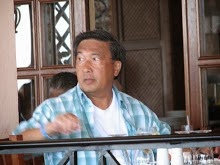
My photo
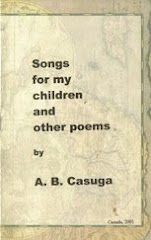
ALBERT B. CASUGA, a Philippine-born writer, lives in Mississauga, Ontario, Canada, where he continues to write poetry, fiction, and criticism after his retirement from teaching and serving as an elected member of his region's school board. He was nominated to the Mississauga Arts Council Literary Awards in 2007. A graduate of the Royal and Pontifical University of St. Thomas (now University of Santo Tomas, Manila. Literature and English, magna cum laude), he taught English and Literature (Criticism, Theory, and Creative Writing) at the Philippines' De La Salle University and San Beda College. He has authored books of poetry, short stories, literary theory and criticism. He has won awards for his works in Canada, the U.S.A., and the Philippines. His latest work, A Theory of Echoes and Other Poems was published February 2009 by the University of Santo Tomas Publishing House. His fiction and poetry were published by online literary journals Asia Writes and Coastal Poems recently. He was a Fellow at the 1972 Silliman University Writers Workshop, Philippines. As a journalist, he worked with the United Press International and wrote an art column for the defunct Philippines Herald.

Saturday, March 23, 2013

A VALEDICTION


A Poem for Lent. A joy to nurture, a covenant of the purest love. Lest we forget.

 A VALEDICTION


"Is my gloom, after all, shade of His hand outstretched caressingly?"---From "The Hound of Heaven" by Francis Thompson
 

All that it takes to remember that I am still with you
is this morning’s sun, glaring from a clear blue sky,

and I have never absconded, never left your side
even when I found myself at the edge of the field

merely a part of your life’s curious appurtenances,
someone you’d remember when the muezzin calls

from his minaret, or angelus intones from emporia
microphones, or when the dry season lends penitence

its hauteur from random worshippers of a crucifixion
forgotten in the hill of skulls, a mocking flagellation.

I will be there when litanies of pain fill your evenings,
I will be there when you lose all faith in love or dreams.

At the edge of the field, I will be there, waiting for you
in the shadows, until you finally stop running away .


 —Albert B. Casuga


Sunday, March 17, 2013

A THING SHE TOOK AWAY: A HAITI FUGUE


A THING SHE TOOK AWAY: TWO POEMS
 

1. FABIANNE GEISMAR, 15 : A DEATH IN HAITI


Shot dead for stealing mirrors.
---Headline, The Toronto Star, Catastrophe in Haiti, Jan 20, 2009, Pg. 19


While the temblor's carrion burn
in common graves unnamed,
you have a name to go by, and
will have confreres wail to mourn
your falling on brittle rubble,
mirror clutched as you would a rag doll
if you had a more innocent childhood,
if you even were a lass in pigtails
or braids or ribbons or princess veils,
and did not have to scrounge for food
or even think that a purloined mirror
is a prize too precious to die for.

O, Fabianne, would you have seen
a flushed reflection of the fairest face
this wounded city has haplessly hidden
in unforgiving debris of shattered grace?
Or would you have recoiled from scars
on scars that faces become inured to
seen through cracks of shattered mirrors?

---ALBERT B. CASUGA

2.  THE MIRROR

When the face looks back at itself/ from the mirror, what does it see? ---From “First One, Then the Other” by Luisa A. Igloria, Via Negativa


Was it Fabianne Geismar’s* fantasy, lifting that mirror?
Mirror as loot in temblor-stricken Haiti is fantasy

enough for that crumpled lass on the rubble of Haiti.
Haiti made sure the lass absconded too with enough

bullets in her brain, rending a dream of seeing her face
face itself in a purloined vanity piece pocked with bullets

when retrieved for Wal-Mart from her tight embrace.

Embrace your mirror, girl, a trophy of blooming. When?
When stirrings in your haunches told you what to steal?

Steal the heart of that lad staring at you with shy lust:
lust for love, for all that wreckage allows you to steal

so you can see your mouth that will kiss him, your eyes,
eyes that will shape him in your breasts, your so…

So supple body ripened quickly to life’s urgent quiver.

---ALBERT B. CASUGA

* SHOT DEAD FOR STEALING MIRRORS. Fabianne Geismar, 15, was shot by police pursuing looters.---Headline and Caption, The Toronto Star, Catastrophe in Haiti, Jan 20, 2009, Pg. 19


Saturday, March 16, 2013

"THE THINGS THEY BROUGHT": SIX POEMS FROM REFUGEE CAMPS

Photo by Guardian Co UK
 

‘THE THINGS THEY BROUGHT”:
SIX POEMS FROM REFUGEE CAMPS

A cane, bracelets, a phone, these are among the cherished possessions for Syrian refugees, whose names have been changed to protect them.---The Toronto Star, 03-16-13


A Cane

He will make it, no two-hour trek will break him.
At the Iraqi border, at a camp for war refugees,
He looked around for a safe place for his cane,
An unbroken ally propping him up every time
His old knees buckled. Ibrahim, 70, the sentry noted,
Personal property brought: wooden cane. No value.


A Wheelchair

Did you bring anything with you? A soldier asked
Before she could cross into the camp. “Nothing,”
She mumbled. “Only my soul, nothing more.”
And your wheelchair? The registry clerk pointed
To a rusty one. Amir, 24, whispered warily, “Sorry,
I just thought it was part of my body. Sorry. Sorry.”
 

A Phone

Most important for me, Sir, he said. With this phone
I can catch signals from Syria, talk to my father,
And I will not be alone here. And I also have my family
Here in this mobile. Their pictures are here. Voices,
Too; when we are free again, I will call them, and talk
To my father, my mother, and my brother Yusuf…
 

A Bouzouki (Syrian String Instrument)

He said his fingers are not too old to play on the bouzouki.
“Only thing I could run away with when they killed my
Neighbours. Most important thing, I play to remind me
Of my homeland. My beloved Syria. As long as I have music
From this, all that I now own in the whole fucking world,
I will find relief for my fears and sorrows. No family. Nothing.”


Bracelets, Not Nancy

Will Maryam, 8, find Nancy back in Damascus? "I left her.
She is the most important thing to me in the whole world.
But these bracelets are second only to Nancy, my doll,
A gift from my brother working in Jordan, I miss him
So very much, but my mother said we must pray to Allah
So I could find Nancy again and show her to my brother."
 

Iman, 25, Two Boys and the Koran

Ahmed is two, Aishia is one, but this Koran belonged
To my family, grandfather and his father before him.
At this Nizip refugee camp in Turkey, people ask me why
I do not look worried at all, even with my two pillars,
My boys, and a husband at war. Why? I hold the holy book
To my breast, as long as I have it, I am connected to Allah.


---ALBERT B. CASUGA


Inspired by excerpts of conversations with the refugees published in the Toronto Star with some photographs of these unnamed refugees by Brian Sokol, UNHCR.
 
 
Photo by unmultimedia.org

Thursday, March 7, 2013

A WAKING UP SHRUG


A WAKING UP SHRUG

Waking up on Fifth Line, when the ground fog
creeps on moonlit streets like a late lover lost
under slept-on sheets, surprises me as still
the best time to rise when mornings are really
midday scrambles to catch something: bus,
tram, train, time, traffic, trash bins trampled
over, reeking tramps, ad nauseam. I am still.

On a porch, where houses are still better off
with them, I sip my minted tea as serenely
as I could, miming the movements of my mind:
if I knew then what I know now, if I loved then
as fiercely as I could have, if I could turn time
around and give it a kick in its arrogant behind,
if I could shelve that rushing sunrise and not
waken to carpenter bees and highway buzzing…

However languid or rushed my mornings are,
does not matter now. Waking up still beats not
getting up or not waking up to another still day.
I am most still when I can feel my shoulders shrug.

—Albert B. Casuga

Monday, March 4, 2013

THE PASTURE


THE PASTURE

The olden days are comforting, memory/ that exists with no mind to box it in, /a pasture. --- From “Olden Days” by Hannah Stephenson, posted 09-12-11 in The Storialist.


Olden days as a pasture---an expanse
of growth and green alive to laughter
and song---that’s where I am going.

Where windswept bramble rustle
with grass, you will find me there.
I can’t be rushed to skip off beyond.

I have time to paint a collage of faces
I have known in the deep mosaic
of a past now graffitied on these walls.

Isn’t this why we hoard our memories?
We carry them like playing marbles
in pockets over our hearts, an easy draw

when the game is called, a quick toss
into holes dug on dirt we crawl on like
the kids we were, rolling them to dusk.

Olden days are there to sieve through
to find markers along obscured paths
once brightly lit now lost or darkened.

A smile after a first kiss would help me
remember there are caresses there
as indelible, as urgent, as when first

given or surrendered by the one lover
whose courage saw me through times
when absconding was an easy way out.

A rollicking hug from the boisterous
son, a lonely issue, my only boy, recalls
a hesitant embrace for my dying father

who whispered from his rocking chair
my schoolboy snivelling was poor form,
he needed a man’s goodbye. Goodbye.

The litter of olden days strewn like dry
leaves along my walk home holds me
back, awake again: I do not want to go.


---Albert B. Casuga
THE PASTURE

The olden days are comforting, memory/ that exists with no mind to box it in, /a pasture. --- From “Olden Days” by Hannah Stephenson, posted 09-12-11 in The Storialist.


Olden days as a pasture---an expanse
of growth and green alive to laughter
and song---that’s where I am going. 

Where windswept bramble rustle
with grass, you will find me there.
I can’t be rushed to skip off beyond. 

I have time to paint a collage of faces
I have known in the deep mosaic
of a past now graffitied on these walls. 

Isn’t this why we hoard our memories?
We carry them like playing marbles
in pockets over our hearts, an easy draw 

when the game is called, a quick toss
into holes dug on dirt we crawl on like
the kids we were, rolling them to dusk. 

Olden days are there to sieve through
to find markers along obscured paths
once brightly lit now lost or darkened. 

A smile after a first kiss would help me
remember there are caresses there
as indelible, as urgent, as when first 

given or surrendered by the one lover
whose courage saw me through times
when absconding was an easy way out. 

A rollicking hug from the boisterous
son, a lonely issue, my only boy, recalls
a hesitant embrace for my dying father 

who whispered from his rocking chair
my schoolboy snivelling was poor form,
he needed a man’s goodbye. Goodbye. 

The litter of olden days strewn like dry
leaves along my walk home holds me
back, awake again: I do not want to go.


---Albert B. Casuga

Sunday, March 3, 2013

OCCUPYING THE GARDEN: A HUNGER


OCCUPYING THE GARDEN: A HUNGER

What do I want, what do I need? Later, I tell myself, later. There’s plenty of work, the hours full of obligation. But I know I am not virtuous: I am always my hunger. ---From “Hunger” by Luisa A. Igloria, Via Negativa

What if this place were made only for the other?
You are yourself, but you are also others’ other. 

Were you conceived for yourself, or for a specie?
Someone must extend the process of evolution. 

Your first act out of the womb was to let out a cry.
Was it not to alert the birthing other you’re here? 

And you will bring joy to a union forged in dreams,
but you could always be the unwanted obligation. 

What if you were the inevitable happenstance
come from the aches of groin and gravid reasons? 

Are you an issue of love or lust? An afterthought?
When did you start to even aspire to be yourself? 

Dare you grow then to even ask: What do I want?
What do I need? Selfish angst? No. Must-ask ones. 

One cannot give what one does not have, operatio
sequitur esse.  Find and feed your hunger to know 

what you are here for. Are you a brother’s keeper?
Or does a lover keep you? Either way, a hunger. 

If you were for the other, you must be provident;
but fill your tills first before giving a ruddy cent. 

Is your neighbour the village thief? Love him.
Clothe the naked, as you would with a fig leaf. 

Before long, you would have guessed how little
you are without the other, and learn to whistle 

in the dark, and wait, and build, and gather
behind walls, until, one on top of the other, 

you begin to climb beyond your pauper space
to occupy a lost garden, a haven, as your place. 

---Albert B. Casuga

Saturday, March 2, 2013

PORCH TALK ON THE APOCALYPSE


PORCH TALK ON THE APOCALYPSE 

Sun through a skim of clouds. A nuthatch and a downy woodpecker trade anxious, nasal notes between the faint shadows of the trees. ---Dave Bonta, The Morning Porch

N:      Think this winter will be our last? Mayan 2012, remember?
DW:  Nah, might just be a peep at the God Particle by a savant.
N:      What’s with the peppy, sunshiny, head-in-the-clouds cant?
DW:  Been pecking on wood all my life! What’s with the dander?
N:      Not enough nuts or weevils as it is. Why end it all? It’s futile.
DW:  Boredom. Renewal. Occupy. He’s hinted these for a while.
N:      Occupy. Uh-oh. Come back to reclaim this neck of the woods?
DW:  Final Coming. Like Advent. Last trip, like. He’s tired. Pissed.

N:      Like driving scruffy tenants out for punching holes on walls?
DW:  More like ozone layer holes. Global warming, oil spills, Nuts.
N:      T
hey’re already murdering each other. Wars, famine, Woods.
DW:  He’s got to have the last say. He wants them to say: We repent!

N:      What’s the point? Couldn’t he consider his love well spent?
DW:  Don’t know about you. I would like to bore a few more holes.
 

—Albert B. Casuga

Friday, March 1, 2013

PERCHANCE TO DREAM: TWO POEMS


PERCHANCE TO DREAM: TWO POEMS


1. DREAMING

Keep your eyes wide open if you want to dream---Paolo Coelho


The ones we talk about or ache to recall
the morning after, we call nightmares. 

A love-sick, maudlin, slobbering goodbye
in the tight-pillow-hug tearjerker dream? 

It was not a dream. It is a stifled desire,
a constipation “devoutly to be wished”. 

Shrinks shrank these into Freudian blots
on the balance sheets of love and hate: 

You want to run as wildly far away as you
could, id permitting, haunches allowing. 

One needy life is enough torment; free
yourself then from this strangled trellis, 

where hanging like a wanton leaf is not
the twin of hanging on but dangling still 

until hurts can no longer wound you,
nor gentle caress save you. You are a stone. 

No fall can sever you from tangled vines
that summer burns, nor frost cripple you; 

you would not even pray for the spring
to bring sunrises and sunsets to heal you. 

Open your eyes and dream that loneliness
becomes you; you are strong and alone, 

omni soli, semper.  Will courage redeem
you then from the stupidity of being brave 

and alone?  And when you sleep, will you
remember to open your eyes and  dream? 

--- Albert B. Casuga


2. HE DREAMT WITH OPEN EYES 

(For Steve Jobs+) 

Dance a digital dream, and spin a web
around this globe where everyone knows
if you floss your teeth, or pick your nose,
if you still venture out of your craven cave. 

Did you earn enough to buy a paperbook
that made you a little prince of a pauper,
when learning meant to read or to hunger
for that leftover burger, or die in a nook, 

coupling with a book, ranting of a stable
boy, romping in hay, dung, and cackling
hen with the Lady of the Manor, stripping
bare all that is noble, her drawers on a table? 

Dance the jig of the devil astride the tombs
of the slovenly, slothful, and obtuse writers,
who bartered their dreams with publishers
stuffed with ducats, scribblers with crumbs. 

Dare you now liberate these dumb brothers
who dream with closed eyes, sing rhymes
like drooling mutes, or untinkling chimes?
Internet, iPad, Kodo, Kindle, their druthers, 

you dreamt them with open eyes and saw
that nightmares are only for the blind,
all who dream with closed eyes, the kind
who cannot see behind walls grass also grow. 

--- Albert B. Casuga

Photo by Reuters


Thursday, February 28, 2013

JUST A WOMAN


JUST A WOMAN

Warm light on the back are familiar fingers
but they will not be back as caresses again.
They can only unravel bandages of wounds
that will not heal but will not feel any pain.

I am done with them. All feelings betray us
before they become clear: they sap courage,
and quickly turn into skeletons of passion.
I want to be a woman, not a chair to catch
torn and tired bodies that need mending.

I, too, hanker for strength from the strong,
unquenchable hunger I could eagerly satisfy
when it finds its harbor and home in a place
I, and only I, can shape or rearrange or own,
or drink like a glass of cold water to cool me
down when I have no more need for loving.

A primal urge clear on this face. Feel it. Fill it.

---ALBERT B. CASUGA

A poem inspired by a Luisa Igloria poem and subsequently published by Axlepin Publishing as a featured poem in January 2013. @ Painting above by Hugo Urlacher of Argentina.

Wednesday, February 27, 2013

STAYING ALIVE


STAYING ALIVE

Because what we now have is a life
we will never have again, something
as unrepeatable as living or dying,
we drink to it as often as we turn down
an empty cup, and learn to forgive
what was given or not, noblese oblige,
coming as we do to this strange place
without as much as a warning or even
our consent. We did not know. 

Because we did not plan to be born,
is it too vexing to learn--perhaps
to revel in--the myriad acts of loving,
of living, and in return be grateful
to perform the surprisingly magical art
of shaping life, nurturing it, finding it
where no one would lead us, blind
as we are to this fire in our weak loins? 

Was that left behind by a rushed maker,
like a spare screw, and we had to find
where it would fit snugly, divinely apt
and delicately, deliciously, our manner
of staying alive when dying is better?
 

--- ALBERT B. CASUGA