My photo
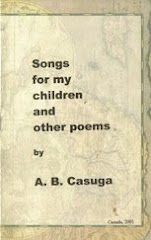
ALBERT B. CASUGA, a Philippine-born writer, lives in Mississauga, Ontario, Canada, where he continues to write poetry, fiction, and criticism after his retirement from teaching and serving as an elected member of his region's school board. He was nominated to the Mississauga Arts Council Literary Awards in 2007. A graduate of the Royal and Pontifical University of St. Thomas (now University of Santo Tomas, Manila. Literature and English, magna cum laude), he taught English and Literature (Criticism, Theory, and Creative Writing) at the Philippines' De La Salle University and San Beda College. He has authored books of poetry, short stories, literary theory and criticism. He has won awards for his works in Canada, the U.S.A., and the Philippines. His latest work, A Theory of Echoes and Other Poems was published February 2009 by the University of Santo Tomas Publishing House. His fiction and poetry were published by online literary journals Asia Writes and Coastal Poems recently. He was a Fellow at the 1972 Silliman University Writers Workshop, Philippines. As a journalist, he worked with the United Press International and wrote an art column for the defunct Philippines Herald.

Saturday, July 6, 2013

OUR YOKE TO TRY: THE ODDS


OUR YOKE TO TRY: THE ODDS

For us, there is only the trying. The rest is not our business/ ...Love is most nearly itself/ Where here and now cease to matter./ Old men ought to be explorers/ Here and there does not matter/ We must be still and still moving/ Into another intensity...From “East Coker, The Four Quartets, T. S. Eliot

Because we could not hold on to love
As it must be held, given pure and free,
We can only try to find what is most
Nearly itself, until we get to a still point.


Time does not define where that may be,
But it must linger in the mother’s breasts,
When she suckles her infant into a life
Where there is nothing but uncertainty.


How precariously certain is this mock-up
Of staying alive when it is impermanence
That most resembles it? A will-o’-the-wisp
Or a cruel mirage hounds us, it is there


But not here. Why love then, or live at all?
When uncertain weather is most certain,
Why dare fritter precious lifetime on this
Uncharted clearing? It is our yoke to try.


We will perish trying, measure dying by
How true our exploring must be, we
Cannot stop, we simply move into another
Space, with flaming eagerness or anger.


---Albert B. Casuga

Thursday, July 4, 2013

OLD WOMEN IN VACANT LOTS


OLD WOMEN IN VACANT LOTS


Wipe your hand across your mouth, and laugh;/ The worlds revolve like ancient women/ Gathering fuel in vacant lots.---T. S. Eliot, “Preludes”, Collected Poems 1909-1935


1.
Debris around the empty schoolhouse
have been cleared, gathered into motley
piles neatly lined on where the road was
before that too crumbled with village
life; only the old women stayed longer
than any of the taut-jawed rescuers now
back in cities where Ishinomaki is just a
dot in the grids pressed upon the brittle
maps. The temblor and the tsunami
are still everything to them: raw feelings,
ceaseless nightmares of weeping men
picking up limp bodies of children dug
out of the rubble, still tightly clutching
their shredded books and broken crayon.


2.
Their gnarled fingers and weary faces
stick out like bookmarks at the last light
of sundown, clipped between pages of rags
flapping in the uncertain weather, while
they move in little circles like crayfish
clambering over what remains of the yard
that once teemed with laughing children;
they would stop to talk over the muffled
rumble of the excavators, and bend quickly
to glean more rubbish or gather briefly
to touch and bless a tear from a blouse or
a piece from a muddied shirt they would
gently put away in their bamboo baskets.


3.
Other times, other seasons, they would
be here picking up ripped twigs dried
on the banks of the river at the foot of the
hill, fuel for the vats of the sweetened
yams they would boil to regale the boys
and girls gathered around them at school
break, laughing as raucously as the wee
urchins, while wiping their caramelled
lips with shawls they would wrap their
heads with when they walk down the hill,
to wait for another daybreak of fuel
picking, praying for a kinder season. Soon.

---ALBERT B. CASUGA

Wednesday, July 3, 2013

BENCH GRAFFITI


BENCH GRAFFITI
 
If you came this way,/ Taking any route, starting from anywhere,/ At any time or at any season,/ It would always be the same: you have to put off/ Sense and notion. – T. S. Eliot, “Little Gidding”, Four Quartets
 
You are beautiful! An unlikely graffiti
on the park bench brushed on the seat
and the back slats must shoo parkers
away---a stalker nearby? A pedophile?
 
Why not a lonely chap who has no one
to say those words to? Why not a lad
too shy to blurt it out to that ingénue?
Why not a happy-feeling litterbug?
 
"You are beautiful " should go a long way
into making a homely jogger feel she
could use the stroking; no one would
run a hand over those spindly dry legs.
 
Why not the kindest guess about mad
men painting nice things in the dark?
 
---Albert B. Casuga

Tuesday, July 2, 2013

ALL THE DAYS DWINDLE DOWN: TWO POEMS


ALL THE DAYS DWINDLE DOWN: TWO POEMS
 

1. RHYTHMS OF A DAY

It is a rhythm we learn early enough:
that bird’s quiet climb up a trunk
is also its feeding hour; it is working
for its transient stay in this palace
of trees at the edge of the woods.

From a porch, between sips of tea,
the watcher espies the cuckoo dance
on the tulip tree--a hop-skip-and-pick
not unlike the hip-hop kids’ dancing
away from embalming classrooms
at end of day: hop-skip-and-pick

pebbles to throw at a party of wrens
that whirr noisily away, squawking
mayhem at hallooing children who
cackle at the frenzy as if they were
born to raise hell, and for the fleeing
birds to screech for mercy, mercy!

The rhythm of a summer day: a bird
on the tulip tree minding its business
is scared silly by the clangor of a dump
truck rattling through raven packs
snatching trash from spilling bins
that line up the street like pallbearers.

Elsewhere in Tripoli, napalm bombs
scare dumpsite scavengers picking up
metal to shape the bullets for another
day’s battle. Rhythms of a day, we call it.
 

2. DISCARDED DAYS
 
What have we discarded cutting through tunnels
we must have plodded to quarry from lives we
might have been accidentally given? What loves
have we found, what hearts have we lost? Layers
of clay, cracked stones, and silt could build us our
houses of hurts and ruptured dreams. Not a home.

But we take care to wake up to days we can shape,
to moments we could mould like delicate bowls
whence we share victual and drink for our hungry
and thirsty souls. When travel becomes a burden
of faithlessness or pain, we call each other out:
Be brave, hold on, take on the world if we must!

When these passageways fall dark, we walk on.
After all, our lives are not made of discarded days.
 

---ALBERT B. CASUGA

Monday, July 1, 2013

THE ETERNITY WE KNOW: TWO POEMS


THE ETERNITY WE KNOW: TWO POEMS

Sit. Feast on your life. ---Derek Walcott  “Love After Love


I. UNTIL MEMORY FADES

Has anyone come back from this defiled form
and mapped out ways to get back to that eternity
we claim as heirs to, where days are as chartless
as the river stream that must flow to an endless,
ceaseless fountainhead which has no beginning?
There is no other way back except by destruction.

When every rampart has been carted away, we
do not pine for them like those we cannot lose
because we store them in vaults of our memory:
they are our milestones of an afterlife we choose
to build from achieved desires, fulfilled dreams--
these chambers of a heart that will not crumble.

What, indeed, do we know of eternity? Save this:
We are never away from it. Until memory fades.


II. FEAST ON YOUR LIFE

Although this invitation will prolong our wait
in the cold antechambers that we surround
ourselves with, we will cautiously accept it.

Why not? Sitting here, staring at a kaleidoscope
of the many faces we have constructed to meet
other faces, I celebrate a love affair with myself.

Who else will do that for me? There were lovers,
and there were lovers, but they held on to their
own chisels to pare and scrape their own image

of what they could have and hold not unlike
a wild-eyed Pygmalion sculpting flesh onto his one
desire, a Galatea of his rawest wants and dreams.

I will sit and wait for the feast of all feasts
to be served on my table, my head on a platter,
my heart seasoning a bowl of hope, a soupçon

of little mercies that lovers often do: a salving
of hurts, a troth of endless fealty, a promise
that the image on the mirror is finally, only mine.

---ALBERT B. CASUGA

Sunday, June 30, 2013

COMING HOME: POEMS IN THREE VOICES


COMING HOME: POEMS IN THREE VOICES


1.  Her Questions

How far have you gone from all that you were,
little chipped stone from a hidden tributary,
little pebble that has yet to reach the bottom
of the well to hear its thunk and come to rest?

How far, indeed, that you must finally beg
to be taken home? Where, what place, what
troubled spaces have you been all these years?
Bitter years, you say almost in descant candor.

Take you home? But where do you belong?
If I knew, if I could follow that map long
faded in your doleful heart that has dogged
every fickle chord from every pied piper—

If I could find every pied-a-terre you’ve been
that I might collect the shattered life pieces
left of your gypsy heart so I could remould
them to our heart’s desire, I would. I will.

Take you home. Prop you up, start you up
once again from whence you came, where
your heart is not merely a sieve for sorrow
or pain, but where it is a fortress of care.

2.  Looking Back

Trek back to the church belfry and be the deft
hands of the carillonneur you wished you were
when you were young, malleable, and oh, so free
to dream, to laugh, to thumb your little nose

at the carousing lads vaulting over rooftops
to call your name, to sing your name like
perching sparrows lined on some errant wires
at sunset warbling: sweet-sweet, sweet-sweet!

Take me back. Take me back. And we will retrace
those letters carved on some saplings grown tall
beyond our reach, and sing with carillon clangor
those old evening songs, brave songs, love songs.

We will outdo the bell choir master on the belfry,
ring them all, sing them all, hum them all until
sundown overtakes us and we hold our tremulous
voices like stuttered promises of coming home.

3.  His Condition

I am back, but I have nothing new to say,
nor anything that I can offer save myself.
Unchanged, undefined, unshackled, free.

There is no other way you would have me.
Would you rather I had lost my insouciance?
Would you have me speak only one language,

that of fear, and would not risk this loss again?
Sing only your song? Part my hair another way?
At the edge of the woods, I have mastered wiles.

You’d think I had changed and now just a shadow
of a broken man come home to lick old wounds
that were left unsalved, cankered when I lost you.

I am the same, and this sameness will make you
want to look again even if the thousand faces
that you behold are those from a shattered mirror.

---ALBERT B. CASUGA


Saturday, June 29, 2013

THE SHOW BEGINS AT CURTAIN FALL


THE SHOW

Curtain falls. The show begins.
The end is really its start.
Like small stories before this,
a protagonist struts on the stage,
his antagonist leaps unto a wing,
they quickly mumble their lines,
and like crossed swords swoon
into muffled profanities sworn
to befall the other at cockcrow.

Nothing thickens the plot, no
act curdles to beg for untangling,
there is no climactic resolution.
The stage is darkened and bare.
No one stirs for a curtain call,
not even a stagehand to watch
a quick and easy curtain fall.
Like life imitating a theatre act,
there is no audience for this end.

--- Albert B. Casuga
 

Wednesday, June 26, 2013

LOST PASSIONS: THREE POEMS


LOST PASSIONS: THREE POEMS

I have lost my passion: why should I need to keep it
Since what is kept must be adulterated?—T.S. Eliot, Gerontion


1. Dry Timber

What could I tell you after all that was said?
Nothing could be taken back, nothing offered.
The passion I thought I had is an old saw---
It would not, could not cut through the years
That have turned into whorled cores in a tree
Cut down in the harvest of logs, a clearing
That will not grow again. Will not be here again.
Dry timber in a forest fire.

2. The Sunflower

As faith would have it, she is loyal to the scorcher.
She moves her face for her hoard of warm caress,
Until he singes all that is tinder dry in the woods
Where she finds herself the first to perish by fire.

3. Frozen Acts

He will find what he has not spent of his life
like a distant thunder. It has lost its rumble
before crawling across dark clouds with a hint
of a lightning. No jolt here, no surprises. Nil.

Quite like a deus ex machina in a pulp piece
that lends itself into a silent film where she
screams for her knight in shining armour
to save her from a berserk Kingkong, but all
it ends with is that silent scream, a Munch
finis that starts all illusions to remake, if he
could beg for another run around the floor,
and redeem a wasted lifetime of frozen acts.


---ALBERT B. CASUGA


Tuesday, June 25, 2013

PATINTERO: REMEMBERING INDAY+


PATINTERO

(Remembering Inday+ on her Birthday, June 26, 2013)*


How do I best remember you, hermanita?
That father would call you princesita mia
after a swig of Domecq and sarsaparilla?

You were not one to get excited by these,
nor would you bat an eyelash; you’d jump
off his lap and call out to me: “ ‘manong!

That was always my cue for another game
of patintero under the lone lamp on our
camino; your sad eyes lit up, you’d smile.

The smile you bravely left me when you
hugged me from your sick bed, was your
own smile, nobody else’s. I will not forget.

---Albert B. Casuga


*Brenda Teodora B. Casuga-Maglaya, is a younger sister, who was also my best childhood friend.

Monday, June 24, 2013

A LAUGHTER OF LEAVES


A LAUGHTER OF LEAVES
 
Toddling among the leaves,
she lets out a shriek only
diving seagulls can make
as they taunt the raucous
fishermen to let some catch
off their bursting nets, share
the joie d’vivre only drunken
sailors home from the seas
are full of. Aieeeeeeeekkkk!
 
The darkening sky lets out
a funnel of fall wind, roils
the crackling leaves raked
by these carousing innocents,
and she stumbles on a heap,
swims through the mound
of sienna and fallen foliage,
but her laughter makes him
tremble now, her pensive
grandpere:
 
Mon dieu, let her laugh, let
the pall of transience pass,
that she may be defiant
with full laughter. Forever.
 
---ALBERT B. CASUGA