My photo
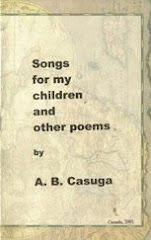
ALBERT B. CASUGA, a Philippine-born writer, lives in Mississauga, Ontario, Canada, where he continues to write poetry, fiction, and criticism after his retirement from teaching and serving as an elected member of his region's school board. He was nominated to the Mississauga Arts Council Literary Awards in 2007. A graduate of the Royal and Pontifical University of St. Thomas (now University of Santo Tomas, Manila. Literature and English, magna cum laude), he taught English and Literature (Criticism, Theory, and Creative Writing) at the Philippines' De La Salle University and San Beda College. He has authored books of poetry, short stories, literary theory and criticism. He has won awards for his works in Canada, the U.S.A., and the Philippines. His latest work, A Theory of Echoes and Other Poems was published February 2009 by the University of Santo Tomas Publishing House. His fiction and poetry were published by online literary journals Asia Writes and Coastal Poems recently. He was a Fellow at the 1972 Silliman University Writers Workshop, Philippines. As a journalist, he worked with the United Press International and wrote an art column for the defunct Philippines Herald.

Friday, September 18, 2009

PART 8 LITERARY CRITICISM: CRITICIZING TECHNIQUE IN FICTION --- EFFECTIVE CHARACTERIZATION

PART 8 LITERARY CRITICISM: CRITICIZING TECHNIQUE IN FICTION --- EFFECTIVE CHARACTERIZATION

The believability of the story depends a lot on the type of characters used by the artist and how he characterizes them (or how he shapes them up so they would “appear” capable of doing what they are made to do in the story).

TYPES: The story writer may use any of the following types of characterization:

1. Descriptive Characterization

a. Round. When the character received full characterization on all levels (physical and psychological) and in all manners (direct – physical description through the author’s exposition, mental limning, dialogue and accompanying description of manner of speech, and physical description of character made by other characters in the story; indirect – through testimony of other personae on the personal idiosyncrasies of the character, through the author’s exposition on the significance of the character’s actions, through the character’s actions and reactions to certain given conditions in the plot). Main characters --- protagonist and antagonist --- should receive this type of characterization. The rounder they are, the more developed they would appear, hence, would be more believable.

b. Flat. When one of the outstanding aspects of the character is emphasized --- for instance, his physical assets --- he is said to be a “flat” character. While this may sometimes be considered a weak point in characterization, especially when the character involved is a major persona, it may also be deliberately used to portray some narrow-minded character, or some such uneventful character.

2. Characterization through Action

a. Developing Character. When the character evolves or changes in the process of unfolding the plot because he is affected by the events, he is said to be “developing.” This means, he does not remain the same throughout the story, but that he is transformed by the course of events because they were deliberately introduced to change him. Major characters in the story are normally developing characters.

b. Static Character. As the label implies, this type of character remains unchanged throughout the story. Minor characters are usually this type so they would not overshadow the major character who is, after all, responsible for carrying out the main action of the story; i.e., he figures in the main conflict, changes it, or is changed by it. In the case of the major characters, static characterization is often considered a fault unless this is called for by the subject matter or role played by the character.

3. Roles.

a. Protagonist. In layman’s language, he is the “hero” of the story. However, this does not mean that he has the classical traits of the hero. He is simply the major character who must be the main actor of the main line of conflict, and he is the persona around which most of the actions revolve. As a main character, he is said to be an effective protagonist if he is responsible for the advancement of the action towards its logical conclusion in the climax.

b. Antagonist. He opposes the actuations of the protagonist. He provides the obstruction to the protagonist’s plans or line of action so that conflict may arise. The conflict is not dramatic --- and often uninteresting --- if the antagonist does not provide an opposing force. The antagonistic force may be other than human beings; calamities, fortuitous circumstances beyond the characters control (not Deus ex Machina, or fate); they may also be the protagonist’s psychological condition so that he goes against himself as in cases where the ego and the super-ego clash; they may also be spiritual forces like the Gods or belief, or entertainment of deity who interferes with the affairs of men.

c. Minor characters. They may be used to provide:
(a) Foils. Characters that have opposite traits are harnessed so that the author may succeed in contrasting them for the sake of clarity, distinctive characterization, and conflict. One makes the other more distinctive.
(b) Confidant/e. May be used by the author to provide characters on whom some major personae may confide the things in their minds which should otherwise remain unrevealed (in stories which make use of the Objective-Witness point of view, this may be a way through which the mental state of a character could be revealed).
(c) Commentators. They may serve a function similar to that assigned to the Greek Chorus, in that they supply the narration of certain actions that would subtly advance the action or observations which would lead to a more vivid characterization, or they may simply be there to provide authenticity to the locale (as if they were part of the fiction’s furniture).

METHODS OF CHARACTERIZATION

1. Direct. When the author himself undertakes the description through his expositions, the characterization is said to be direct. It could take the form of either physical or psychological description of the character. For example:
a. Physical: “He accosted me with excessive warmth. He had been drinking much. The man wore motley. He had on a tight-fitting party-stripped dress, and his head was surmounted by the conical cap and bells.” (Description of Fortunato in “The Cask of Amontillado”)
b. Psychological: “He had a weak point --- this Fortunato --- although in other regards he was a man to be respected and feared. He prided himself on his connoisseurship of wine. Few Italians have the true virtuoso spirit…in painting and gemmary, Fortunato, like his countryman, was a quack --- but in the matter of old wines, he was sincere.” (From “The Cask of Amontillado”)

2. Indirect. The author may limn the character through the latter’s manner of speech;
For example:
“P-p-p-lease, a-a-a-accept m-m-m-my a-a-a-apologies, M-M-M-Madam, b-b-b-but I-I-I wa-wa-wa-was na-na-na-napping… (Without saying he is a stutterer, the fact may be seen from the manner of speech. This could also reveal dread in the one talking.)

Or, in the observation of others about the personality of the character. The character may also be revealed by what he does under certain defined circumstances --- his actions and reactions.

Indirect characterization may also be both physical and psychological, but all the while, it must be done by somebody else other than the omniscient author.

QUALITIES OF FUNCTIONAL CHARACTERIZATION

1. It must draw the character vividly.
2. It must make the character alive and active.
3. It must be unobtrusive. It is not a forced effort on the part of anybody to reveal the likes of a character without any need for it.
4. It must be consistent to the demands of the subject matter. If the subject matter calls for an intelligent but cold-blooded criminal, at no time should characterization show the character as wavering, unsure, or a bumbling clown.
5. It must make the character believable in such a manner that he acts according to the demands of the situation and to his natural disposition as spelled out by hi role in the story.
6. It must contribute to the objectification of the theme.

These are common denominators for all the fiction written in the different stages of literary development (from Classical to Modern and Post-Modern). There may, however, be some peculiar qualities demanded by other Art Periods, Moods, or Traditions; for instance, in the Absurdist Tradition, the characters need not be consistent to the logical bend of their character. By reason of their absurdity, they violate the line of action that they should normally take in realistic fiction. Thus, they may say nonsensical things or act in a ridiculous manner where the word not suit the actions and vice versa. Obviously, in the case of this type of fiction, the rules may not apply. We hasten to say that this does not necessarily make this type of literature inartistic. But this is subject for another discussion.

SUMMARY OF CHARACTERIZATION IN FICTION

Types: Descriptive: Round, Flat. Characterization through Action: Developing, Static. Roles: Protagonist, Antagonist, Minor (Foil, Confidant, Commentator)

Methods: Direct: Physical, Psychological. Indirect: Physical, Psychological (through other characters other than the author)

Qualities: Vivid, Alive, Active, Unobtrusive, Consistent, Believable, and characterization contributes to objectification of the theme or germ of idea being related through the story.


Next: Part 9 Literary Criticism: Criticizing the Scale of the Fiction and Other Techniques

Thursday, September 17, 2009

PART 7 LITERARY CRITICISM: CRITICIZING TECHNIQUE (FICTION) --- WHAT IS AN EFFECTIVE PLOT?

PART 7 LITERARY CITICISM: CRITICIZING (TECHNIQUE) FICTION
--- WHAT IS AN EFFECTIVE PLOT
?

The plot, as a series of actions in the story, is the backbone of any tale. Grandma’s tales have always been riveting because they would always answer the question of the toddlers gathered around her knees: What happened, abuela? What’s going to happen next? And then…

No story has escaped this essential requirement. Hence, if there is action, there must be a sequence articulated by the author in the order that achieves “verisimilitude’ (art imitating life or a slice of life objectified in the art work.)

Order and Arrangement of Actions. The actions in the plot would be more believable if they were arranged in such a manner that there would be clarity, continuity, drama (there is reasonable pitting of conflicting motivations and interests among the characters), and causality.

The exposition must be situated in the story so as to give a narrative background of the inciting force or initial action. It may occur in the beginning of the story prior to the initial action, or it may be in a narrated past event (flashback), depending on whether or not it succeeds in giving adequate background for any action that demands explanation so that this may become relevant to the story.

The inciting action (initial action) must be reason enough to cause the ensuing conflicts which form the substance of the story. Since it is the principal cause of the drama, it must be significant enough to trigger succeeding actions. This is a measure of its effectiveness.

The complications or conflicts must result from variance of interests among characters and forces which figure in the story. They must be dramatic in such a way that a problem which cries for a solution or conclusion arises. Conflict is usually characterized by interest, suspense, and dramatic opposition among forces. These must conform to the nature of the characters and the demands of the plot so that it (plot) may make the subject matter believable.

The turning point is said to be effective if it reaches a level of interest which promises a decisive change in either the action or the characters. This change must provide the solution to the problem which has reached a fever point in this critical level of the story. It is the promise of a change which makes the discovery in the climax significant. Otherwise, without this change, there would be no story, there being no movement.

The climax is the resulting action which is caused by the conflicts and promised in the turning point. It is the change in the story. It concludes the movement of actions. It is said to be effective when it is the logical conclusion that naturally follows from the nature of the conflicts; and it provides a convincing and significant transformation of things in the story.

The denouement or resolution is deemed effective if it succeeds in levelling off the fever-pitch of emotion that has been aroused through the pace of the story. It should explain the effect of the change on the situation or on the characters. An effective denouement may also provide an explanation for the turn of events from the initial action through to the climax.

The narrative is usually arranged chronologically. It may sometimes be arranged in medias res (the story begins in the midst of actions and goes back to the causes of the action which may even become the climax).

Logical order may take the form of the story starting from the conclusion or climax and going back to the details or causes of the finale; or vice versa.

Psychologically, the story may be arranged according to the thought patterns of the characters or the author. (For instance, in “The Sound and the Fury" by William Faulkner, the story of the degeneration of the Compson family was told through the different streams-of-consciousness of the idiot, Benjy, and his brother, Quentin. In J.D. Salinger’s “The Catcher on the Rye,” the episodes are arranged according to the memory patterns of Holden Caulfield, the principal character).

That order which best suits the demands of the subject matter is said to be effective. For instance, if the subject matter is a step-by-step description of the commission of a crime as in “The Cask of Amontillado”, the author is expected to relate the story in the order in which the steps happen. In this manner, the reader may feel as if he is himself performing the perfect crime. Because of this, the story assumes greater believability and emotional effect.

Next: Part 8 Literary Criticism: Criticizing (Technique) Fiction --- Effective Characterization (Types and Methods).

Wednesday, September 16, 2009

PART 6 LITERARY CRITICISM: CRITICIZING TECHNIQUE (FICTION) --- THE EFFECTIVE POINT OF VIEW

PART 6 LITERARY CRITICISM: CRITICIZING TECHNIQUE (FICTION)
--- THE EFFECTIVE POINT OF VIEW

Point of view in fiction means the angle through which the story is told so that it may create the illusion of believable reality. This “believable reality” may not necessarily be an “imitation” of external reality as we know it. It is a reality which comes naturally from the logical dictates of the subject matter as well as the nature of the characters, plots, and settings as they were constructed.

For instance, if the character is insane, he cannot now be acting like a sane man in the story unless a specific change in the course of the story has been introduced to justify this. An unwarranted vitiation of a character’s nature would be violation of the purpose of creating a verisimilitude out of the artist’s chosen experience.

Point of view may be omniscient or all knowing; objective or third-person witness; protagonist or first person.

Omniscient Point of View. The omniscient point of view is generally demanded by stories where the author must see all the actions occurring, internal and external, so he could explain the process of action in the plot as he tells the story.

Protagonist Point of View. This view is where any of the major characters recount the story because the author believes that the closer the narrator of story is to the actions, the more convincing the story would become.

Objective-Witness Point of View. The objective-witness point of view uses a narrator who does not actively participate in the actions of the story although he is a character, and he simply relates the actions as he sees them externally without commenting on the implications or significance of the actions. He relates only those aspects known to him. His limited viewpoint may also make certain stories believable in that these are normal occurrences seen by a witness who happens to have been there when the events took place.

Choice of point of view is ordinarily governed by:

1. Demands of the Subject Matter. Example: Psychological subject matter might demand the omniscient point of view because the author has to see through the minds of the characters. For instance, in “Candido’s Apocalypse” by Nick Joaquin, the author has to see through the disturbed mind of Bobby Heredia in order to tell the story of how this adolescent reacts to his convictions that finally identify him with the “phoney” world he disdains as a schizophrenic idealist. 1

2. Believability. Is it qualified as a point of view by virtue of the competence of the story teller? For instance, “The Cask of Amontillado” by Edgar Allan Poe uses a protagonist point of view because it is about the commission of a perfect crime (the narrator's crime). If somebody else told it aside from the perpetrator of the crime --- maybe the author in his characteristic omniscience, or a third person as a witness --- it would no longer be a perfect crime because somebody else knew about it.

3. The Objectification of the Subject Matter. A narrator who is considered competent goes a long way in creating a story that could stand on its own in that it is palpable, probable, and credible. It is an objectified theme or idea that has a verifiable being in terms of the actions in the plot, the characterization through acts of commission or omission, its possible occurrence in a locale, and its objective existence as a “virtual reality” that has a life of its own.

4. The establishment of a verisimilitude. Example: In “The Killers” by Ernest Hemingway, the point of view is that of a disinterested witness who matter-of-factly tells the story of a plot to slay a resigned Ole Andreson. This point of view lends credence to the general mood of indifference and diffident non-involvement of the characters in the affairs of their neighbours. The witness point of view helps in creating the theme of “ineffectuality of human relationship” into a palpable reality so pervasive one can almost feel it.

Note:

1 Nick Joaquin, “Candido’s Apocalypse,” The Philippine Free Press, December 11, 1965. Page 9 etseq.


Next: Part 7 Literary Criticism: Criticizing Fiction – What is an Effective Plot?

Tuesday, September 15, 2009

PART 5 LITERARY CRITICISM: CRITICIZING TECHNIQUE IN FICTION

PART 5 LITERARY CRITICISM: CRITICIZING TECHNIQUE IN FICTION
(What is Technique? What are the Elements of Technique?)

What is technique?

Technique refers to the manner in which the artist articulated and presented his selected materials in terms of his media and content.

Two aspects are important here:

1. Articulation --- how he put his materials together such that there would be an objectification and subjectification of the experience.

2. Presentation --- how he arranged the materials so that they would assume a clear, integrated, and harmonious form wherein the medium shapes the content, and vice versa. (These qualities are what characterize the beautiful, according to St. Thomas: claritas, integritas, consonantia. “Id quod visum placet.”)

When the artist articulates his materials, he is governed by certain rules of dexterity which vary from art form to art form, from Art Period to Art Period, and sometimes from artist to artist. Thus, the technique in painting would be different from poetry; although, one is aware’ of course, of certain experiments of the Surrealists, Symbolists, and Imagists in the visualization of their ideas in terms of the arrangement of lines and orthographic symbols on the printed page. Ideography has suggested a manner by which painting and poetry could make use of the same principles of visualization. 1

Among these rules of articulation, of course, are the rules of grammar which are fundamental. The rules of speech will go a long way in the determination of rhyme and rhythm which may prove helpful in the objectification of an experience. The rules of linguistic usage are part of those which govern the use of words, sentences, punctuations, and the like, in the work of art. There are rules of composition for the different fine arts. Literary composition postulates: effective sentence writing results in effective paragraphs provided there is an effective development of topic sentences; compositions are effective if they have unity, coherence, and emphasis.

These rules, of course, are a matter of convention, and the artist may choose to violate them for the purpose of amending them in order to arrive at a clearer manner of expression, hence, better communication.

Presentation refers to the arrangement of the selected materials such that they would have the order, scale, point of view, characterization, and plot arrangement which would be consistent to the demands of the artistic purpose of objectifying the aesthetic experience being conveyed to the appreciator.

Again, presentation would vary from art to art, and from Art Period to Art Period --- for instance, the presentation of sculpture is different from painting in that the former has three dimensions normally if it is the round, and the latter, two dimensions (the third, that of depth is simulated in terms of primary materials of colours, lines, and chiaroscuro).

For our purpose, we limit this discussion to technique in fiction. The elements of technique in fiction may be summarized as follows:

TECHNIQUE

A. Point of View: Omniscient, Protagonist, Objective Witness

B. Order: Chronological, Logical, Psychological, In Medias Res (ongoing action). Arrangement of actions in the plot: exposition, initial action, complications, turning point, climax, denouement (resolution).

C. Characterization: Direct, Indirect, Physical, Psychological, Dialogue, Exposition, Testimony of other characters

D. Scale: Length of story, length of episodes, narratives, expository sections, paragraph and sentence structures, words as they appear on page

E. Other Techniques: From literary tradition and practices, from favourite authors, etc.

Since technique is the most apparent and external aspect in the objective form (the story, poem, novel, drama), it should receive the artist’s greatest attention. An interesting form is made doubly so by an interesting technique, the art work’s faces, as it were.

Note:

1. Modern poetry makes use of ideographic devices to visualize on the page an abstract idea. The Surrealists, like Apollinaire, pioneered in this. The Imagists, under the influence of T.E. Hulme, also practised this. Ezra Pound, Oscar Williams, William Carlos Williams, E.E. Cummings, and even D. H. Lawrence used this device. It takes the form of orthographic arrangements on the page in order to concretize an otherwise abstract idea or mood, whatever it is the artist would like to convey. Ideographs like Chinese and Japanese characters “picture” ideas with the strokes of the arranged lines.


Next: Sectionalized discussions of the Elements of Technique in Fiction, and the artistic norms that make them effective. This Section One on Criticism of Fiction is rounded up by a Practicum.

Section Two of Literary Criticism will be on the Criticism of Poetry.

Monday, September 14, 2009

PART 4 LITERARY CRITICISM: FOCUSING ON THE ELEMENTS OF STYLE

PART 4 LITERARY CRITICISM: FOCUSING ON THE ELEMENTS OF STYLE

What stand out as the elements of style from the preceding discussion would be: use of language---verbal and orthographic; use of figures and images; and use of symbols.

1. Language. As far as language is concerned, that of prose varies from that of poetry. What is common between them, however, is that both have particular rhythms and degrees of concentration.

Poetic language is concise and highly “charged” in that it aims to be hard in imagery. Prose tends to specify qualifications in terms of modifiers sometimes at the expense of conciseness. Poetic language is calculated to directly affect the emotion, while prose’s appeal is ultimately to the intellect. Of course, poetry’s ultimate appeal, too, is to the intellect.

Verbal energies of the language refer to the significance ordinarily attached to the sound of the letters as they become components of words. The phonemes in any language assume meaning from the manner they are inflected to the duration of their phonation. For instance, the short o (as in pop) is not half as successful in expressing a depressed as the long o sound in “moan”. It also refers to the language’s use of the organized sounds in the word components (e.g., alliteration, onomatopoeia, assonance, and consonance), rhyme, and rhythm. Rhyme is normally absent in prose but may be used as a sound device and as a unifying element in poetry. Rhythm in prose is most useful in the objectification of thought and feeling. For instance, short sentences that provide the staccato effect may exude the idea or mood of something businesslike, brisk, and uncaring. Hemingway is known to be fond of these bare, bald, fast rhythms which have a way of unmistakably expressing the “grace under pressure” of many of his alienated characters like those of “A Clean Well-Lighted Place.”

The orthographic energies of language extend from the significance achieved through the visual appearance of the letters, words, sentences, paragraphs, and entire sections of composition on the page to the use of mechanical language devices like the punctuations (See Sensory-Impressionistic Level of Analysis in previous discussion of the concept of analysis in literary appreciation.)

2. Figures (of language, speech, and thought) make up the images. They are largely responsible for concretizing an otherwise abstract experience. The more vivid these are, the easier for the appreciator to visualize and appreciate the experience being conveyed.

Symbols in terms of situations or ideas are also useful in the objectification of an experience. In Edgar Allan Poe’s “The Cask of Amontillado,” the description of Montresor’s family seal is one such symbol. It shows a snake whose head is being crushed by a heel but, at the same time, the snake has succeeded in embedding its fangs into the heel. This is an eloquent expression of the Montresor motto: Nemo me impune lacessit. (No one hurts me with impunity. This helps characterize Montresor as one who would not take an insult lying down. This further explains Montresor’s motivation of murdering Fortunato at the catacombs.) 1

3. Vision of the Artist. As far as the other aspect of style is concerned, the selection of concretizing elements depends largely on the vision of the artist. One who has a narrow view of the human condition is ordinarily inferior to one whose vision is prodigious; one who has a meagre stock of experiences would find himself less successful than one who has a vast store of primary and/or vicarious experiences.

In poetry, these objectifying details are the images used. In fiction, these are: Subject Matter; Plot; Characters; and Setting. The experience with which the short story writer, dramatist, or novelist might want to convey normally begins in his mind as a “theme” or a germ of an idea, or a feeling, or an attitude. This theme determines the subject matter which may either be a universal human experience or a particular one. The human experiences may be something familiar or esoteric depending on the theme being objectified. The subject matter is the first device which the fictionist uses in order to concretize or objectify his otherwise abstract theme (the root of his aesthetic experience, a realization which he would like to convey to his audience).

The subject matter determines the plot or the series of action that would make the subject matter believable and virtually “real.” The plot may consist of an exposition (the history or background of the first action done in the present context of the story), the initial or inciting action (which causes the complication of the action in that it breeds a series of character interaction or what is also known as the rising of the action or complication or conflicts (man vs. man, man vs. nature, man vs. animal, man vs. God, man vs. himself, etc.), the turning point (that action in the story which promises a change in the current of the plot or in a major character), the climax (the result of what was started, complicated, and promised in the turning point --- what is sometimes called the epiphany or the discovery. There is a definite conclusion which results in either the change of situation or character from the actions which have been coagulated), and finally, the resolution or denouement which shows the effect of the climax on the characters or on the action of the story. 2

The plot usually determines the types of characters who would act out the activities in the series of actions. These characters should be capable, by their nature, of accomplishing the actions assigned (by the author) to them in the plot. All their actions should thereafter be consistent to their natures in order to make them believable. The more believable the characters are, the more believable should the plot also be.

Since all these actions will have to take place somewhere --- they cannot happen in a vacuum --- they will have to take place in a definite locale described by the author. The setting must be such that the actions can happen there convincingly. It must also help advance the plot by making the occurrences happen believably in point of place and time.

In the selection of these details, the artist must be guided by the following rules so that these materials may achieve the purpose of fiction which is to create a verisimilitude or a believable reality out of the virtual reality reflected or objectified in the objective form (the short story, drama, or novel in this case);

In order to make the story convincing, the artist must make sure that:

A. The Subject Matter:
1. fulfills the demands of the theme for objectification;
2. is adequately familiar as an experience;
3. is convincing or believable;
4. is the principal device for creating the virtual reality into a verisimilitude.

B. The Plot:
1. fulfills the demands of the subject matter by putting a figure on the experience used;
2. consists of actions that flow naturally from the characters’ peculiar make-up, type, or personality;
3. is believable or convincing according to the logic of the experience in the subject matter;
4. contributes to the creation of a verisimilitude; and
5. contributes to the objectification of the theme.

C. The Characters:
1. All the above except No. 2;
2. must advance the actions by what they do. They are responsible for the flow of the action. It is their decision and efforts which cause the action. Actions must proceed out of their nature.

D. The Setting:
1. All the above.
2. must help advance the action; i.e., the actions can happen ordinarily in such a setting;
3. must be consistent to the demands of the subject matter, plot, and characters; i.e., they contribute to the occurrence of believable action.

Summarizing the elements of style, they may be restated in the following organization:

STYLE

A. Diction: formal, informal, neutral; dialogue lines

B. Symbols: Images, Conventionalized symbols

C. Linguistic Devices: Literary (denotations, connotations, figures); Verbal (phonemes, organized sounds – alliteration, onomatopoeia, assonance, consonance), Rhyme (couplet, tercet, quatrain, quintet or quintain, sestet, septet, octet or octave, etc., masculine, feminine, full or half rhyme) Rhythm (Foot: iamb, trochee, anapest, dactyl, spondee, phyrric, amphibrach; Metre: mono, di, tri, tetra,penta, hexa, hepta, octa, nona, deca metre)

D. Selected Details: (Fiction) subject matter, plot, characters, setting; (Poetry) Central image or primary structure, minor structures or images.

Notes:

1 Edgar Allan Poe, “The Cask of Amontillado,” Introduction to Literature: Stories. Altenbernd & Lewis (Eds), MacMillan co., USA, 1969. Page 3.

2 Ibid. See Altenbernd & Lewis, Introduction to Literature: Stories for a discussion of the elements of fiction.


Next: Part 5 Literary Criticism: Criticizing Technique (What is Technique? Elements of Technique).

Sunday, September 13, 2009

PART 3 LITERARY CRITICISM: CRITICIZING STYLE IN FICTION

PART III LITERARY CRITICISM: CRITICISING STYLE (FICTION)

What is style?

In an essay on What is Style, F. L. Lucas said: “Style has got bad name by growing associated with precious and superior persons who, like Oscar Wilde, spend a morning putting in a comma, and the afternoon (so he said) taking it out again.”

But that is obviously abuse of style.

“For the word means merely “a way of expressing oneself in language, manner or appearance; or, secondly, “a good way of so expressing oneself.’ “Lucas wrote.

If then style is a manner of expression, in literature it must be the use of the medium --- language --- and the selection of concretizing details which find their base in the author’s experience, his way of life, and his entire personality. The medium must be so used to unmistakably objectify the aesthetic experience which the artist would like to communicate. The details used must likewise be necessary and adequate in carrying out the same purpose.

What kind of language is used? Is it the language that could best express the experience being objectified? Are the verbal and literary energies of the language so manipulated and articulated as to objectify and emotionalize the experience being communicated through the objective form (artistic result)? Is the diction used appropriate? Effective? Adequate? Does the artistic use interesting and original manners of symbolization in order to objectify the experience? Is there clarity of expression, such that the meaning is derivable unmistakably from the various words, sentences, paragraphs, or stanzas, and the entire composition? Is there integrity or coherence? Is there a harmony of parts or materials used?

These are questions that are normally answered in the criticism of style or the use of medium and content. Of course, as was explained earlier, the criteria for judging the effectiveness, adequacy, and appropriateness of language devices vary from Art Period to Art Period in the various stages of literary development. (Literary history classifies these into: Classicism, Medieval (Gothic), Renaissance, Naturalism, Impressionism, Symbolism, Expressionism, Surrealism, Vorticism, Futurism, Dadaism, Existentialism, Populist Art, Revolutionary Art, etc.). 1

Therefore, the critic must find his standards from those criteria which were used during the time the work under consideration was done. Of course, there are common denominators of how well they serve the artistic purpose as devices of media. This stems from the fact that all art from Classicism to the present still engage in the objectification of the artistic experience.

To illustrate the above, the critic might come across legislative criticism like the following during the Elizabethan Period (Renaissance Humanism abounded):
“Our proportion poetically resteth in five points: staff, measure, concord, situation, and figure.” --- George Puttenham, The Arte of English Poesie (1589)

“Frame your stile to perspicuity, and to be sensible.” --- George Gascoigne, “Certain Notes of Instruction Concerning the Making of Verse,” Poesies (1575)

“We should not so soone yield our consents captive to the authoritie of antiquitie, unless we saw more reason; all our understandings are not built by the square of Greece and Italie. We are the children of nature as well as they.” --- Samuel Daniel, “A Defense of Ryme,” a reply to Campion in his Panegyrike to the King (1603) 2

Then again, the criticism of style varies according to the type of criticism the critic is employing. If he is using legislative criticism, it is possible that he would be dictating how the work should have been written according to well-established standards; if he is using theoretical criticism, he would be discussing the nature of the work in general and comparing how the wok under consideration stands vis-a-vis other pre-existing forms; if he is using descriptive criticism, he would be analyzing the use of medium as well as judging the content in the selected details and showing the reason why they were used at all. (See George Watson, The Literary Critics, Penguin Books, for extensive discussion of these types.)

The type of criticism one would find profitable in the formal approach would probably be a cross between theoretical and descriptive criticism since the analysis will have to depend on a literary theory as a springboard of dissection.

Legislative criticism is hardly functional in this approach because the use of media and content varies according to the purpose of the artist as well as the demands of the experiences being objectified. Besides, legislative criticism is deductive, while the formal approach is inductive.

Notes:

1 For workable definitions, consult any dictionary of art or literary terms. See Beckson & Ganz’s A Reader’s Guide to Literary Terms.

2 Elizabethan Critical Essays edited by G. Gregory Smith, 2 vols. (Oxford 1904) I, 53, 212; II, 68, 330-1; 366-7.


Next: Part IV Literary Criticism: The Elements of Style in Poetry and Fiction

Friday, September 11, 2009

PART 2 LITERARY CRITICISM: DISCOVERING THE ARTISTIC PURPOSE

LITERARY CRITICISM PART 2: DISCOVERING THE ARTISTIC PURPOSE AS A BASIS FOR CRITICISM

The preceding discussion on the nature of criticism singles out as its first step the definition of the purpose of the work of art from the work itself. Inductively, the appreciator arrives at this during analysis.

The question is, will he arrive at this? Will not the induced purpose vary from that of the artist’s? If what he induces varies from that avowed by the artist, will this render appreciation invalid?

In the first place, what is that purpose supposed to be? For our purposes – in the empirically-based appreciation of literature – it is what the author intended in presenting the work for appreciation. But is that information not derivable only from the author? If it were, then criticism will be of no moment – it will have started on the wrong footing, and would naturally end up with the wrong conclusion; hence, it would be futile and useless.

Literary history, however, provides ample evidence that the activity has prevailed to complete the tripartite relationship that must be endemic in any activity that involves literary appreciation: the artist, the critic, and the appreciator. The critic is the man in the middle whose function is to assist the undiscerning appreciator. This has become imperative because the growth of the artist’s awareness of things has not been in direct proportion to the growth of the appreciator’s. In many cases, critics have shown a more rapid development in this regard than even the artists themselves – because many of these critics are also creative artists (T.S. Eliot, Robert Penn Warren, Edgar Allan Poe, Archibald MacLeish, Gemino Abad, Edith Tiempo, to name a few).

To answer the first question, it is important to believe with F.R. Leavis that this purpose is derivable --- and the source may not be the author but the objective artistic result itself, the work of art that confronts the appreciator.

“But what I have to insist on is that intention in the important sense can only be determined by the tests applied in literary criticism. The analysis and judgment of works of literary art belong to the literary critic, who is one in so far as he observes a disciplined relevance in response, comment, and determination of significance. He is concerned with the work in front of him as something that should contain within itself the reason why it is so and not otherwise.

“The more experience --- experience of life and literature together --- he brings to bear on it the better, of course; and it is true that extraneous information may make him more percipient. But the business of critical intelligence will remain what it was: to ensure relevance of response and to determine what is actually there in the work of art.

“The critic will be especially wary how he uses extraneous knowledge about the writer’s intentions. Intentions are nothing in art except as realized, and the tests of realization will remain what they were. They are applied in the operation of the critic’s sensibility; they are a matter of his sense, derived from his literary experience, of what the living thing feels like --- of the difference between that which has been willed and put there, or represent no profound integration, and that which grows from a deep centre of life. The tests may very well reveal that the deep animating intention (if that is the right word) is something very different from the intention the author would declare.” (Leavis as quoted by H. Coombes in Literary Criticism. Page 9 (Underscoring supplied). 1

In quoting the above, Mr. Coombes is practically assuring the reader that such a purpose may be derived from the work. And this purpose, as has been stated earlier, is ordinarily pegged to the common purpose of all works in fine art: To objectify and subjectify (concretize and emotionalize) an otherwise abstract aesthetic experience for the purpose of soliciting or engendering aesthetic delight in the artist as well as in the appreciator.

It is the achievement of this purpose which is judged by the critic. Quite obviously, the purpose includes within its purview the achievement of that which is artistic --- that which is objectified to convey an aesthetic experience to the appreciator (or even to the author-artist himself) so that he may experience a satisfaction of his aesthetic attitude (taste). Therefore, the appreciator is judging the achievement of the artist along the lines of artistry --- the skill he applied into the work of art.

This is the purpose which becomes the basis for what Mr. Leavis terms the “relevance of response,” something the critic must work for in his readers. This “relevance of response,” according to Mr. Coombes, is the central point in literary criticism: it is in the words of the writer, in his choice, ordering, and organization of language, that his worth shows itself --- as a literary artist expressing experience worth our deepest attention, he matters there or not at all.” 2 (Ibid, Pg. 11)

In other words, in the Style and Technique. How is the artistic purpose achieved by the artist in terms of his style and technique?


Next: Part III Literary Critcism: The Criticism of Style and Technique

LOL Literatures in Other Languages: Azade Seyhan

LOL Literatures in Other Languages: Azade Seyhan

WRITING OUTSIDE THE NATION

Thursday, September 10, 2009

A THEORY OF LITERARY CRITICISM IN AN EMPIRICALLY-BASED APPRECIATION OF LITERATURE: PART I, SECTION 1: CRITICIZING FICTION

The following series resumes the serialized discussion of the Levels of Literary Appreciation based on the author’s The Aesthetics of Literature: the Concept of An Empirically-Based Appreciation of Imaginative Literature.

Preceding discussions in this blog were on literary analysis as a basis for criticism. The final part will be on the theory of literary evaluation as a by-product of literary appreciation in the study of literature as humanistic discipline.


A THEORY OF LITERARY CRITICISM IN AN EMPIRICALLY-BASED APPRECIATION OF LITERATURE: PART I SECTION 1: CRITICIZING FICTION

In an empirically-based appreciation of literature, criticism is a mode of evaluation which involves the rendering of a judgment on the formal value of the artistic oeuvre.

In other words, while it is a form of evaluation, it is different from the third level (Evaluation) in that it is a critical judgment on the excellence of the artistic effort involved in the articulation of the various elements of the medium and content in order to achieve the artistic purpose of objectifying and emotionalizing an aesthetic experience. The third level focuses its attention on the worth of the experience or reality which was shaped up through a certain style and technique.

The artistic effort being judged here refers to the artist’s application of skill --- his style and technique. These are ultimately the repositories of what is considered artistic in the wok. Artistry is not found in the experience being configurated. It is reflected in the formation of the experience, in the application of artistic skill. Therefore, artistry is reflected in the artist’s style and technique.

Criticism in an empirically-based appreciation of literature is primary formal in its approach; i.e., it begins a posteriori (inductively) with the objective form – the art work (a phenomenon with a definite, particular “being” concretized by the objective elements of medium and content).

Because it is formal (i.e., addressed to the concrete form – the poem on the page, the sculpture in the round, etc.), it is often referred to as “objective criticism.” “Objective criticism of literature is criticism based upon qualities demonstrably present in the literary work, not qualities present in the writer or reader… Such a criticism requires that a reader know what the literary work was intended to do, whether it succeeded in doing it, how its various parts contributed to or hindered that operation.” (Duhamel & Hughes, Literature: Form and Function.) 1

The requirements mentioned in the directly preceding paragraph demand that analysis precedes criticism, because it is in analysis where the appreciator would get acquainted not only with the meaning of the work, but also with the purpose or intention of the artist and the various parts utilized in achieving his artistic purpose.

After the analysis, the appreciator normally arrives at a synthesis of what the artist has been trying to convey (the idea, the theme, the experience); he (the appreciator) will also recognize that ordinarily the purpose of the artist is to objectify or concretize this experience so that it may be transferred to the beholder in a palpable fashion since it is only in this form that the experience becomes specifically meaningful.

If the purpose of the artist is to objectify his aesthetic experience so that this may be perceived by the appreciator for his delight, it follows that criticism of the work will have to be based or whether or not this purpose was achieved in terms of the artistic materials (medium and content) available to the artist and recognized by the appreciator in the course of analysis. In brief, the appreciator will now make a judgment on: l) how well the artist’s style served the artistic purpose of objectifying the aesthetic experience which is being conveyed to the beholder; and 2) how well the technique served the artistic purpose of objectifying the same experience.

As common denominators, the outstanding qualities which become the criteria of how well the style and technique serve the artistic purpose are: whether or not the various media-elements are (1) effective (capable of exciting aesthetic delight – which is ultimately personal in that it appeals to the educated taste), (2) necessary (that they are a sine qua non to objectification), and (3) adequate; and whether or not the formulation and presentation of these elements are necessary, effective, and adequate.

These qualities, however, vary from art form to art form, from Art Period to Art Period. In other words, there are particular genre standards that are peculiar to each of the different stages of literary history; for instance, the qualities of an artistic style during the Classical Period may be radically different from that of the Romantic Period.

Because of the preceding, it would be imperative for anyone who might want to criticize literature for a keener appreciation of the art to (1) have a clear conception of what literature is (literary theory) and what it can do (its function); (2) to know his literary history; (3) and, to understand the aesthetics of literature – the modes of literary appreciation, the qualities to appreciate in good literature, and the criteria for valuable literature on three levels: universal values, formal or genre values (what makes a good poem, short story, novel, drama, and essay), and personal values (those peculiar to the biases and prejudices of the reader who has had a liberal sampling of literature in the different literary forms. 2

This preparation is necessary because a “good literary critic, when he is practising his art – that is to say, when he is committing his criticism to paper—is characteristically engaged in doing two things: he gives us, as completely and as clearly as he can, his considered response to a short story, to a play, a novel, a poem, and essay, so he can help us to a fuller enjoyment and understanding of the experience in and behind the writing; (and/or, he reveals, by examining a piece of writing in detail, the elements in the writing which combine to make its particularly quality.” (H. Coombes, Literary Criticism) 3

Such a preparation will naturally make criticism fair and intelligent, because, after all, the work of art – it is assumed – was done in fairness and with great intelligence. Of course, before one should waste one’s time on criticizing the work, he should at least have been able to determine through analysis if there is reasonable significance in the work which is worth spending one’s precious lifetime on.

Then again, in the words of T. S. Eliot (“The Use of Poetry and the Use of Criticism,” Selected Essays) “criticism must always profess an end in view, which, roughly speaking, appears to be the elucidation of works of art and the correction of taste” 4

One cannot hope to explain the beauty of an artistic product if one does not know what makes it beautiful; nor would one be capable of correcting misguided or unguided appreciators’ tastes, if one does not have an impeccable and intelligent taste in the first place.

But why should one engage in criticism in order to appreciate a work of art? Is that not making the process more complicated? Rather than think criticism is a complication, the student of literature should take it as an effort towards making the appreciation keener and more intelligent as appreciation must be keen and intelligent. (only man can appreciate. He is not about ready to default on this virtue which distinguishes him from the primates). If it is a rational activity at all, it might as well be a reasonable and reasoning one. In higher education, it is the student’s proper activity anyway.

“Especially for the beginning student of literature today, faced with a rapidly growing diversity of literary works and qualities, and too often introduced to them only through a hasty and meaningless survey of names, titles, and other routine external data, the main value of studying criticism is that it may arouse in him the desire to think through what he is reading in literature generally, and sharpen his ability to do so. Its first and most important fruit is to make him realize that evaluation – seeing things for what they are, seeing them in their importance – it is not a matter of caprice, custom, or affectation, but that it can emerge from intelligently conceived premises and aims … Criticism can thus bring into activity the noblest of human qualities: namely, the quality of sinceritiy, the desire to discern the truth, to see some point in what one is doing or thinking, and to keep penetrating until the answer is found.” (Walter Jackson Bate, Criticism: The Major Texts). 5

It must be emphasized that criticism’s classification as a rational and human activity is by no means a manner of patting the homo sapiens on his back. It is concededly a proper activity of his species. Besides, it should be taken as one of those means by which man could realize his differentia --- his rational potentialities towards knowing – because man, among all beings, has been “condemned to know.” Inasmuch as he does not yet know everything (in spite of the millions of years he has been around), he might as well go on knowing – synthesizing – and hope that someday he will wake up fulfilling the requirements of his perfection.

Notes:

1. Duhamel & Hughes, Literature: Form and Function, Prentice Hall, N.Y., 1969. Introduction.

2. Levels of Evaluation discussed in succeeding parts of this series.

3. H. Coombes, Literary Criticism, Penguin Books Lt., Hammondsworth, Middlesex, 1963. Page 7.

4. T. S. Eliot, “The Function of Criticism” (From Eliot essay of the same title) Selected Prose, John Hayward, Ed. Peregrine Books, Penguin Books Lts., Hammondsworth, Middlesex. 1963. Page 18.

5. Walter Jackson Bate, Criticism: The Major Texts. Doubleday Anchor Books, Garden City. 1959. Introduction.


Next: Part II Literary Criticism: Discovering the Artistic Purpose as a Premise for Criticism

Monday, September 7, 2009

POETRY: A HARVEST OF NEW POEMS AND OLD (REWRITTEN)


A HARVEST OF
NEW POEMS AND OLD


LOVE IN THE BUTTERFLY GARDEN

--- The female carries the male butterfly on her back while they reproduce, and then the female eats the male while waiting for the pupa to become another butterfly, and then she dies shortly after. --- Bohol Butterfly Farm Guide Felix.

1.


How a butterfly farm can turn
an upside down imitation of life,
haunts me still this side of art as life
or life as art as transfixed visions
of what we must be now:
like the gravid mariposa luring its mate
in a flight of duty -– she must bear
the male of her specie on her back
while they consummate a dance on air
not unlike our act of mating ---
she enamouring her mate
with scents purloined from blossoms
as, conjoined, they flit from flower to leaf
tumbling on air in ecstasy
not unknown to us when wild and young
and brave with joie de vivre,
for they must breed their kind
in a chrysalis of quiescence hurriedly,
urgently, before an inexorable end
where the male must be consumed
as her victual while clinging
to bramble branches bearing her pupa
seen to us now, voyeurs of unfolding
beauty and arresting splendour,
as the preening papillon bestirring
the dry air into a flutter of magic
sprung from throes of death and dying,
for she, too, must soon perish
after this function of issuing
a magnificence that for us can only be
borne of love and loving, yes,
perhaps also onto death and dying.


2.

The poet’s refrain, “how do I love thee”,
is supercilious here, cher ami,
it cannot match the male butterfly’s sacrifice,
nor this mariposa’s dying
to bear life, beauty, and splendour.
Alas, beauty is an omen here.


A RIVER'S RUSH

--On a cruise along Lachine, Quebec

It is the river as mother to the sea
Entraps us into this womblike feeling of ease;
It is the river draws us to this discovery
Of need, our quiet helplessness.
We are the river ran its course
Into an engulfment of restless sea.
How far have we gone from our rivered Nara?
Or how long have we gone astray?
Does the river current come full circle
From the breaking waves of sea?
Do we meet each other, dreamlike,
In the endless stream of the world’s Lachines?
When do we come back as rivulets
In some hidden rock spring?
The river runs full circle, and we discover
We have not even halfway met.
When will my currents break into your rocks,
You distant sea, you entrapment of need
And engulfment of ease?
When will the sea create the river?
When will the river create the sea?
Where they meet in the trickle of a little garden,
Who laves the riverstones?
Who laps the greening shores?
The river’s rush is also our question.


THE FINAL TEMPTATION


…and from his rib sprung Eve to ease his loneliness.--Sunday school tale.


Adam names grass whatever they may be,
but does he feel their caress on the navel gently
pressed where pressed they ought not
on afternoons like this? This afternoon is hot.


Blue skies have virtues all their own seen through leaves.
O, blue skies, what new birds bring you? What eves
Bring you when evenings are soft wind on my cheek?
Twitter of unnamed birds, tremor of eel in some creek?


If I only knew what Adam is abroad about all day,
I would not ask you, black boughs, which way
To Adam, O which way?
Afternoons darken like this and soon it will rain.


He will have new tales tonight. I know that;
but that tale about the Tree, I will get him tell me again.


A STRIVING AFTER WIND


--- All things are full of weariness; a man cannot utter it.
(Ecclesiastes)


Malaise stamped on evenings like this ripens romance:
Wisdom becomes our sad bohemia, and we are clowns.
We laugh at what night disgorges --- the gilded askance


But night defines shadows twixt dancer and the dance;
We are cynics grown old, now satyrs of the lounge
Malaise-stamped on evenings like this. Ripens romance


When we, Simon-like, doubt wine and whore’s relevance?
They, too, have time who walk the streets, liven towns
We laugh at. What night disgorges (the gilded askance)


Hounds us, we them, arguing the grip of night and trance
Makes of us involuntary heroes but our bravura drowns,
Malaise-stamped, into evenings like this. Ripens romance.


Romance is talk of God and lady’s drink, a dash of Launce-
Lot, which, too, has time as we have time for cups and daunce
We laugh at. What night disgorges (the gilded askance)


This painful laughter? This wastefulness of remembrance?
We have become martyrs of meaning yet must be clowns
Malaise-stamped on evenings like this. Ripens romance.
We laugh at what night disgorges: the gilded askance.


WHERE THE FINAL WEAPON IS A CHAIR


Ah, to be old and a mariner come upon that restful cove,
to be old, cher ami, is a gallant slouching on that chair –
where the final weapon is the chair not love,
some porch of the heart grown insensitive to care.

This must be the reverie of a changing season;
We never knew quite well how far we had travelled
before we ceased to chant our rising songs:

O we have blanched at the rustle of dried leaves
O we have quaked at the fullness of a street’s silence
O we have hushed at the coyness of echoing eves
O we have known the crag flower’s quintessence!

It is no longer Nara beyond this echo-call.
Where am I? Where are we?
If the morning never becomes an afternoon,
will it always be a waking into a moment
of disfigured song, a dawn of perpetual clocking?


A LESSON ON BUBBLES

Bubbles burst when you catch them,
Much like your wildest dreams:
The blowing is good while it lasts;
Soon the suds run dry, the bubbles fly
From your grasp; elusive illusions
Remain like tombstones. You were
Here once, but just that once
Until bubbles fill the rooms again,
Fly, and burst while catching them,
Much like your fondest dreams.
Catching bubbles, bursting bubbles,
Popping bubbles while you can;
It is a game grown old in our hands,
We tire of it and let the suds run dry.


BAILEY’S BALLOON


---The boy stuck a message to his balloon: If you are there,
God, show me where you keep your miracles. And he let it fly.


However high it goes, it will come down --–
Wrinkled on a branch, its message undelivered.
Harsh spring winds will blow it out of town
Before its whimsy, nay, its prayer is discovered.
Why play crapshoot among the clouds, my boy?
Could God be there, or does he hide elsewhere
Among the stars, or in some bramble being coy
Lest he expose himself as burning bush in fanfare?
Let your balloon fly shorn of its couriered burden
Of finding him sheltered in some unlikely heaven
Where heaven is not — for he never left your side
As you let it go to look for where his miracles abide.


DIES IRAE: A POEM FOR OLD MEN

1.

Halfway, between this river stone and many rocks after,
Nara shall have gone from our echoes-call.
We have wandered into a sunken mangrove and wonder:
Is it as silent there? Are there crabs there?
What quiet mood is pinching bloodless our spleens?
This is another pool –-- navel upon the earth.
Always, always, we cannot be grown men here.

After the white rocks, after the riverbend,
Nara becomes the dreaded dream.
We have put off many plans of soulful revisiting ---
We will go on re-stepping beyond the white stones,
Each step becoming the startled rising
Into a darkened city farther downstream
Where we once resolved never to die in.


2.

Do we wake up then afraid of Nara?
But rising here is the nightmare come so soon,
Treason in the daytime, maelstrom at night:

The nightmare was of cackling frogs
And serpents rending skulls and cerebrae
Of kitemakers who sing while termite logs
Burn and children, chanting the Dies Irae,
Mush brainmatter, pulling out allegory
Like unwanted white hair, stuffing black grass
Where brain was, casting tired similes
Into dirty tin cans where earthworm wastage was:

River swells drown us where, surfacing,
We wake up knowing our days have become
Termite nights and decaying metaphors.


A HOMECOMING


Tanqui’s supreme conceit is its dread
Of withering grass in the month of the frogs
When rain, like fingers in the night, tread
The lesions gangrened on a hillock’s carrion,
Carcass of a season mourned
As the briefest of them all.


“The rain is on the hill, the dry pond
Is red with clay, the gods are back!
And so must I --- shadow of a past long gone ---
Weeping, running through these deserted streets,
Crouching now in mud pools of childhood fun
When songs were chanted as songs for the dance.
A dance for the grass! My limbs for the grass!
I must dance for Tanqui’s singéd grass!”


He dances hard, his body clean and gleaming,
But Tanqui’s rain is on the ashen hill.
Neither his dancing nor his lusty screaming
Will stop this dreaded withering.
Tanqui’s conceit is stranger still
When songs are sung not for her lads and lasses
But for this stranger who, dying, has come back
To dance for black grass, dance naked
For Tanqui’s withered pantheon grass.


ONCE UPON A SUMMER SOLSTICE

(For Francisco F. Casuga+)


There is a scampering of grace in the dry woods
and a pulse upon some soliloquy:
it is the rain come as a smooth and forbidding lace
upon the cup of the dead and dying weather.


It is past the season of the grub.


The flirt of the monsoon upon the arid lap of Nara
is caked on the thick napes of children
dancing naked in the mire of the fields,
gaping to catch the fingers of the rain,
slithering like parched serpents guzzling raindrops
cupped in the hollow of gnarled father’s palms.


There will be no songs, for the ritual is not of birth
but of death as summer dies in Nara
and with it every titter bursting from a child’s mouth.


The rain becomes a bloody plot.


THE BRUSHFIRE WHILE IT LASTED


---They called it People Power, kuno!
Leery Smokey Mountain scavenger.


It is the hunger on brown wrinkles
lined in the irony of parched lips
parted in smile that convulses
the clot of flames violent in the blood
of these gnoméd comrades now
crouched in the muck of this burning river.
The anger was good while it lasted.


--- ALBERT B. CASUGA
Mississauga, 2009