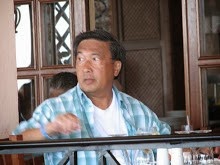
My photo
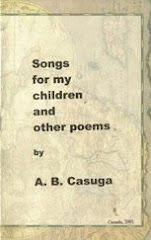
ALBERT B. CASUGA, a Philippine-born writer, lives in Mississauga, Ontario, Canada, where he continues to write poetry, fiction, and criticism after his retirement from teaching and serving as an elected member of his region's school board. He was nominated to the Mississauga Arts Council Literary Awards in 2007. A graduate of the Royal and Pontifical University of St. Thomas (now University of Santo Tomas, Manila. Literature and English, magna cum laude), he taught English and Literature (Criticism, Theory, and Creative Writing) at the Philippines' De La Salle University and San Beda College. He has authored books of poetry, short stories, literary theory and criticism. He has won awards for his works in Canada, the U.S.A., and the Philippines. His latest work, A Theory of Echoes and Other Poems was published February 2009 by the University of Santo Tomas Publishing House. His fiction and poetry were published by online literary journals Asia Writes and Coastal Poems recently. He was a Fellow at the 1972 Silliman University Writers Workshop, Philippines. As a journalist, he worked with the United Press International and wrote an art column for the defunct Philippines Herald.

Saturday, July 13, 2013

TEMPLES


TEMPLES  

What temples rise from the deluge of shades,/ what languages of grandeur echo in these ancient retreats?/ Or what language of absence befuddles before this death/ that crumples something to nothing?/ Why is there something rather than nothing?--- From Autumn's Question

1.  A Place to Pray: Sierras (Ca. 70s)*

Cold and rough hewn pews align the red clay floor
where rifles had lain at stock and inert most dawns
when bloodcurdling screams of combat gave way
to hard-earned slumber and crackle of campfire
in tempo with the rhythm of breath heard where life
might still have lingered among the beds carved
from crevices where crag flowers have bloomed
before nightmares came with the fall of sparrows:
this night’s sleep would be tomorrow’s horror.

But daybreak brought instead a temple’s prayer:
Upon this cave, our people will build their church.


*Somewhere in the Sierras of Cagayan Valley, Penablanca, Cagayan, Northern Philippines. A refuge for the Peoples Revolution.
 

2. A Place to Pray: The War Years (ca. 40s)*

(Grandmother’s Oración)

She would pull us down to our knees
on sundowns like this when dusk
was most gentle, tides ebbed quietly
like a murmured prayer: Oración!

Pray, little ones, He will keep us safe.
Pray that in the dark, we find our way.
Pray that the night will be our blanket.
Pray that the dawn brings back our sun.

Was it the distinct tremolo on her voice
that makes these echoes of an evening
orison cut through this familiar silence
that has survived brief lives and years?

Running back to evacuation shelters
in caverns carved through mountains
to hide us from the slit-eyed marauders,
we scurried with gleaned root crop dug

from scorched soil left ashen in bombed
out farms, but sunsets were her signal
moments when she would stop us dead
from our absconding: Vamos a rezar!

Let us pray! Pray that we get there,
With all our hands, fingers, and feet.
Pray that in the dark we find our way,
Pray that sunrise will be there. Pray!

Sudden rain on foggy evenings like this,
the power out, brings back the shadows
of that past world. In the dark, I pray
she blesses me with a touch on my back

and whisper that she, too, is still lifting
her voice to whom it may still concern,
we get to eat the root crop in our bags,
and children in the desert find theirs.

The war years are gone, but fearsome
havoc promises to catch up with us yet:
I pray the bright clearing in the woods
where a tree has fallen is a place to pray.

---ALBERT B. CASUGA

*Somewhere in villages of Baguling, a town in La Union Province, Northern Philippines. (Among the mountain tribes, while running from mop up operations of the retreating Japanese Occupation army on the ground and kamikazes in the air.)


Thursday, July 11, 2013

A LEAP OF FAITH: LESSONS IN THREE TAKES


A LEAP OF FAITH: LESSONS IN THREE TAKES

Give. Receive. Dance. --- Nijun Mehta
 

1.  Datta:  A Gift Outright

If this were a glimpse at dying and how the mind,
fragile as it is, could pull one back to life, I would
work at it, break free from cages that have held
me captive, look at the burning sun long and hard
until I am wedded to its brilliance and finally unified.

This is the vessel that I offer you to have and to hold,
but I must fill it with the salving grace that will mold
my injured spirit back to what I carefully surrendered
for you to mend and nurture when it had foundered,
lost at some hostile sea, a boat shorn of sail, unanchored.

Like Pygmalion, I will chisel every jagged chip, remold
every broken edge, to remake this cup and will unfold
before your eyes like an earthen jar spun out of my hand,
pared clean at its brim, to collect a wellspring of fluid
nectar to last us a lifetime of all that is sweet and kind.


2. Dayadhvam: Lessons on Receiving  

When the torch of desire burns clean
you would have learned all there is to learn:
To give, Datta. To feel and care, Dayadhvam.
To own and control, Damyata.Therefore,

To love beyond all loving because it is pure
like the mother suckles her infant. Give.


To know when caring will make things grow
like the raindrops nourish but will not sting.
To have and to hold even when that lashes
irreducible hurts to weary hearts that care.

It is for this that, naked, we halloo in the rain,
Let it come! Let all desires fill our dry vessels.


Then we wake up to the warm caress of the Sun
for the day is always new, the flower lovely.
Is not the rose lovelier when its thorns sharpen?
Does not the potter’s knife need its razor edge

to pare the lips of the wine jar and smoothen
its mouth that lovers may drink to full desire?


Bare your body then to its wild abandon, salve
it with the cool spring water now welled
from the earth, and open your mouth to kiss
the sunlight, defy the anguish. Never say, not yet.

Let it come! Let the leaves fall on this Upanishad,
because the leap of faith is never to say Not yet.


3. Damyata:  A Mud Dance Dialogue

Mud as fire extinguisher? Bloody overkill, I say.
Douse it with a spit of brandy and gin chaser,
and off to a cabin at the edge of the woods! Huh.
“How about we try some joy”? A blowhard’s line.
How about a walk in the woods, mud and all,
and answer old questions left unanswered:


Is love most nearly itself when it ceases to matter?
What is need that it remains unsatiated, unmet,
when lovers seek ardour to brim beyond fulfillment?
Ah, let’s slosh away in the mud where mud is,
and we might yet find a balm for this burning ember
we carry around like raw marks singed in our palms.


What joy is there where union is not communion?
What need is there for glowing embers flaming out
of buckets? I would rather we danced in this muck

of mud and find our freed fears become the dance,
our only dance, before the stroke of midnight,
before the convulsions of laughter turn to pain.


---ALBERT B. CASUGA
Mississauga, July 11, 2013


Tuesday, July 9, 2013

LEITMOTIFS: HOME


LEITMOTIFS

1. A Warm Hug of Home

Would the cup of my palms nestle you?
Give you a nestling’s echoing chamber,
where you could trill all you want or can?

That wind behind the trees, would it pick
your notes up and let your song be whole
again, your refrains brave and true again?

Through these woods, troll like a stout
heart whose one crescendo is of gladness
that the day’s night must bring a sunrise

as bright as it is gentle when it presses
your cold back to a warm hug of home,
where you will fearlessly sing your song:

Fly with me to the swaying tree tops!
Reach out for me. I am back. I am home.

2. Winding Your Way Home

My errands get simpler now: cut marks
On trees, branches, rocks, leaves, walls,
wherever I know you will wind your way
coming home. It is a long route back.

But you will find them like those prints
of fallen leaves mottling the lake girdling
bluffs we run to when we retrieve lost
memories that somehow remain clear:

we smell them, we touch them, we feel
them like waning fevers that stay warm
on our flushed faces. We will not forget.
We are condemned to remember. Always.


--ALBERT B. CASUGA

Sunday, July 7, 2013

BEING PROUD OF HER


BEING PROUD OF HER*
 
(For Mimi, Blanca and Ding+ Nolledo)

Let me at it---get me to my concupiscibles.
Green. Ripples. Sidled boats. Verdant growth.
Do you not see the metaphor stripped  bare
Of all that is recondite? Lorca saw it: Verde.
Old Nick’s barking tremolo swooned to it—
Evensong lullaby hushed his beer-body riot.
“Shh…the quiet lord cometh, he is on his way,
Laving ripples murmur to the brackish rocks
Serving sentry on the bluff: it is the end of day,
One more goodbye, one more sleep. No cocks
Crow here anymore.”  Mimi has a good eye.

Do you not feel what you ought to also see?
The idled empty boats are Indios Bravos tables.
Our tippling comrades are not there anymore,
Like the gin-ran pumps of absent boatmen,
These tubs tug at loose ropes linking them
Briefly like tumbler-toasting, tired, trolling
Troubadours. Beyond, it will always be green;
The gentle whimsy of wind is caressing here.
But the lights will be turned down soon,
Like sundown’s stealth, the creeping gloom.

At the old haunt—Nick, Pete, Pascua-Sanchez,
Papen, Erwin, Recah, Blanca, Adrian, Cuadra,
Are still shadows on the wall, not unlike catfish
Bobbing up for air as we did, drunken Bravos,
Fighting for breath when carousing left us
Struggling to surface from the depths of dives
Into bottomless pain and puzzlement: why
Did we have to walk out, foglike, into a dawn
Where bright days turned us all into harlequins
Miming what we thought were loud promises
to stay alive like these green dancing ripples
moving my eyes now grafted into Mimi’s Eye.

---ALBERT B. CASUGA
Mississauga, 07-07-13

 
*A poem written in the persona of the late Philippine writer and novelist non pareil Wilfrido D. “Ding” Nolledo, father of artist Melissa Nolledo, and beloved husband of writer-editor Blanca Datuin-Nolledo, who writes a blog “Cropsharing in the Bounty of Love” where she collects hitherto unknown remembrances of one of the finest writers in English in the Philippines, “But for the Lovers” author, Wilfrido Nolledo.

Saturday, July 6, 2013

OUR YOKE TO TRY: THE ODDS


OUR YOKE TO TRY: THE ODDS

For us, there is only the trying. The rest is not our business/ ...Love is most nearly itself/ Where here and now cease to matter./ Old men ought to be explorers/ Here and there does not matter/ We must be still and still moving/ Into another intensity...From “East Coker, The Four Quartets, T. S. Eliot

Because we could not hold on to love
As it must be held, given pure and free,
We can only try to find what is most
Nearly itself, until we get to a still point.


Time does not define where that may be,
But it must linger in the mother’s breasts,
When she suckles her infant into a life
Where there is nothing but uncertainty.


How precariously certain is this mock-up
Of staying alive when it is impermanence
That most resembles it? A will-o’-the-wisp
Or a cruel mirage hounds us, it is there


But not here. Why love then, or live at all?
When uncertain weather is most certain,
Why dare fritter precious lifetime on this
Uncharted clearing? It is our yoke to try.


We will perish trying, measure dying by
How true our exploring must be, we
Cannot stop, we simply move into another
Space, with flaming eagerness or anger.


---Albert B. Casuga

Thursday, July 4, 2013

OLD WOMEN IN VACANT LOTS


OLD WOMEN IN VACANT LOTS


Wipe your hand across your mouth, and laugh;/ The worlds revolve like ancient women/ Gathering fuel in vacant lots.---T. S. Eliot, “Preludes”, Collected Poems 1909-1935


1.
Debris around the empty schoolhouse
have been cleared, gathered into motley
piles neatly lined on where the road was
before that too crumbled with village
life; only the old women stayed longer
than any of the taut-jawed rescuers now
back in cities where Ishinomaki is just a
dot in the grids pressed upon the brittle
maps. The temblor and the tsunami
are still everything to them: raw feelings,
ceaseless nightmares of weeping men
picking up limp bodies of children dug
out of the rubble, still tightly clutching
their shredded books and broken crayon.


2.
Their gnarled fingers and weary faces
stick out like bookmarks at the last light
of sundown, clipped between pages of rags
flapping in the uncertain weather, while
they move in little circles like crayfish
clambering over what remains of the yard
that once teemed with laughing children;
they would stop to talk over the muffled
rumble of the excavators, and bend quickly
to glean more rubbish or gather briefly
to touch and bless a tear from a blouse or
a piece from a muddied shirt they would
gently put away in their bamboo baskets.


3.
Other times, other seasons, they would
be here picking up ripped twigs dried
on the banks of the river at the foot of the
hill, fuel for the vats of the sweetened
yams they would boil to regale the boys
and girls gathered around them at school
break, laughing as raucously as the wee
urchins, while wiping their caramelled
lips with shawls they would wrap their
heads with when they walk down the hill,
to wait for another daybreak of fuel
picking, praying for a kinder season. Soon.

---ALBERT B. CASUGA

Wednesday, July 3, 2013

BENCH GRAFFITI


BENCH GRAFFITI
 
If you came this way,/ Taking any route, starting from anywhere,/ At any time or at any season,/ It would always be the same: you have to put off/ Sense and notion. – T. S. Eliot, “Little Gidding”, Four Quartets
 
You are beautiful! An unlikely graffiti
on the park bench brushed on the seat
and the back slats must shoo parkers
away---a stalker nearby? A pedophile?
 
Why not a lonely chap who has no one
to say those words to? Why not a lad
too shy to blurt it out to that ingénue?
Why not a happy-feeling litterbug?
 
"You are beautiful " should go a long way
into making a homely jogger feel she
could use the stroking; no one would
run a hand over those spindly dry legs.
 
Why not the kindest guess about mad
men painting nice things in the dark?
 
---Albert B. Casuga

Tuesday, July 2, 2013

ALL THE DAYS DWINDLE DOWN: TWO POEMS


ALL THE DAYS DWINDLE DOWN: TWO POEMS
 

1. RHYTHMS OF A DAY

It is a rhythm we learn early enough:
that bird’s quiet climb up a trunk
is also its feeding hour; it is working
for its transient stay in this palace
of trees at the edge of the woods.

From a porch, between sips of tea,
the watcher espies the cuckoo dance
on the tulip tree--a hop-skip-and-pick
not unlike the hip-hop kids’ dancing
away from embalming classrooms
at end of day: hop-skip-and-pick

pebbles to throw at a party of wrens
that whirr noisily away, squawking
mayhem at hallooing children who
cackle at the frenzy as if they were
born to raise hell, and for the fleeing
birds to screech for mercy, mercy!

The rhythm of a summer day: a bird
on the tulip tree minding its business
is scared silly by the clangor of a dump
truck rattling through raven packs
snatching trash from spilling bins
that line up the street like pallbearers.

Elsewhere in Tripoli, napalm bombs
scare dumpsite scavengers picking up
metal to shape the bullets for another
day’s battle. Rhythms of a day, we call it.
 

2. DISCARDED DAYS
 
What have we discarded cutting through tunnels
we must have plodded to quarry from lives we
might have been accidentally given? What loves
have we found, what hearts have we lost? Layers
of clay, cracked stones, and silt could build us our
houses of hurts and ruptured dreams. Not a home.

But we take care to wake up to days we can shape,
to moments we could mould like delicate bowls
whence we share victual and drink for our hungry
and thirsty souls. When travel becomes a burden
of faithlessness or pain, we call each other out:
Be brave, hold on, take on the world if we must!

When these passageways fall dark, we walk on.
After all, our lives are not made of discarded days.
 

---ALBERT B. CASUGA

Monday, July 1, 2013

THE ETERNITY WE KNOW: TWO POEMS


THE ETERNITY WE KNOW: TWO POEMS

Sit. Feast on your life. ---Derek Walcott  “Love After Love


I. UNTIL MEMORY FADES

Has anyone come back from this defiled form
and mapped out ways to get back to that eternity
we claim as heirs to, where days are as chartless
as the river stream that must flow to an endless,
ceaseless fountainhead which has no beginning?
There is no other way back except by destruction.

When every rampart has been carted away, we
do not pine for them like those we cannot lose
because we store them in vaults of our memory:
they are our milestones of an afterlife we choose
to build from achieved desires, fulfilled dreams--
these chambers of a heart that will not crumble.

What, indeed, do we know of eternity? Save this:
We are never away from it. Until memory fades.


II. FEAST ON YOUR LIFE

Although this invitation will prolong our wait
in the cold antechambers that we surround
ourselves with, we will cautiously accept it.

Why not? Sitting here, staring at a kaleidoscope
of the many faces we have constructed to meet
other faces, I celebrate a love affair with myself.

Who else will do that for me? There were lovers,
and there were lovers, but they held on to their
own chisels to pare and scrape their own image

of what they could have and hold not unlike
a wild-eyed Pygmalion sculpting flesh onto his one
desire, a Galatea of his rawest wants and dreams.

I will sit and wait for the feast of all feasts
to be served on my table, my head on a platter,
my heart seasoning a bowl of hope, a soupçon

of little mercies that lovers often do: a salving
of hurts, a troth of endless fealty, a promise
that the image on the mirror is finally, only mine.

---ALBERT B. CASUGA