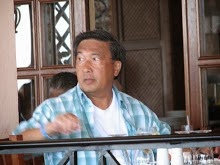
My photo
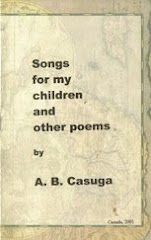
ALBERT B. CASUGA, a Philippine-born writer, lives in Mississauga, Ontario, Canada, where he continues to write poetry, fiction, and criticism after his retirement from teaching and serving as an elected member of his region's school board. He was nominated to the Mississauga Arts Council Literary Awards in 2007. A graduate of the Royal and Pontifical University of St. Thomas (now University of Santo Tomas, Manila. Literature and English, magna cum laude), he taught English and Literature (Criticism, Theory, and Creative Writing) at the Philippines' De La Salle University and San Beda College. He has authored books of poetry, short stories, literary theory and criticism. He has won awards for his works in Canada, the U.S.A., and the Philippines. His latest work, A Theory of Echoes and Other Poems was published February 2009 by the University of Santo Tomas Publishing House. His fiction and poetry were published by online literary journals Asia Writes and Coastal Poems recently. He was a Fellow at the 1972 Silliman University Writers Workshop, Philippines. As a journalist, he worked with the United Press International and wrote an art column for the defunct Philippines Herald.

Wednesday, September 30, 2015

COMING HOME: LIGHT THROUGH A CRACKED MIRROR

MY POEM TODAY is for a friend who goes back to old haunts and finds there are memories that need to be purged of their pain. Where, what place do these come from? Where do they belong?


COMING HOME: LIGHT THROUGH A CRACKED MIRROR


“Ring the bells that can still ring/ Forget your perfect offering/ There is a crack in everything/ That's how the light gets in” ~ Leonard Cohen


How far have you gone from all that you were,
little chipped stone from a hidden tributary,
little pebble that has yet to reach the bottom
of the well to hear its thump and come to rest?

How far, indeed, that you must finally beg
to be taken home? Where, what place, what
troubled spaces have you been all these years?
Bitter years, you say almost in descant candor.

Take you home? But where do you belong?
If I knew, if I could follow that map long
faded in your doleful heart that has dogged
every fickle chord from every pied piper—

If I could find every pied-a-terre you’ve been
that I might collect the shattered life pieces
left of your gypsy heart so I could remould
them to our heart’s desire, I would. I will.

Take you home. Prop you up, start you up
once again whence you came, where
your heart is not merely a sieve for sorrow
or pain, but where it is a fortress of care.
---ALBERT B. CASUGA

Monday, August 31, 2015

THE LEAP OF FAITH: NEVER TO SAY NOT YET


Why must one believe? How can one believe? Why believe in Life, Love, and Letting Go? Why and when must one make his leap of faith, or not at all?


 THE LEAP OF FAITH: NEVER TO SAY NOT YET


When the torch of desire burns clean
you would have learned all there is to learn:

To give, Datta. To feel and care, Dayadhvam.
To own and control, Damyata.Therefore,

To love beyond all loving because it is pure
like the mother suckles her infant. Give.

To know when caring will make things grow
like the raindrops nourish but will not sting.

To have and to hold even when that lashes
irreducible hurts to weary hearts that care.

It is for this that, naked, we halloo in the rain,
Let it come! Let all desires fill our dry vessels.

Then we wake to the warm caress of the Sun
for the day is always new, the flower lovely.

Is not the rose lovelier when its thorns sharpen?
Does not the potter’s knife need its razor edge

to pare the lips of the wine jar and smoothen
its mouth that lovers may drink to full desire?

Bare your body then to its wild abandon, salve
it with the cool spring water now welled

from the earth, and open your mouth to kiss
the sunlight, defy the anguish. Never say, not yet.

Let it come! Let the leaves fall on this Upanishad,
because the leap of faith is never to say Not yet.


—ALBERT B. CASUGA

Tuesday, August 18, 2015

LITTLE SHADOWS AT SUNDOWN


MY POEM TODAY goes back to the sea for those old sounds, the old sights, so familiar with my growing up. I was an only son, and had sisters to protect. Like this young lad who has his sisters covered.


LITTLE SHADOWS AT SUNDOWN


(For the Wee Ones at the Beach)


There is where here is:
Do you hear the murmur
Of the seawaves laving this shore?

It is the whispered caress of a mother
Come upon her little ones’ romping
Among the sundown shadows.


Where the flushed horizon
Meets the sea, a father’s
Face gleams ruddy 

With laughter’s heat
Still on his crinkled brow.


O, that this cacophony of sounds
Becomes the noise of a lifetime
This heart (from a distance)
Could hearken to, leap up to,
Velvety notes of a joie de vivre

That this place was built for,
Made of, remembered by:

 
Is this not, after all, the paradise
He thought was lost in time past
Visited now upon his dotage

When he hankers for joy,
A little life left while there is time?


The little shadows taunt the sea
To reach their limbs. Gleeful,
Their now surprised screams,
When touched at last, are drowned
By whimper of the ebbtide waves
That has turned to gentle laughter.


---ALBERT B. CASUGA

Saturday, August 15, 2015

WHEN LOVE IS MOST NDARLY ITSELF


MY POEM TODAY IS ABOUT WHEN LOVE IS MOST NEARLY ITSELF. These poems were prompted by the post of Thich Nhat Hanh on How to Love, Love and what it is, and what it does. (See my post in comment section below for photo of his book "How to Love")


WHEN LOVE IS MOST NEARLY ITSELF


"For us, there is only the trying. The rest is not our business/ ...Love is most nearly itself/ Where here and now cease to matter./ Old men ought to be explorers/ Here and there does not matter/ We must b...e still and still moving/ Into another intensity...From “East Coker, The Four Quartets, T. S. Eliot


Because we could not hold on to love
As it must be held, given pure and free,
We can only try to find what is most
Nearly itself, until we get to a still point.


Time does not define where that may be,
But it must linger in the mother’s breasts,
When she suckles her infant into a life
Where there is nothing but uncertainty.


How precariously certain is this mock-up
Of staying alive when it is impermanence
That most resembles it? A will-o’-the-wisp
Or a cruel mirage hounds us, it is there


But not here. Why love then, or live at all?
When uncertain weather is most certain,
Why dare fritter precious lifetime on this
Uncharted clearing? It is our yoke to try.


We will perish trying, measure dying by
How true our exploring must be, we
Cannot stop, we simply move into another
Space, with flaming eagerness or anger.


---ALBERT B. CASUGA

Wednesday, August 12, 2015

SAYONARA


MY POEM TODAY was prompted by this post shared with me by poet Felix Fojas who suggested I write a poem on his grief. I said I would not be rid of the pain in my heart about this victim in the 1945 bombing of Nagasaki in Japan during WWII until I let it out in a poem. I asked him to write a poem, too. Here is "SAYONARA".


SAYONARA

(For all the Children who perished from the Bomb)


I must hurry before they set it on fire,
I must hurry to where they built the pyre.
I must lay you gently down, my brother,
I must save you, Hiro, from some more pain.


There, beyond, Otosan waits for you, to carry you
To where Mother builds a little hut with tatami
Where you will all lie down to rest at sundown,
Where you are all far from the burning cloud.


Father and Mother will no longer be lonely.
Sayonara, Hiro, my little brother. I will not weep.


--- ALBERT B. CASUGA
August 11, 2015, 70 years after the bombing of Nagasaki


Thursday, August 6, 2015

HIROSHIMA: YOKED HAIKUS


MY POEM TODAY IS A SET OF HAIKUS YOKED TO OBJECTIFY THE HORRIFYING EXPERIENCE OF THE USE OF THE FIRST ATOMIC BOMB AS AN INSTRUMENT OF WAR. On August 6, 1945, The American War Plane Enola Gay dropped the Atomic Bomb that the US invented and approved by President Truman to be dropped on the Japanese City to purportedly end World War II. What an end it was. Might this happen again?


HIROSHIMA: YOKED HAIKUS
(For all the Victims of War, Lest We Forget)
...
It was easy to
let the Big Boy go, Enola
Gay, it simply killed.


No, not just bodies,
But a country's broken soul:
Ruptured, killed, kaput.

 
Slay the children,
Memories cannot perish.
They remain alive.


It is sepuku,
Harakiri, and all that
too, stemming war.


Incinerate all
children and otosans too,
stop this damn war.


It goes on to kill
more in old Nagasaki
while damn Yankees cheer.


Hiroshima, we
still mourn for human cruelty
that came as a cloud.


---ALBERT B. CASUGA
August 6, 2015


The story behind LIFE photographer Alfred Eisenstaedt's image of a mother and child in the wasteland of 1945 Hiroshima:


Wednesday, July 29, 2015

THE LILT OF A NOSEFLUTE: A DIVE INTO ORIGINS


MY POEM TODAY was prompted by Luisa Igloria's poem, "Where We Live" in Via Negativa.


THE LILT OF A NOSEFLUTE: A DIVE INTO ORIGINS

(For all my Baguio Cousins)


The lilt of a noseflute over the farthest reaches
 Of the valley is an echo of sundown orisons
You long for; it is as true as the joy of a harvest
Dance, and laughter over who finds the longest
Marrow inside the butchered offering’s bones,
Or cull the biggest bowl of buffalo’s ligaments
That could float or sink into the vats of caldo,
Keeping us all warm and raring for jars of
basi

While we sing or even howl carousing songs
Known only to this edge of the terraces where
Endless sunsets will mark the birth and rebirth
Of the fondest and happiest remembrances
Of a time gone by that villagers thought was all
That can be, and nothing more. Thus, a sacrifice.


You grew beyond those magical full moon rituals,
And discovered your own necromancy elsewhere
Where dead worlds are decreed alive again from
Your throne of songs and words, where finally
You feel the throb of these mountains in your
Veins and wish they were plucked like strings
In your heart and make you sing as the happy
Child that must return with the sun, again and
Again, in glorious bravura over these blue hills,
Unapologetic, and never merely a background.


---ALBERT B. CASUGA

*Caldo - Bone Soup; Basi - Sugar Cane Wine
A Photo by Bobby Wong, Jr., Ifugao Rice Terraces, Philippines

Tuesday, July 14, 2015

THE ACCOUNTANT


MY POEM TODAY. The Great Grief continues.


THE ACCOUNTANT


Sunny and cold. A nuthatch lands on the dead cherry and begins a close inspection of the limbs, dapper as an accountant in his gray suit.---Dave Bonta, The Morning Porch


Almost invisible, he plods quickly through carrion
piled helter-skelter on the bulldozed hillock. Dead
heads, dead eyes, dead limbs, dead legs, dead dead
form wreaths on the gaping holes in graveyards we
now know: Kampuchea, Syria, Maguindanao, Somalia,
Libya, Uganda, Nigeria, Botswana, Russian pogroms,
Mein Kampf railroads to the Herr’s crematoriums,
killing fields: he was there, “been there, done that”,
his austere and remote account of his unique job:
counter of the dead, keeper of the books, master
of the morgues, “keep them coming while we could,
death shall have no dominion.” Nor a condominium.
Like the nuthatch, he walks with a limp in his dark,
gray suit, shrugs, leaps over the dead cherry and
stifles a long, deep yawn, and fixes his ledger pages.


— Albert B, Casuga

Sunday, July 12, 2015

HEAVEN CAN WAIT


MY POEM TODAY is still about the abomination being done on Earth---specially the killing of helpless and innocent children. Can heaven wait? Please?


HEAVEN CAN WAIT


Suffer the little children to come unto me, and forbid them not: for of such is the kingdom of God. --- St. Mark ch. 10 v. 14, the Holy Bible
...

(For all the Holy Innocents)

Heaven can wait. Hell cannot. Cut them
like flotsam and weed-traps wrapping
bloated carrion beelining toward the sea.

What controls cannot contain, infanticide
could quickly provide: terminate them,
abort before a trimester germinates more
burden, stop the plague of life on a dying
planet. When echoes of children’s laughter
could no longer be heard in a muted valley,
elusive peace and quiet would be there,
no duties to rear, no grain shortages.

Wars will cease from an attrition of warriors,
old soldiers wither in unstocked barracks,
the draftees will stop coming. They have all,
all perished, in abortion camps, in famine
camps, in evacuation camps, in flood camps,
in garbage dumps and landfills, God’s Act
stamped across records: avoid insurance runs.

The boys have been massacred before
in the hills of Bethlehem, and the pillage
written about in Gospel language as the day
of the innocents, now los ninos inocentes.
Why can’t that be done again? No in vitros
will be possible, nor will it be allowed either.
No rhythm of swords. Just Syrian chemicals.

Do not copulate, depopulate, depopulate!
Pill boxes will bear this mandate. Absent
the plea for missing kids, more is better.
Children soldiers? What for? Kill. Be killed.
Hell will be heaven on earth, death is life.
Nothing will be everything. A Zero sum.
Wrath descended, Apocalypse has come.


---ALBERT B. CASUGA

Saturday, July 11, 2015

HIS WAILING WALL


MY POEM TODAY CONCLUDES THE GREAT GRIEF SERIES I started to round up information on the dread of losing our world to extinction.


HIS WAILING WALL

Ubi solitudinem faciunt, pacem appellant --- Tacitus*


Either way, distance finds me
looking up or down this cliff,
an unlikely sanctuary I escape
into aching for scarce solitude.


How can one be alone among
the darting seagulls? Or silent
with lost memories jarred by
blasts of breaking waves below?

 
Here, gods revel in their haven
of whistling winds and clouds,
down there fishermen cackle,
chewing sargasso, guzzling gin,

 
while their thrown nets fill up
with flotsam floating around
moss-gowned boulders staring
at the sky like dark green eyes.

 
Is it this vast and empty space
between that scares me now,
when I should be murmuring
secrets to messenger winds?

 
I would scream unbearable
pain, holler down bitter anger;
I must share muffled grief,
loosen taut shackles of despair.


Either way, I find wailing walls
in air, water, rocks, and wind;
like Job I weep for peace, hope
to gently fall in the cup of palms

 
waiting to catch my carrion
now carved out of a shattered
world of faithlessness and fear,
unable to hold on to life or love.

 
On this piece of jutting rock,
have I not found the little place
where I could reach His Hand
quickly were I to fall, either way?


---ALBERT B. CASUGA