My photo
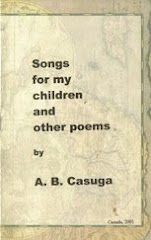
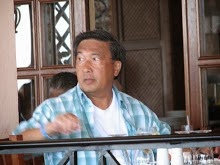
ALBERT B. CASUGA, a Philippine-born writer, lives in Mississauga, Ontario, Canada, where he continues to write poetry, fiction, and criticism after his retirement from teaching and serving as an elected member of his region's school board. He was nominated to the Mississauga Arts Council Literary Awards in 2007. A graduate of the Royal and Pontifical University of St. Thomas (now University of Santo Tomas, Manila. Literature and English, magna cum laude), he taught English and Literature (Criticism, Theory, and Creative Writing) at the Philippines' De La Salle University and San Beda College. He has authored books of poetry, short stories, literary theory and criticism. He has won awards for his works in Canada, the U.S.A., and the Philippines. His latest work, A Theory of Echoes and Other Poems was published February 2009 by the University of Santo Tomas Publishing House. His fiction and poetry were published by online literary journals Asia Writes and Coastal Poems recently. He was a Fellow at the 1972 Silliman University Writers Workshop, Philippines. As a journalist, he worked with the United Press International and wrote an art column for the defunct Philippines Herald.

Sunday, April 7, 2013

THE BIG QUESTIONS, 7: WHAT MEANING MEANS


Poem #7 for National Poetry Month (NaPoMo, April) responds to the big question: What do we know? Virtual Realities and Valuable Authorities.* (What is knowledge? Do we know what we know? How do we know what we know is the truth? Do we need to go through the rigours of epistemology?)


WHAT MEANING MEANS


Giving up on giving up is a better choice,
when being sensible and clear are futile.
Words would lose meaning, ours will not.

Where you see a vine leading its tendrils
up to a broken branch shedding a last leaf,
you make me see its undulant plummet

to the parched pond mottled by blackened
and brittle leaves long dead even before
the end of this long hot summer. It is real.

Is this not our faultless way of knowing
what we pretend to know when we can
no longer see the dancer from the dance?

Would not the falling of that lonely leaf
trace the slower climb of a clinging vine?
Like seeing both sides of the wall at once.


---ALBERT B. CASUGA


*To celebrate this Poetry Month, we thought of collecting a series of poems that would respond to these Big Questions posited by Simon Blackburn, Professor of Philosophy at the University of Cambridge, in his book The Big Questions Philosophy, 2009, Quercus Publishing Plc, London, UK. pp.38-47. He says about knowing: "...we need our confidence to match what happens. That is the gold standard for knowledge and truth alike." (Ibid, pg.47)
 
Painting: Adam and Eve in Paradise by Ian Brueghel the Elder.
(The apple from the Tree of Knowledge? What does that mean?)

Saturday, April 6, 2013

THE BIG QUESTIONS, 6: MEANING AS AXIOM


NaPoMo Day 6: Here's a poetic response to the Big Question: Why is There Something and Not Nothing? (The Strange Ways of Being)*


MEANING AS AXIOM


If another twig falls in the night,
as silently as it grew as a sapling
toward the sky, would that mean
anything anyway to anyone?


The graveyard of a fallen tree
may tell untold stories that stay
untold until a struggling stray root
breaks through dry rot and ground
for yet another flushed cherry tree.

 
The inexorable is also axiom here:
life begins in death in a spun gyre
twirling into flowers, forever moving.
Nothing is everything here, but there
where leaves had once fallen, broken
twigs spring back as fluttering birds
twittering on branches like new leaves.


—Albert B. Casuga
*Simon Blackburn, The Big Questions: Philosophy, Quercus Publishing Plc, London, UK, 2009.


Friday, April 5, 2013

THE BIG QUESTIONS 5: CHOOSING CHAOS

(April 5, 2013) Day 5 of NaPoMo (National Poetry Month, April) and here is my poem-a-day answer to one of the Big Questions posited by Simon Blackburn in his "Am I Free? (Choices and Responsibility)".*


CHOOSING CHAOS

Order is articulated chaos, its desire
an old rebellion that recalls the loss
of a streamlined paradise. Nothing
is needed here. Everything is given.

Then, why walk out of this Garden?
A provident Eden where everything
grew including his wanton dreams,
of having his way: orders be damned.

How simple things would have been.
Each pebble on the pond had a reason
to be there, each star a constellation
of sunlight, each sun a starter of life.

How serenely flowers would bloom
on the tip of thorns, or water flow
gently from the cracks of dry rocks,
and ripe fruit fall into open mouths.

Everything can happen here, nothing
is everything there, a cipher is full.
How benignly would mountains rise
from the sea, and lakes from mudpools.

Would movement have moved this
conspiracy of stillness and creation?
He could not see this, nor feel the pain
of a yanked rib to make a woman cane.

A yearning rooted in his belly burned,
a lust for roaming the hidden valleys,
finding struggle with fish and grain
a surprising tug on his arms and loins.

Walking out on a promise of fullness
and unbridled abundance, did he
choose somehow to stand on hind legs
and see whence came the thunderous

offer? You who are made in my image,
shall have dominion over all that you
see and taste, all that is still or moves,
or none but the courage to choose.

He chose to shape his own order out
of the unseen chaos of growth he
occupied East of Eden, and decided:
We will gather ourselves some fig leaves.

We will make ourselves our own image.

--- ALBERT B. CASUGA

*Simon Blackburn is Professor of Philosophy at the University of Cambridge, Research Professor of Philosophy at the University of North Carolina. The Big Questions: Philosophy was published by Quercus Publishing Plc, London, UK, 2009.

Thursday, April 4, 2013

THE BIG QUESTIONS 4: A ZERO POINT

 
 "Is Death To Be Feared?":  One of the Big Questions included by Simon Blackburn in his The Big Questions: Philosophy. Here is my take for an answer via NaPoMo Poem-a-Day posts (April 4, Poem #4).


.
A ZERO POINT
 
 
He said it first: after this death,
there is no other. It is peremptory.

But a world without a memory,
is as final as it can get without you.

Will it be a place where love is free?
Magical, except you can’t come back.

The pictures will be on the walls,
as mute as the hooks they hang on.

They will not talk to you, they can’t.
Even if they could, they would not.

Even if you have become the cobweb
wrapped tight on the broken frames,

you would not have been there. No.
You are not part of the furniture.

Like dust in abandoned houses, you
will inhabit the nooks and crannies,

and would not be disturbed until
termites take over. Too late then,

because you are not even a remnant
of temps perdu, you are lost in time

and in space; even among the stars
and black holes, you are not there.

Like the sound of a single hand
clapping, you will not be heard.

The first death is always the last.


---ALBERT B. CASUGA

Wednesday, April 3, 2013

THE BIG QUESTIONS 3: BETWEEN HERE AND THERE


BETWEEN HERE AND THERE

A poverty of language requires reading
between the lines: the eyes cannot see,
nor scents mean anything. No taste
or touch could jump out of nothing.
A trick, if there is one, is that meaning
cannot mean beyond the compulsions
of a body made for this time only.

Does one learn to understand a heart’s
diction? What words leap out of silence?
Why does one need to listen to whispers
of absence? Why do sounds of sorrow
and madness register the same timbre
where indifference is the sounding board?


Is this why we would rather tolerate poets?
They read and write between the lines,
and could not care less about the simple,
palpable grip of certainty bereft of clarity.
What is clearness if the whole truth hides
behind the unknown here and a dark there?


If meaning could not be found in one place,
here, why do we think we really understand?
Between the lines, we may yet begin to know
that we need to go there to be truly here.


---ALBERT B. CASUGA
In response to the Big Question: What is Human Nature (The Problem of Interpretation) by Simon Blackburn, The Big Questions: Philosophy, Quercus Publishing Plc, London, UK, pg. 18 etseq.

Tuesday, April 2, 2013

BIG QUESTION 2: CAN WE UNDERSTAND EACH OTHER?*

This is Poem-a-day #2 in my foray into using poetry to answer some of the Big Questions.* 

YOU AND I

Words in their primary or immediate signification stand for nothing, but the ideas in the mind of him that uses them. ---John Locke
 

Are you talking to me? Are you writing to me?
Answers to questions you pitch into the dark
are meanings I assign to the questions you ask.

Always, you and I, will be at opposite ends
of a half-lit hallway where echoes are as urgent
as the tremulous confessions we burden ourselves

with each time we look into our reflections
on the one-way mirrors we look into when hiding
hurts hurled like hunting knives at target trees.

When I call you, I mean to quickly hold you down,
to find your voice, to shape your feelings, to own
your thoughts, to mould you as I want to have you.

I interpret you through my own lenses and mirror
you as you would me and have our confluence
in this reflection, a dragging into a cold dungeon

of thought constructing meaning instead of finding
it, and the “You” becomes the “I” held in bondage.
Except that in this conquest, I lose everything.

Questions and answers become elusive phantoms
of meaning, configurations of troth to the other
turn into fantasy, dreams and desire but delusions.


---ALBERT B. CASUGA

*This poem was prompted by Simon Blackburn's "Can We Understand Each Other? Treating Words Carefully," The Big Questions: Philosophy, Quercus Publishing, London, UK, 2009 


Monday, April 1, 2013

THE BIG QUESTIONS 1: WHAT IS IT ALL FOR?


My first poem for the National Poetry Month (NaPoMo)---April 2013. Am exploring poetic answers to the BIG QUESTIONS. (Cosmological, Philosophical. Why not? Make this exercise worth it. Stuart Clark listed down questions on The Universe in his Big Questions book, and Simon Blackburn his list in The Big Questions: Philosophy. Our first question is from Blackburn: WHAT IS IT (Life) ALL FOR?
 
 
IN SEARCH OF MEANINGS

Missing the many splendored thing
is one way of looking at this search.
How really far out there do we need
to fly, or espy for the god particle we
seemed to have lost in the process?

Why look behind the stars or in them?
Did we not lose our angels coming off
the crib or the direst cranny for shelter?
They do not grow with us, nor guide us.
Absconding, they quietly creep away.

Courage and devilment open our eyes
to what stories we could live with or by,
or what places to board up or occupy.
Orphans at birth, we are alone at death.
What we mean here is what we make.

The womb is a meaning we cannot do
without: our final breath is a call:
Mother, hold me. Our first cry is a call:
Mother, love me. And then we grow old
shaping up all excess purposes and ends.

The tomb is yet another meaning we
scarcely begin to understand before it
pulls us to its urgent demand: living
to die trying to live while dying is easy
may yet be the meaning we struggle for.
 

---ALBERT B. CASUGA


Friday, March 29, 2013

THE RESURRECTION: TWO LENTEN POEMS


THE RESURRECTION: TWO LENTEN POEMS

(For Pope Benedict and Pope Francis, 2013 AD)


A VIGIL CONUNDRUM: HIS TOMB IS A WOMB*

"What misery to be afraid of death./ What wretchedness,
to believe only in what can be proven." ---Mary Oliver

He chafed at the two-and-a-half-hour service,
and at night yet: a vigil, the pastor called it.
“Why a vigil? Who are we losing early sleep over?”

“You should not have come along this evening
with a sour heretic’s spleen, you put the heathens
to shame,” his beads-wagging wife snapped as he
rather timorously dared to vent his quiet  protest:

“Why this vigil? We have lived with this truth
for centuries now. Why behave like we have
to prove that He did prevail over dying or death
by crucifixion between thugs on the hill of skulls?

“That grave stone moved during Pilate’s watch?
Not even his twelve comrades could do that.
His carrion bore Life. This tomb is a womb.”

“What in the name of the saints did you say?
A womb tomb?”  She snarled under her breath.
But he would sheepishly answer: “Am poetic.
I mean all types of dying or death entombed.

“But this was the true womb of life and living.
In that cave, this world’s hideous hate died
so that it may become the womb of a Rock.
His carrion gave birth to a glorious empire

“Of enduring love, against whose ramparts no
vicious malice, mayhem, nor evil shall ever
prevail.” Askance, she stared at him as she would
a madman, and said: Hush! The vigil has begun.
 

---ALBERT B. CASUGA

*Holy Saturday of Lent. Revised from an earlier poem March 29, 2013
 

Philippine poet Rita B. Gadi posted the following in response to the poem above. We are reposting this from MY FACEBOOK NOTES.


NONE

It seems not enough
to have hurt You once
in Calvary.

Each day I repeat
the rending of Your heart
quenching Your thirst with acid,
rolling the dice
for the price of Your robe
the glint of instant gain
twirling in my palms,

LORD, HAVE MERCY!

Please take me back
pressed inside the smallest
particle of space
between
the wooden sliver and Your skin
my holiest intimacy
with Your enormous grief,

LORD, I AM NOT WORTHY!


---RITA B. GADI
From her “Prayers for the Present”

Wednesday, March 27, 2013

THE ULTRA SOUND OF HIS HEART TEST


THE HEART TEST*


Big breath...relax...tiny breath...no, too much, tiny...
very good...relax... and she nudged him rather sharply
with her gelled dowser (for want of a better word
for a heart's diviner)... This is as close as my old skin
could get to a presence of breasts, er, mammaries,
he sighed under his now tortured breathing regimen.
Move closer to me, please...put your knees up...tiny
breath, hold...and relax. There were jolts on his ribs,
more kneading of his belly, his navel, back to his chest.

And he heard the swishing staccato echoing promptly
to each of her stabs, urgently wheedling his pumping
heart to tell her what might have been lascivious were
this not the one ultra sound that would tell him he
would be around for a little while, but these are about
the closest he would get to the smell of glands and their
jolting touch on his bare back. What if they were bare
breasts, he wondered. Big breath, please...relax...tiny
breath...no, no, that's too much... Heart tests be damned,
he said and closed his eyes, having come so near to
a touch that would remain as cold as the gel on his navel.

---ALBERT B. CASUGA


Sunday, March 24, 2013

THE SEASHORE SHELLS; TWO POEMS


TWO POEMS: THE SEASHORE SHELLS


For Lolita Tadina Molanida  (1943-2013+),
In Memoriam for a Prom Partner and Friend*


1. PICKING UP LOST SHELLS
 
We had little worlds then, but they were good.
Were they as bright as our dreams though?
It was the prom night I cherish most, we would
Finally hold each other, gingerly stepping toe
To anxious toe, dancing timid glances away,
Deaf to the music, anxious for that deep sway
We giggled at when our prom coach yelled:
“Hold those hands like you liked each other!
One-two. One two-three---sway!” She  called
Out, we sashayed, twirled away from each other,
Only to glide back into that one sudden embrace,
When I stepped on your wayward shoelace.

Life’s promenades must end, they can’t go on,
Like a lifetime of absence until I heard you’d gone.

 
2. IN CANAOAY, AT PORO POINT

That’s where to go when you ache
for a piece of that elusive paradise,
it is a stone’s throw from there
where languid sunsets play tricks
on squinting eyes, a will-0’-the-wisp
laved by ebbtide, a sundown bravura
of rainbows, a Wagnerian grandeur.

Here I am, picking up abandoned
shells. Could their quondam settlers
have required more wiggle space,
find ease where there is nothing
left of free and unbridled growing?
I, too, have bartered for lost dreams
but like Orpheus I looked too closely.

Have I turned around to size up my
trophy coming out of struggles
to recast quotidian days into happy
residues of life and love? Did I lose
what I endlessly return to, where
coming back is also coming home?
I look back for shells that I had lost.


---ALBERT B. CASUGA


*La Union High School, Junior-Senior Prom, 1959