My photo
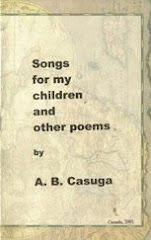
ALBERT B. CASUGA, a Philippine-born writer, lives in Mississauga, Ontario, Canada, where he continues to write poetry, fiction, and criticism after his retirement from teaching and serving as an elected member of his region's school board. He was nominated to the Mississauga Arts Council Literary Awards in 2007. A graduate of the Royal and Pontifical University of St. Thomas (now University of Santo Tomas, Manila. Literature and English, magna cum laude), he taught English and Literature (Criticism, Theory, and Creative Writing) at the Philippines' De La Salle University and San Beda College. He has authored books of poetry, short stories, literary theory and criticism. He has won awards for his works in Canada, the U.S.A., and the Philippines. His latest work, A Theory of Echoes and Other Poems was published February 2009 by the University of Santo Tomas Publishing House. His fiction and poetry were published by online literary journals Asia Writes and Coastal Poems recently. He was a Fellow at the 1972 Silliman University Writers Workshop, Philippines. As a journalist, he worked with the United Press International and wrote an art column for the defunct Philippines Herald.

Thursday, January 14, 2016

YOU AND I ---OR IS IT "I OR YOU?" (AS BENCHMARKS OF CONSCIOUSNESS)


MY POEM (For January 13) WAS PROMPTED ABOUT A POST ON "CONSCIOUSNESS" as the brain describing itself to itself. Can we know what we really claim to "know: or is it just a construct (however inchoate or incomplete) in our brain to explain what we sense or even perceive? Science still has a lot to explain before it claims to have arrived at the invention "artificial intelligence." Or are we simply using a portion of the "force" we have primordially? May the force be with you. I...s that it?


YOU AND I --- OR IS IT "I OR YOU?"
(AS BENCHMARKS OF CONSCIOUSNESS)


Words in their primary or immediate signification stand for nothing, but the ideas in the mind of him that uses them. ---John Locke


Are you talking to me? Are you writing to me?
Answers to questions you pitch into the dark
are meanings I assign to the questions you ask.

Always, you and I, will be at opposite ends
of a half-lit hallway where echoes are as urgent
as the tremulous confessions we burden ourselves
with each time we look into our reflections
on the one-way mirrors we look into when hiding
hurts hurled like hunting knives at target trees.

When I call you, I mean to quickly hold you down,
to find your voice, to shape your feelings, to own
your thoughts, to mould you as I want to have you.

I interpret you through my own lenses and mirror
you as you would me and have our confluence
in this reflection, a dragging into a cold dungeon
of thought constructing meaning instead of finding
it, and the “You” becomes the “I” held in bondage.
Except that in this conquest, I lose everything.

Questions and answers become elusive phantoms
of meaning, configurations of troth to the other
turn into fantasy, dreams and desire but delusions.

---ALBERT B. CASUGA


*This poem was prompted by Simon Blackburn's "Can We Understand Each Other? Treating Words Carefully," The Big Questions: Philosophy, Quercus Publishing, London, UK, 2009

Monday, January 11, 2016

ATOP A HILL OVERLOOKING THE SEA: TWO POEMS FOR MOTHER


MY TWO POEMS TODAY: Remembering My Mother, NENITA BUENAVENTURA CASUGA on her birthday anniversary, January 11, 2016. She would have been 93. I miss her. (Father and Mother rest now beside each other in graves atop a hill overlooking San Fernando Bay.)


ATOP A HILL OVERLOOKING THE SEA: TWO POEMS FOR MOTHER


1. AN UNCERTAIN QUIET
(For Mother*)


But there is silence now at the phoebe’s nest–-/ the fledglings have flown–-Icarus-like must test/ their wings against the sinews of a summer wind. / Is this uncertain quiet also an augury of mourning? ---From “Gone: A Weaning Song”, A. B. Casuga, 06-10-12

Is this uncertain quiet also an augury of mourning?
It is a cool, bright, and clear but silent morning,
what should move have not, even the gentle breeze
ruffling foliage rampant now on the crowns of trees
seemed to have gone still like the stale pool of mud
that must have caked in the warm night and seized
around the trunk clinging, child-like, on Mother’s
knee wailing: Don’t go! Don’t leave me! Please stay?

But she could not; she has waited for this clear day
to take a trip she must have wished for among others,
all dreams gone stale then, but she must go and meet
Father somehow where he has waited along a street
where they were to see each other again on a cool day,
eager to wrap each other in arms that pleaded: Stay!

---Albert B. Casuga


*Nenita Buenaventura Casuga, b. January 11, 1923 , d. June 11, 2012)+ R.I.P.


2. GRIEF: THE OTHER FORM
(Remembering Mother)


"Don't grieve. Anything you lose comes around in another form." ~ Rumi


Lo siento, mucho. I am sorry. Sympathies,
thoughts, and prayers.They are staple;
when the loss stings, these do salve pain.
But is sorrow eased somehow by these
when in the gloom, they are only able
to shape and reshape, as only niceties can,
into dread that they will not be there again
when mornings jolt the stricken and unable
into a stream of emptiness, a hollow niche
where totems people the blank memories
that must fill in the gaps like this candle
melts into a candelabra to hide what it can
about the abyss of oblivion, a gaping solace,
when the dead are interred in this dark place?

--ALBERT B. CASUGA


Sunday, January 10, 2016

IN HER TIME: A SKIING LESSON


MY POEM TODAY IS FOR MY littlest grandchild, Marie Clementine Casuga-Lalonde, who has learned how to ski in a mere year or two, she has been badgering her parents to go to the hills which she now loves. This poem was prompted by a video of her siblings and her going down the slopes. She did not even have a tether. She could stop at will. She is a MAHVELOUS DAHHLING.


IN HER TIME: A SKIING LESSON


(For Marie Clementine, My Wee Lass on the Ski Slopes)


Will you grow older than these lessons,
Mon chère? Will you gather pictures
Like dada-abuelo peppers and papers
His dusty study with his world’s magic?

Papa will no doubt pin this on his wall,
I wager all my left-over memories,
He will: it is this lesson of love and daring
That he will always remember, repeat:

“Go, chère, find your slope and subdue it,
Ride over all the covered snow lumps,
Leap over the stumps, swerve and stomp.
No dreads, brave girl, this glide is yours.”

Down there, in yet another world, prayer
Is passé; that comes only after a striving,
Not after the wind, but a hankering for power
You must dig out from your heart when sliding.

Down there, when you have grabbed your slope,
Eat the snow on the ground, it is your prayer.
Lick the pine cones on your way off the trail
They are your trophies. Each one, my prayer.

---ALBERT B. CASUGA
January 10, 2016


Saturday, January 9, 2016

THE CANON OF THE CIPHER: FIVE POEMS FOR FATHER


MY POEMS TODAY (JANUARY 9, 2016) ARE IN MEMORY OF MY LATE FATHER, FRANCISCO FLORES CASUGA who would have been 95.


THE CANON OF THE CIPHER:
FIVE POEMS FOR FATHER


(For Father, Francisco F. Casuga+)


I. RETURNING TO THE ROOT

“Will courage Redeem stupidity?”
-- Nick Joaquin


There is a manner of returning to the root
explains the virtue of a hole,
its quietness the petering circle:
The canon of the cipher indicts us all.

And you, rocking yourself to an eddy,
drown the death wish: O that grief
on sons’ faces could tell you all.
“Will courage be visited upon my children?”

It is this cut whittles the tree down,
not of consumption but of fright
that bereaving is one’s splintering
of children’s bones. Death is our betrayal.

They are sons gaping as grandfathers die
shapes the gloom of the breaking circle.
They who knew the frenzy of the bloodcry
must never return to find sons become spittle.

1971 Manila, Philippines

(This poem was adjudged the Grand Prize Winner of the first Philippine National Parnasso Poetry Writing Contest (1971). A handsome trophy sculpted by noted Philippine sculptor Edwin Castrillo and a "princely" sum of a thousand pesos made me happy. Father must have returned the favour. But he was no longer around to applaud. I would not even have minded a slap on the nape.)


II. A SWIMMING LESSON

How much of those happy times
would you bring back, like waves
ebb but must always rush back?

It is the sea returns you intact
into my now empty days, windy days,
your laughter always a raw memory.

You threw me into those restless
waves, cried out a challenge: "Swim!
Kick hard, swing your arms! Swim!"

And I never stopped, not for hurts,
not for lost dreams, nor for losses.
You warned me never ever to cry.

11-03-11 Mississauga, Canada

*Culled from "Poesias Para Los Muertos" (11-01-11). I was not able to say goodbye to my Father when he passed away at the Bethany Hospital in San Fernando City, La Union Province, the Philippines. Just as well. He is still with me.


III. ONCE UPON A SUMMER SOLSTICE

There is a scampering of grace in the dry woods
and a pulse upon some soliloquy:
it is the rain come as a smooth and forbidding lace
upon the cup of the dead and dying weather.
It is past the season of the grub.

The flirt of the monsoon upon the arid lap of Nara
is caked on the thick napes of children
dancing naked in the mire of the fields,
gaping to catch the fingers of the rain,
slithering like parched serpents guzzling raindrops
cupped in the hollow of gnarled father’s palms.

There will be no songs. The ritual is not of birth
but of death as summer dies in Nara
and with it every titter bursting from a child’s mouth.
The rain becomes a bloody plot.


June 2009. Mississauga, Canada


IV. A HOMECOMING

We re-buried Father’s remains on a hillock overlooking the sea.---A Letter from Home


Tanqui’s supreme conceit is its dread
Of withering grass in the month of the frogs
When rain, like fingers in the night, tread
The lesions gangrened on a hillock’s carrion,
Carcass of a season mourned
As the briefest of them all.

“The rain is on the hill, the dry pond
Is red with clay, the gods are back!
And so must I --- shadow of a past long gone ---
Weeping, running through these deserted streets,
Crouching now in mud pools of childhood fun
When songs were chanted as songs for the dance.
A dance for the grass! My limbs for the grass!
I must dance for Tanqui’s singéd grass!”

He dances hard, his body clean and gleaming,
But Tanqui’s rain is on the ashen hill.
Neither his dancing nor his lusty screaming
Will stop this dreaded withering.
Tanqui’s conceit is stranger still
When songs are sung not for her lads and lasses
But for this stranger who, dying, has come back
To dance for black grass, dance naked
For Tanqui’s withered pantheon grass.


Canada 2009

V. DOWN THE SLOPE

"Yet all the precedent is on my side:/I know that winter death has never tried/The earth but it has failed;.../It cannot check the peeper’s silver croak."
--- Robert Frost, The Onset


I would run down the slope and catch myself
a rolling ball of snow before it falls into the ravine,
but walking through the silently falling snow
at the trail is a choice for these creaking knees---
no more gossoon games defying gravity for me
or flying off the hillside edge into fluff below
among the stiffened bramble and wild apple tree.

There’s warmth in the silence of falling snow:
I feel his gentle hands on my nape, I hear him,
I ask him if he would drink a pint with me
if I had reached beer-guzzling age before
he’d make his final trek, before he’d leave,
but I hear his whistling for the wind instead
and tug at his wayward kite now puncturing
some sombre summer sky in San Fernando.

O, how I’d run down the barren slopes to catch
his fallen kite among the burnt logs of the kaingin,*
but these are flakes I find myself catching
and whipped out twigs that break the silence
of falling snow. O my father.


--- ALBERT B. CASUGA
2013, Mississauga. Canada

* Clearings made by burning forests.
+In Memoriam (b. January 9. 1921 d. December 5, 1974)


Friday, January 8, 2016

DIALOGUES ON PLANNING FOR A TREEHOUSE


MY POEMS TODAY ARE ABOUT BUILDING HOUSES --- TREEHOUSES. These were prompted by a KarmaTubeOrg. post on an artist who builds mini-houses for the homeless from salvaging recyclable house and machine parts piled on the weekly garbage around his city's curbs. He expresses his art in his building designs and loves actually building the mini-chalets.


DIALOGUES ON PLANNING FOR A TREEHOUSE


(Voices... from Three Generations)


(For my Grandchildren)


1.
Come summer, we will build
another treehouse on an oak
overlooking the creek, there
is more of you now to gather
remnants we can put together.
Nothing bigger, but higher,
maybe closer to the clouds,
nearer to the stars, away from
the giggling girls next door.
We will see less of the world.
2.
Or more of it below: yelping
dogs lining up for the lift-leg
tree astride our river bank,
are easy slingshot targets off
stouter, steadier branches.
O, and there is soldier-boy
doing it with the wife round
the clock since he came back
wounded from Iraq, Libya,
and all on the eastern crack.
3.
Shush, buddyboy, that’s not
what treehouses are for. What
are they for, gramps? To espy
on sparrows, robins, jays, owls
talk to each other on sundowns.

So, if we build it a bit higher,
we can also build a treehouse
for God, can we not, gramps?
Why ever for, laddie? He is
everywhere. But nowhere near?
4.
Cool. A treehouse for God on
the river bend. Then, maybe,
just maybe, we can visit him
anytime, gramps, ask for help
for starving kids in Somalia.
Hook him up on a telephone
line, strings and cans and all,
and maybe Dad can provide
Him with a Bell Internet link,
alert Him on the Facebook!
5.
So he can stop all killings and all,
and punish priests who molest
altar boys and girls, and...Whoa!
Whoa, boys, we are building a
treehouse, not His jailhouse.
Could we build one for God,
anyway, gramps? We got boards
and plywood and shingles and
nails, and...borrow mom’s cross,
to protect Him in His treehouse.


--- ALBERT B. CASUGA


Thursday, January 7, 2016

SOMEWHERE, AN OLD QUESTION


MY OTHER POEM TODAY is also on kindness. It is the root behind the question as old as Eden: "Am I my brother's keeper?" Like the earlier poem, Finitude Unbound, it asks: "Or are these spaces our own echo chambers where ripples of our calls are heard by others?"


SOMEWHERE, AN OLD QUESTION
...
"On the other's back, we rise from our pauper's space..."---from an old poem I wrote years ago whose title I can't remember. Senior moment. <3 p="">

It is what we have absently forgotten,
that we still abide in a strange gyroscope
of happenstance of giving and taking,
of coming and going, visions and revisions.

Or there simply is nothing to remember
from the darkness whence we came except
the pain of pushing or pulling out of a hole
into a yet more fearsome cave of struggle.

Is it dread then that is left in our satchels?
This journey has neither maps nor diviners
to guard against a free fall into an abyss
of irreducible gloom and cold desert silence.

Is this dome of midnight stars also a strum
for a quiet waking into a space of loneliness?
Or are these spaces our own echo chambers
where ripples of our calls are heard by others?

Somewhere a wing roils the air that the other
breathes. Somewhere the tremulous murmur
of a prayer is answered. Somewhere an old
question is asked: Am I my brother’s keeper?

---Albert B. Casuga


Wednesday, January 6, 2016

A SONG OF TWO GAMES


MY POEMS TODAY: A stab at defining what it means to be happy. That is our business while we are alive, isn't it? Let's work on it.


A SONG OF TWO GAMES
(For All My Love Ones)
...
I never said I’d stopped playing. /… your turn now/ to guess which one is hiding the sun. ---Luisa A. Igloria, “Letter to Fortune”, Morning Porch


1. Game One
“Quick, guess where the pebble is,
and if you do, you will be happy!”

What if this were the only wager
in a game of chance of opening
and closing a cup over a rolling
pebble, not unlike the hide-’n-seek
the sun plays now with clouds
darting hither and thither with
winds blowing from all directions?

Will you take it? Will I dare?
What have we got to lose,
one way or another? I hold
your hand and you squeeze mine,
a signal to choose the arrant hiding cup,
and voila: I miss it. Happiness, too?

Happy is as happy does: you are
with me to roll the dice. Would I care
willy-nilly where happiness lies?
Under the cup where the pebble
has custody of nothing, least of all
my joie de vivre — you, my love,
who will be my ransom should I
lose this game of chance?


2. Game Two (After a Letter to Fortune)


“Quick now, guess now: high winds
rearrange the clouds, having learned
too about this game of chance.
Which one is hiding the sun? Which?
Mind the wager: if you fail this test,
should you pin the tail on the wrong
side of the donkey, or choose poorly,
you will keep on guessing all your life
whether or not you can be happy.”

Happy is as happy does: you are
with me to roll the dice. Would I care
willy-nilly where happiness lies?
With you, my love, neither wind nor
cloud will hide the sun. You are my sun.
Should I choose madly, choose badly,
what of it? I never said I’d stop playing.


—Albert B. Casuga


Tuesday, January 5, 2016

HE DREAMT WITH OPEN EYES: A CYBORG DREAM


MY POEM TODAY was prompted by an Aeon Magazine essay on "Cyborg Dreams" of technology liberating man from the shackles of the body. Even Steve Jobs, bless his departed soul, did not think so. He dreamt with open eyes.


HE DREAMT WITH OPEN EYES


(For Steve Jobs+)


Dance a digital dream, and spin a web
around this globe where everyone knows
if you floss your teeth, or pick your nose,
if you still venture out of your craven cave.

Did you earn enough to buy a paperbook
that made you a little prince of a pauper,
when learning meant to read or to hunger
for that leftover burger, or die in a nook,

coupling with a book, ranting of a stable
boy, romping in hay, dung, and cackling
hen with the Lady of the Manor, stripping
bare all that is noble, her drawers on a table?

Dance the jig of the devil astride the tombs
of the slovenly, slothful, and obtuse writers,
who bartered their dreams with publishers
stuffed with ducats, scribblers with crumbs.

Dare you now liberate these dumb brothers
who dream with closed eyes, sing rhymes
like drooling mutes, or untinkling chimes?
Internet, iPad, Kodo, Kindle, their druthers,

you dreamt them with open eyes and saw
that nightmares are only for the blind,
all who dream with closed eyes, the kind
who cannot see behind walls grass also grow.

--- Albert B. Casuga


Monday, January 4, 2016

A GODLIKE WHIMSY

MY POEM TODAY was prompted by my envy of an artist who can work under any pressure---the street artist. Not the graffiti artist. The one who works on a painting for under 20 minutes and sell it, too. Met one at the Strip in Las Vegas. We chatted while he painted furiously. I bought his painting.


A GODLIKE WHIMSY


A graffiti artist? No, sir, I use spray cans not brushes. I paint. ---Las Vegas Street Artist


Is it any different, this splashing of colour
Behind a glass cage, from the wild abandon
Of defacing, disfiguring all walls and fences
That come between you and your pure anger
Cursing a dark and ugly hole you call home
In a jungle where tendrils are skyscrapers
And black trellises of filthy woven grid wires
Swollen like hissing, smugly snaking, serpents
Slithering swiftly after swallowing whores
Snagged and stoned inside gaols of penury,
A condition not of their making but of a city
Beyond repair, cursed, now beyond rebuke.
Where you would have been a midnight
Rogue spraying mangled rants of hate
On defenceless palace walls and mansions
Fenced off with forbiddingly harsh barricades
Of vulgar wealth and embarrassing splendor,
You chose a prison of art, a cage of glass,
Where you would rather spray raw beauty
On surfaces that scarcely know a raison d’etre
Of creating and spreading beauty now gone
where it ought to be, a quixotic task you share
With a craftsman in the sky who might just
Be smiling down on you in gleeful whimsy,
Because you, in utter smallness or madness,
Would rather shape beauty and be godlike.


---ALBERT B. CASUGA

Friday, January 1, 2016

POEMS: ART AND BEAUTY (For Willy, Jun, and Al+)

A painting by Philippine National Artist Fernando Amorsolo


GIVING BEAUTY BACK

Transfigured, we come
Back to old haunts like the wind
And give back beauty.
---Albert B. Casuga
12/31/15


Poems for the Exhibit of Jun and Willy


TWO POEMS ON ART AND BEAUTY

(For Willie Buhay, Jun Alday, and Al Manrique +,
My San Beda College Students as Artists)


1. STILL LIFE
On the canvas, still life remains still,
but for the ravages of neglect and time.
For a little while, movement there will
come from light thrown off like mime
from palpable forms that are frozen
inexorably, dictates of chiaroscuro,
ideographic demands, or even unspoken
meaning jutting out of dashed impasto.
Will their narrative then lend them light
like the moon borrows from the sun?
How luminous will faces shine in sunlight?
Will flowers glow, will river streams run?
When these happen, will all the sparkle
Bound by bastidor* speak or mumble?
 

*Bastidor – frame


 2. AFTER ALL THESE YEARS


Imagine if all of us were caterpillars,
all inching toward that one branch
or leaf whence we spread our wings
to carry out a bounden duty of flitting
from one rose garden to a hillock
smothered by a rainbow of pansies:


Would we race to the highest branch
and shed our cocoon shackles quickly
to fulfill this raison d’etre of spreading
beauty where it is scarce or now gone?
 Imagine if all that we lived for were a
task as gleeful as this godlike whimsy.


Would we not scale beyond this boot,
and swing beyond this silken thread?
Or tear through bramble or grappling
gossamer webs that drag us down
even as we crawl toward sunlit fronds
to spread our wings and get beauty done?


Wherever beauty is, we will be there,
And if our troth be true, we will all
Be stuck there, too, spinning webs
of words, music that will outlive us all.


—ALBERT B. CASUGA
Canada, Deccember 31, 2015