My photo
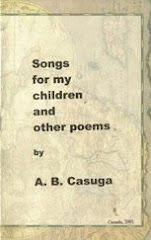
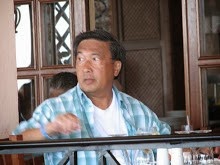
ALBERT B. CASUGA, a Philippine-born writer, lives in Mississauga, Ontario, Canada, where he continues to write poetry, fiction, and criticism after his retirement from teaching and serving as an elected member of his region's school board. He was nominated to the Mississauga Arts Council Literary Awards in 2007. A graduate of the Royal and Pontifical University of St. Thomas (now University of Santo Tomas, Manila. Literature and English, magna cum laude), he taught English and Literature (Criticism, Theory, and Creative Writing) at the Philippines' De La Salle University and San Beda College. He has authored books of poetry, short stories, literary theory and criticism. He has won awards for his works in Canada, the U.S.A., and the Philippines. His latest work, A Theory of Echoes and Other Poems was published February 2009 by the University of Santo Tomas Publishing House. His fiction and poetry were published by online literary journals Asia Writes and Coastal Poems recently. He was a Fellow at the 1972 Silliman University Writers Workshop, Philippines. As a journalist, he worked with the United Press International and wrote an art column for the defunct Philippines Herald.

Wednesday, November 10, 2010

CANADA'S $50,000 GILLER AWARD WON BY DEBUT NOVEL

The Toronto Star's publishing reporter Vit Wagner reported today that Canada's $50,000 Scotiabank Giller Prize, "Canada's most prestigious fiction award," was awarded to Johanna Skibsrub, 30, of New Glasgow, Nova Scotia, who won with her debut novel The Sentimentalists.

(Please click on the images to zoom in on the text of his Star reports.)


THE finalists and  FAQs on their work follows. Vit Wagner, in an earlier report, expressed disappointment that Montreal's Miguel Syjuco, a Philippine-born writer who won the Asian Man Booker Award and the Philippine Palanca Memorial Literary Award for his debut novel Ilustrado, was virtually ignored by the Giller when it was not --- surprisingly --- even included in the longlist of the award despite rave reviews in Canada and internationally. This blog agreed with Wagner in earlier posts.


(Please click on the image to zoom in on the reporter's text. @The Toronto Star.)


Thursday, November 4, 2010

THE DEATH OF A POET: OPHELIA ALCANTARA-DIMALANTA +

Ophelia Alcantara Dimalanta, Poet (1934 – 2010+)


A HOMECOMING DREAM


...I regret to inform you that our dear Ophie Dimalanta passed away shortly before dinnertime in her Navotas home due to hypertension-related illness....she got out of the house, returned promptly because she was not feeling well. She died in her sleep. --- Nov. 4, 2010 E-mail from Wendell Capili, poet and University of the Philippines professor:

To die, to sleep; / To sleep? Perchance to dream. Ay, there’s the rub,/ For in that sleep of death what dreams may come/ When we have shuffled off this mortal coil, /Must give us pause.
--- Hamlet, Prince of Denmark, William Shakespeare


The dreams must include a salon of jesters
Belting throaty ululations announcing her coming
To the party of outpouring angst and crippling blocks.

Are you all poets here? Yarn spinners maybe? Ah,
Sparrows wounded in flight bogged down by fear
Of rejection slips and rancid rancorous reviews!

She will touch them ever so lightly, giggling a little,
Having been there, flying, dying, having done that,
All figures waylaid on her poems’ wake bleeding.

Why write at all when raucously rabid living
Is raunchy enough for the sad and unfulfilled
Who find themselves eunuched by etudes and song?

The salon erupts into muffled moans and laughter,
Crowning its homecoming poet and doyenne,
Proclaiming life and love will trump poetry this time.

Are you all poets here? What rhymes tie you down
When verse and breath and beat must go on flowing,
Or perish with them entangled in death and dying?

A gaping satyr perched on a rock, waits and wails:
Monarch of dreams, lover of lust and life, Ophelia,
You have come home where poems have no dominion.


--- ALBERT B. CASUGA
Mississauga, Nov. 4, 2010


Last April 27, 2009, I posted an entry on Philippine poet Ophelia Dimalanta. I protested her not having been appointed Philippine National Artist, that country's highest artistic award. She deserved it  more than most of the awardees in literature. In my exile, despite a lifetime of writing, I was not qualified to nominate her. But, of course, she did not need it. She is an important Philippine poet who would have lent respectability to the now politically-diminished award.

I am reposting this entry to acknowledge my indebtedness to  Dr. Dimalanta. When I was barely a struggling poet and academic, she introduced me to the literary realm with a preface to my first collection of poems, Narra Poems and Others, published by San Beda College Publiations in 1968.

In 2009, University of Santo Tomas Publishing House (Manila, Philippines) published another collection, A Theory of Echoes  (A Selection of Poems). By nurturing this book through the intracies of publication, Dr. Dimalanta got this collection off the press, and accepted the author's copies on my behalf at its launching in February 2009. Unable to attend, I asked her to accept the books, while I stewed in exile in Canada.


April 27, 2009

OPHELIA A. DIMALANTA: POET AS ARTIST


OPHELIA A. DIMALANTA, poet, critic, playwright, professor, writing workshop director, writer-in-residence, and multi-awarded author, is my nominee for the Philippine National Artist Award. If she is not recognized at this point of her literary life, I shall continue nominating her until she wins a well-deserved title: National Artist.

An exile from the current literary scene of that country, however, I am afraid I will not qualify as a nominator. Neither would I have a voter’s card.

Will my being a life-long literary creature give me some credentials?

As a critic and a reader of Philippine literature for decades now, I believe Dr. Dimalanta should already have been proclaimed national artist. Not that she would need it. Of course, that would even be superfluous. A tautology.

Dr. Dimalanta is an important poet. An author of unassailable credentials, she is by definition an artist who would lend her reputation to that award.

But that would all be prattle if her art would not bear her out. The following poems illustrate the range of her style and content.


MONTAGE

Monday jolts and she bogs down, a ragbag
Splayed off at tangents. Windows
To the outside and flecks of faces
Spring the morning clear at her
To set her into her old dimensions.
Piece by piece she puts on eight o'clock;
Pillows and bedcovers in a tumble pat
Her in place. The clearest cutglass
Of grapefruit juice teetering on a silver
Tray for breakfast-in-bed exigencies
(Both for effect and effectivity)
Is for a fact but fictive in the mind
Which holds the fleeing moment longer,
Stalls the stupor of the previous spree,
Images of her beautiful in blank spaces
Wandering truantlike in private regions
Of the night, wisps of clouds jammed
In one wicked corner of sleep. She hoards
Them like a child at play, triumphantly
Pieces them into a single total perspective:
Splayed off tatters of Sunday, a dark
Undiscipline of clouds settled right
Into this alarming set-up environing
Her Monday-world, jolted suddenly
Into the teeth of everyday people
And cluttering sounds of slapdash.
She exudes it now becomingly
As she glides and putters about
By turns, spreads it as a scent
Ambiguously enwombing her, her form
Dissolved in semi-tones, nameless jewel
Durably ensphered in mist, constantly reborn,
Solid, whole in ever renewing shades.

Montage is the title poem of her first collection which won her first prize in the Philippine Palanca Memorial Literary Award and the best poem in the Poet and Critic Award at the Iowa State University in the USA.

Montage was the “given” central image of a short story I wrote which was published in the student magazine, The Varsitarian – “Monday Morning in a Bus.”


PASSIONAL

Wakes conjure in an uncanny pall,
A kind of sepulchral air evoking
Tombstones turned trysting chambers
For romancing late lovers freed
From life’s containing vaults.
How she hates funerals,
This communal show
Of makeshift grief, as leaden
Feet shove mourners in, deader
Than the mourned dead,
The pale gloss of sympathy
Plastered on thicker than the
Expert’s swab of simulated smile
Upon her own bemused face.
Here she flits around hovering
Over all, once and for all,
Up and about to watch them
Finally mourn her, (miss her?)
For once and then,
Be done, begone!
She is there, and not there,
In the box and everywhere else,
On the wing, her stilled heart
Sprung into the rhythm
Of muted life, a sentence
As purging as real grief,
And as forbearing, and life-giving.

II

They say this is the last to go,
This inward craze, this needling
Ache that starts below, and just
As soon mounts to breast to soul
In a ghostly spiritual surge;
This passion that fires the frame
In mighty thrusts of faith.
Residual spasms and spurts
Have not yet dissipated even
After the last throes, recalling body
As passional, pastoral site
In that sanctifying time out of time,
That one blessed space at once
Uplifted and emancipated.
The last to go they say,
These stirrings in the blood,
Going, going full force
And peaking into theFinal come.
God how she hates funerals
Except her own, that is,
For how exquisitely life’s
Raging now attenuate
Into a warmer crave
That holds a universe.
The body shaken
Into prayer before it
Resurrects ecstatic
Into a longed for
Perfect calm.

Passional is the title poem of Dr. Dimalanta’s sixth poetry collection. Her juxtaposition of a funeral wake and rather “erotic” description of the energy that “is last to go” is striking. Death throes as passion throes are supreme conceits of life, love, and dying. Part II of the poem is certainly one of the best descriptions of how the final death is truly the death of passion, the rigour mortis of the final separation between body and spirit, the final release of a “final come.” The perfect calm and the supreme emancipation of passional release and death release – the poetic juxtaposition is startling and truly poetic.


READ ME


whenever my voice flings arrows
your way at a fiery pace,
read, discover, there is that
something in me
that dies to go gentle.
for when i viciously tangle
with you trying to throw
you off course, inside, i am raring
to cover you, take you, become
all of me fire and water,
flowing, all soft and fluid.
when i try to lord it over, empowered,
it is because inside i am already
slave grovelling, ready to heed your bidding,
crawling waves lapping you up
sea shore hillocks sky
all the way up all drool and drivel,
and when i insolently seek out
pulpits to mount my gospel truths,
i am really one humped question mark
thrashing about for your steadying hand,
and when i try to light you up whole,
there is in fact a part of your flame hence
i would want extinguished
to die rekindled in me alone.
and when i am wind taking roots
in your solid ground, i am roots as well
ready to take flight upon your wings.
when i prance about proud in times square,
i am a child carousing in the greener fringes
of the heart's final roosting.
read this idiolect,
read well, decode, detect,
and love me when i seem to hate.

Read Me as a love poem thrives on the tension built around a love/hate syndrome which becomes the vigorous thrusting, grovelling, thrashing, flowing, crawling, drooling that culminates in the “heart’s final roosting.” This love poem is a superior to Jose Garcia Villa’s Poem 40 (Centipede Poem) as an erotic exercise.


A FEASTING


Stalking hunger takes on varied
Shades and voices; worst is that
Of a child’s whimper in the dark,
An imprisoned cry, voiceless,
Struggling for release, for the open;
Three meals a day, a warming touch,
Sunspace, one’s personal corner
In the most chilling night.
Here they are, all twelve,
Deprivations in all shapes,
Gathered in His bosom,
His Presence, core of light,
As fragile limbs draw strength
And faith from that reaching out,
One magnificent Host in one
Glorious feasting, on a table
Specially laid out for children
And all, in their direst need,
Hungry in more than body,
For more than food, and soon,
Hunger takes on the glow
Of a glorious brightening…
Sunwarm, vibrant against
A backdrop of sheerest dark,
Beyond the deepest blues
And the somber browns
Beyond that hovering gloom,
A grand feasting here, on a table
Laid out for all… each child
A part in us, us children all,
Partaking now of life of love,
Around his radiant presence,
A bounteous feasting
Of faith and ever abiding hope.

The Last Supper does not usually get celebrated in poetry; not even Gerard Manley Hopkins tried. But here is a sublime but altogether real “feasting” for the children “gathered in His bosom”. Here is the Host of the supper that is “laid our for all…each child a part in us, us children all, partaking now of life and love…a bounteous feasting of faith and ever abiding hope.” The Last Supper is, indeed, to this Catholic poet, the First and Everlasting supper: a Eucharist of hope where delicately the poet uses the word “eucharist” without using it.


--oOo--


Ophelia A. Dimalanta was my creative writing professor in my graduate studies at the University of Santo Tomas, in Manila. In one of those classes, she took the podium, read Montage (to perhaps establish her credentials?), and I thought I would write my first submission based on this “performance.” It was written for O. A. Dimalanta:


HOW A POET EXPLAINED HER POETRY
WHILE EUNUCHS SAT DOWN GAPING

(For O.A. Dimalanta)


Eros finds us eunuched and gaping
At hedony begging for Pentecost
Shower the bellydance with fire –
Fire it is makes metaphors frantic
For bedfellows who, stripping bare
The bone of speech, fulfill hollow
Fantasies where moans deliver silences
Deep as the frog’s arrested croak.
“Forgive my bright conceits, Ophelia.”
Conceits are cockfight’s lances
One’s instant mercies, if you may,
Delights rupturing voice-boxes -–
So, bleeding may yet intone unsaid
Music in threnodies clotted
On cockers’ fingers, ganglia garbling
The crow violated on the rooster’s throat.

I don’t remember now what on earth I was trying to say, but the creative writing teacher thought, “there was hardly a dull line.” She was being kind.

--0--

Ophelia Alcantara Dimalanta (born June 16, 1934; died November 4, 2010) was an editor, poet, author, and teacher. She was born in San Juan City in the Philippines. Dimalanta was a full professor of English and has held the position of Dean of the University of Santo Tomas (UST) Faculty of Arts and Letters. She has been a panelist in the UST, UP, Dumaguete and Iligan writers' workshops and a judge in prominent literary award-giving bodies such as the Manila Critics' Circle, Free Press, and Palanca. This status, alongside her teaching experience, has enabled her to reach and influence generations of journalists and creative writers like Recah Trinidad, Arnold Azurin, Cirilo Bautista, Albert B. Casuga, Cristina Pantoja-Hidalgo, Eric Gamalinda, Jose Neil Garcia, Mike Coroza, and Lourd de Veyra.

Dimalanta has several works anthologized in local and foreign journals; has published three books : Anthology of Philippine Contemporary Literature, Readings from Contemporary English and American Literature, and The Philippine Poetic; and a collection of poems, Montage, which won the Iowa State University best poetry award(1969), and first prize in the Palanca Memorial awards for literature(1974).


She was a founding member of the Manila Critics Circle and an honorary fellow of the Philippine Literary Arts Council. In 1999, she founded the UST Center for Creative Writing and Studies and presently serves as its dynamic director.

Cirilo F. Bautista hailed her as "not only our foremost woman poet but also one of the best poets writing now, regardless of gender."
Her poems show the evident influence of T.S. Eliot and Wallace Stevens. Her later poetry draws from a wider range of influences, among them Sylvia Plath, Anne Sexton, and Denise Levertov.

Dimalanta believes that "The older you become and the more mature your art becomes, the more you realize that you have your own identity."

Mrs. Dimalanta also wrote books and critical reviews, handled literature and creative writing classes at the University of Santo Tomas Graduate School, Faculty of Arts and Letters, and De La Salle College . She also aquired a Ph.D. in Literature from the University of Santo Tomas.

In 2002, UST published Dimalanta's verse drama, "Lorenzo Ruiz, Escribano: A Play in Two Acts", with a Filipino translation by Florentino H. Hornedo and Michael M. Coroza. It was premiered on 22-24 February 1994 at UST in a production directed by Isagani R. Cruz. Dimalanta lived with her family in Navotas City.

Honors

* Poet and Critic Best Poem Award from Iowa State University (1968)

* Palanca Awards for Poetry (1974, 1983)

* Fernando Maria Guerrero Award (1976)

* Focus Literary Award for Fiction (1977, 1981)

* Cultural Center of the Philippines Literature Grant for Criticism (1983)

* the Gawad Pambansang Alagad ni Balagtas from the Writers' Union of the Philippines (1990)

* South-East Asia (SEA) Writer's Award from King Bhumibol of Thailand (1999)

From Wikipedia


Paalam, Ophie. Hanggang sa muli nating pagkikita. (In our native Ilocano: Lagip ken ayat iti ipabalun ko kenka, kabsat ko nga man-naniw. Agaluad-ka. Agkitatanto manen, sadin-no man iti papanam.)
Sunday, October 31, 2010

FLORES PARA LOS MUERTOS


....who would fardels bear, / To grunt and sweat under a weary life, / But that the dread of something after death, / The undiscovered country from whose bourn/ No traveller returns, puzzles the will/ And makes us rather bear those ills we have/ Than fly to others that we know not of? --- Hamlet, Prince of Denmark, William Shakespeare


GRAVEYARD EPITAPHS


Flowers for the dead
Rot: the garbage man collects
Dumpster mementos.

Thus, songs for the dead
Become evening echoes drowned
In trash bin clangor.

Remembrances die
With spent candles snuffed
Over silent tombstones.

Flores para los muertos
Are dead flowers in the wind
Though wild winds tow them.

We are fallen twigs
That will not be back on trees
Though wild winds lift us.


--- ALBERT B. CASUGA
Mississauga, October 31, 2010


Wednesday, October 20, 2010

CULTURE WARS: READING/TEACHING LITERATURE IN THE UNIVERSITY'S HUMANITIES PROGRAMS

Should reading Literature be encumbered by literary scholarship, hermeneutics, semiotics, and all forms of "science of meaning"? Would this not miss the "many splendoured thing" sought for in reading for reading's sake? What's not to gain in going back to "naive reading"?

Prof. Robert Pippin's article below should be a clear springboard for more discussion which we hope we could print or re-print in this blog. Please address comments or repartee to albertcasuga@gmail.com Re: Naive Reading.

(This blog repirnts the following New York Times feature as a first in a series of issues dealing with the decline of the Humanities in Universities all over the academic world. A continuation of the debate that sprung some time in the 80s hopes to elicit debate that might focus attention on the "crisis" facing Humanities programs in universities beleaguered by funding problems. Are the Humanities (literature, fine arts, film arts, drama, theatre, languages, etc.) on the way out being considered not critical in finding the unviersity graduate a job?)


In Defense of Naïve Reading

By ROBERT PIPPIN

Reprinted from the New York Times, Opinionator Column, October 10, 2010. The Stone is a forum for contemporary philosophers on issues both timely and timeless.


Remember the culture wars (or the ’80s, for that matter)? “The Closing of the American Mind,” “Cultural Literacy,” “Prof Scam” “Tenured Radicals”? Whatever happened to all that? It occasionally resurfaces, of course. There was the Alan Sokal/Social Text affair in 1996, and there are occasional flaps about winners of bad writing awards and so forth, but the national attention on universities and their mission and place in our larger culture has certainly shifted.

Those culture wars, however much more heat than light they generated, were at least a philosophical debate about values, about what an educated person should know, even about what college was for. All of that has been displaced in the last decade by another sort of discourse: stories about the staggering and growing expense of a college education; the national hysteria about getting one’s children into an “elite” school (or at least one the neighbors might have heard of); the declining impact of a college degree on one’s job prospects; rampant plagiarism; the vast multitudes of part-time or adjunct faculty, usually without health care or much of a future, now teaching our undergraduates; pronouncements on the end of the book, the end of attention spans, even the end of reading itself. But the question of what all this expense and anxiety might ultimately be about, or what the point of it all is, has not surfaced much lately.

It might now be possible to get a different sort of perspective on that discussion of 20 years ago. It is not as if anybody won. The underlying issues ─ especially the philosophical issues ─ have not been resolved. The debate, in the manner of many such public debates and old soldiers, just faded away.

While the public debates may have died down — and while there continue to be such methodological debates in sociology, anthropology and history — it is still the teaching of literature that generates the most academic, and especially non-academic, discussion. There are such debates in philosophy, too, but we tend to get a pass on this issue since debates about what philosophy is have always been one of philosophy’s main topics.

Poems and novels and paintings were not produced as objects for future academic study; there is no reason to think that they could be suitable objects of “research.”

Most students study some literature in college, and most of those are aware that they are being taught a lot of theory along with the literature. They understand that the latest theory is a broad social-science-like approach called “cultural studies,” or a particular version is called “post-colonialism” or “new historicism.” And there are still plenty of gender-theoretical approaches that are prominent. But what often goes unremarked upon in the continuing (though less public) debate about such approaches is that, taking in the longue durée, this instability is in itself completely unremarkable.

The ’80s debaters tended to forget that the teaching of vernacular literature is quite a recent development in the long history of the university. (The same could be said about the relatively recent invention of art history or music as an academic research discipline.) So it is not surprising that, in such a short time, we have not yet settled on the right or commonly agreed upon way to go about it. The fact that the backgrounds and expectations of the student population have changed so dramatically so many times in the last 100 years has made the problem even more difficult.

In the case of vernacular literature, there was from the beginning some tension between the reader’s point of view and what “professional scholarship” required. Naturally enough, the first models were borrowed from the way “research” was done on the classical texts in Greek and Latin that made up most of a student’s exposure to literature until the end of the 19th century. Philology, with its central focus on language, was once the master model for all the sciences and it was natural for teachers to try to train students to make good texts, track down sources, learn about conflicting editions and adjudicate such controversies. Then, as a kind of natural extension of these practices, came historical criticism, national language categorization, work on tracing influences and patronage, all contributing to the worry about classifying various schools, movements or periods. Then came biographical criticism and the flood gates were soon open wide: psychoanalytic criticism, new or formal criticism, semiotics, structuralism, post-structuralism, discourse analysis, reader response criticism or “reception aesthetics,” systems theory, hermeneutics, deconstruction, feminist criticism, cultural studies. And so on.

Clearly, poems and novels and paintings were not produced as objects for future academic study; there is no a priori reason to think that they could be suitable objects of “research.” By and large they were produced for the pleasure and enlightenment of those who enjoyed them. But just as clearly, the teaching of literature in universities ─ especially after the 19th-century research model of Humboldt University of Berlin was widely copied ─ needed a justification consistent with the aims of that academic setting: that fact alone has always shaped the way vernacular literature has been taught.

The main aim was research: the creating and accumulation and transmission of knowledge. And the main model was the natural science model of collaborative research: define problems, break them down into manageable parts, create sub-disciplines and sub-sub-disciplines for the study of these, train students for such research specialties and share everything. With that model, what literature and all the arts needed was something like a general “science of meaning” that could eventually fit that sort of aspiration. Texts or art works could be analyzed as exemplifying and so helping establish such a science. Results could be published in scholarly journals, disputed by others, consensus would eventually emerge and so on. And if it proved impossible to establish anything like a pure science of exclusively literary or artistic or musical meaning, then collaboration with psychoanalysis or anthropology or linguistics would be welcomed.

Will the sciences eventually provide the actual theory of meaning that researchers in literature and the arts will need?

Finally, complicating the situation is the fact that literature study in a university education requires some method of evaluation of whether the student has done well or poorly. Students’ papers must be graded and no faculty member wants to face the inevitable “that’s just your opinion” unarmed, as it were. Learning how to use a research methodology, providing evidence that one has understood and can apply such a method, is understandably an appealing pedagogy.

None of this is in itself wrong-headed or misguided, and the absence of any consensus about this at this still early stage is not surprising. But there are two main dangers created by the inevitable pressures that the research paradigm for the study of literature and the arts within a modern research university brings with it.

First, while it is important and quite natural for literary specialists to try to arrive at a theory of what they do (something that conservatives in the culture wars often refused to concede), there is no particular reason to think that every aspect of the teaching of literature or film or art or all significant writing about the subject should be either an exemplification of how such a theory works or an introduction to what needs to be known in order to become a professor of such an enterprise. This is so for two all-important reasons.

Literature and the arts have a dimension unique in the academy, not shared by the objects studied, or “researched” by our scientific brethren. They invite or invoke, at a kind of “first level,” an aesthetic experience that is by its nature resistant to restatement in more formalized, theoretical or generalizing language. This response can certainly be enriched by knowledge of context and history, but the objects express a first-person or subjective view of human concerns that is falsified if wholly transposed to a more “sideways on” or third person view. Indeed that is in a way the whole point of having the “arts.”

Likewise ─ and this is a much more controversial thesis ─ such works also can directly deliver a kind of practical knowledge and self-understanding not available from a third person or more general formulation of such knowledge. There is no reason to think that such knowledge — exemplified in what Aristotle said about the practically wise man (the phronimos)or in what Pascal meant by the difference between l’esprit géometrique and l’esprit de finesse — is any less knowledge because it cannot be so formalized or even taught as such. Call this a plea for a place for “naïve” reading, teaching and writing — an appreciation and discussion not mediated by a theoretical research question recognizable as such by the modern academy.

This is not all that literary study should be: we certainly need a theory about how artistic works mean anything at all, why or in what sense, reading a novel, say, is different from reading a detailed case history. But there is also no reason to dismiss the “naïve” approach as mere amateurish “belle lettrism.” Naïve reading can be very hard; it can be done well or poorly; people can get better at it. And it doesn’t have to be “formalist” or purely textual criticism. Knowing as much as possible about the social world it was written for, about the author’s other works, his or her contemporaries, and so forth, can be very helpful.

Secondly, the “research model” pressures described are beginning to have another poorly thought out influence. It is quite natural (to some, anyway) to assume that eventually not just the model of the sciences, but the sciences themselves will provide the actual theory of meaning that researchers in such fields will need. One already sees the “application” of “results” from the neurosciences and evolutionary biology to questions about why characters in novels act as they do or what might be responsible for the moods characteristic of certain poets. People seem to be unusually interested in what area of the brain is active when Rilke is read to a subject. The great problem here is not so much a new sort of culture clash (or the victory of one of C.P. Snow’s “two cultures”) but that such applications are spectacular examples of bad literary criticism, not good examples of some revolutionary approach.

If one wants to explain why Dr. Sloper in Henry James’s novel, “Washington Square,” seems so protective yet so cold about his daughter Catherine’s dalliance with a suitor, one has to begin by entertaining the good evidence provided in the novel ─ that he enjoys the power he has over her and wants to keep it; that he fears the loneliness that would result if she leaves; that he knows the suitor is a fortune hunter; that Catherine has become a kind of surrogate wife for him and he regards her as “his” in that sense; that he hates the youth of the suitor; that he hates his daughter for being less accomplished than he would have liked; and that only some of this is available to his awareness, even though all true and playing some role. And one would only be getting started in fashioning an account of what his various actions mean, what he intended, what others understood him to be doing, all before we could even begin looking for anything like “the adaptive fitness” of “what he does.”

If being happy to remain engrossed in the richness of such interpretive possibilities is “naïve,” then so be it.

Robert B. Pippin is the Evelyn Stefansson Nef Distinguished Service Professor in the John U. Nef Committee on Social Thought, the Department of Philosophy, and the College at the University of Chicago. He is the author of several books on German idealism and on theories of modernity. His next book, on the problem of fate in American film noir, will appear in 2011.

Monday, October 18, 2010

THE CHILE MINE MIRACLE: A DISASTER LOVE POEM


ACTS OF GOD


(Please click on image to zoom in on Text.)


All accidents save for Acts of God shall be deemed covered by this insurance policy. -- - Insurance coverage provision.

I lift my eyes to the mountains, from where shall come my help?/ Our help is from the Lord, who made heaven and earth. --- Church hymn based on Ps. 121


Mario Gomez, 63, delivered on his promise:
“Querida mia, donde esta mi beso? Donde esta mi amor?”
Her lips quivering, she flirted on the inserted camera
Snaking through the pit, a cavern of refuge now,
A mansion no less for the indentured thirty-three,
“Ven aqui, Mario mio, si quieres beso, abrazo, y mas!
Ven aca! Venga, venga, viejo. Te quiero! Te quiero!”
Sobs arrested in her throat betrayed her when she bade
Him to stay puissant, she needs her virile man strong.

Those daily papelitos between lovers saw them
Renewing their nuptial vows: when you come out,
Not if you come out,  we will get married once again
At the Iglesia on the hill, and offer our four children,
Our shrivelled skins, our shack, our mortgages, our debts,
Our dwindling years in grateful celebration to El Senor,
Y todos los santos , Who is our help, our true salvation.

Daybreak brought to its amazing plenitude the skills,
The survival tacks, the fattening of starved psyche,
The miracles of man and his science:

They’re out! Lazarus manqué!

They’ve surfaced the heroic thirty three! Sterling silver
Not unlike those Judas ransom , they ascended one
By quivering one, all clutching rusty crucifixes in praise
Of a God who was not in the sealed cavern even as they
Prayed: Our help is from the Lord, who made heaven
And the temblors of this earth.

What does it matter that Seguridad de Oro considers
This entombment non-coverable by mining insurance
Because it was an Act of God? After all, the caving in
Was in great pursuit of gold and silver, metals to shore up
The sinkholes of cities calcified in the manners of greed
That will not serve His greater glory, wherever He has gone
In the caverns of this empty, now liberated cave.
Mario Gomez will have his kiss, hugs, and more.


-- ALBERT B. CASUGA
Mississauga, October 18, 2010

Tuesday, October 12, 2010

A FALL POEM: TWIGS


HAIKUS ON TWIGS


Autumn ---/ even the birds/ and clouds look old.
                                                 --- Basho


1.
Autumn leaves leave twigs
When wild fall winds shear branches
Of their brittle foliage.

2.
Twigs cast thin shadows---
Like trembling fingers, clutch air
For their treetop tuck.

3.
They cannot hold on---
Twigs must break away like sons
Preening as oak trees.

4.
Twigs cracked by wild wind
Fall pell-mell on bristly grass,
Burn as quickly too

When fierce sunrays turn
Valleys to tittering flame:
A covenant with spring.

5.
When twigs break away,
Shorn saplings do not take them
Back as prodigal branches

Like shadows swallowed
By sunsets gone past mountains
Lost to murky nights.

6.
O, we are fallen twigs
And will not be back this way again
Though wild winds lift us.


--- ALBERT B. CASUGA
Mississauga, October 12, 2010

Friday, October 8, 2010

MARIO VARGAS LLOSA WINS NOBEL LITERATURE PRIZE

NOBEL PRIZE IN LIT WON BY WRITER-POLITICIAN LLOSA


Thursday's The National Post reported and carried a New York Times story on this year's Nobel Prize in Literature winner. Mario Vargas Llosa, a Peruvian, is the second South American to garner the 10 million kroner ($1.5 million) plume. Gabriel Garcia Marquez won the Nobel in 1982.

(Please click on the image to zoom in on text.)


A Mario Vargas Llosa: Felicitaciones! Bravo!


Wednesday, October 6, 2010

CANADA'S GILLER FICTION PRIZE LISTS FINALISTS

SMALL PRESS PUBLISHERS DOMINATE

Toronto Star's publishing reporter Vit Wagner reported Tuesday's choices which largely ignored entries from past winners of the Man Booker Literary Prize. The $50,000 book award is Canada's most sought-after literary prize.

(Please click on image to zoom in on text.)


Wagner says: "The 2010 finslists, revealed Tuesday in Toronto, are as subject to debate as those of any other year."

This year's panel of judges: Canadian broadcaster Michael Enright, U.S. novelist Claire Messud, and U.K. author Ali Smith. 38 publishers submitted 98 books.

Favourites Asia Man Booker winner Miguel Syjuco (Ilustrado) and UK Booker finalist Emma Donoghue (Room) were shut out from the previous 13 longlisted authors.


Saturday, October 2, 2010

A HAMMOCK SONG: REMEMBERING JAYJAY

Photo by Bobby Wong Jr.


A HAMMOCK SONG


(For Julian Ashley+, October 2, 1984-January 30, 1885)

It is the Sea eats limb so life (so love)/ may not to its eternal wanting finish/ what it late started must soon deny:/ a clown’s journey through a circle’s shadow. . .


Another fishing season would have gone
by sundown, but I have stopped counting
and stopped fishing, too; think of all the bass
that got away and the crayfish dried brittle
on rocks laved clean of seaweed and brine,
ebb tide marking rhythm and time when
breaking waves drown the homeward hallos
of fishermen pulling empty nets and ruined
mesh dragged off by catamarans whose relics
now jag brackish breakwater rocks when
low tide retrieves stray shells wrapped in flotsam.

It is my hammock hour. Come swing yourself
on this final refuge. Don’t take too long, hijo.
We have groupers to grill, oysters to chuck!

Echoes of your shrill shrieks and laughter startle
me still when I cock my ear to catch them
filling rooms and spaces that I would have shared
with you if you had only given me the chance
to teach you how to fish. But you left without
saying goodbye. At sundown, though,
on my hammock hour, I still hum your lullaby.


--- ALBERT B. CASUGA
October 2, 2010, Mississauga


On October 2, Julian Ashley  Casuga-Dela Rosa, my first grandchld,  would have been 26, but he succumbed to sudden infant death syndrome four months after his birth.

I wrote an earlier poem marking his passing, "For the Grandson Who Did Not Choose to Stay", which I reprint together with the new poem above in his durable memory. O, how we could have gone away fishing, had he stayed longer. Con amor duradero, hijo mio.

(Please click on the image to zoom in on the text.)