My photo
ALBERT B. CASUGA, a Philippine-born writer, lives in Mississauga, Ontario, Canada, where he continues to write poetry, fiction, and criticism after his retirement from teaching and serving as an elected member of his region's school board. He was nominated to the Mississauga Arts Council Literary Awards in 2007. A graduate of the Royal and Pontifical University of St. Thomas (now University of Santo Tomas, Manila. Literature and English, magna cum laude), he taught English and Literature (Criticism, Theory, and Creative Writing) at the Philippines' De La Salle University and San Beda College. He has authored books of poetry, short stories, literary theory and criticism. He has won awards for his works in Canada, the U.S.A., and the Philippines. His latest work, A Theory of Echoes and Other Poems was published February 2009 by the University of Santo Tomas Publishing House. His fiction and poetry were published by online literary journals Asia Writes and Coastal Poems recently. He was a Fellow at the 1972 Silliman University Writers Workshop, Philippines. As a journalist, he worked with the United Press International and wrote an art column for the defunct Philippines Herald.

Tuesday, July 7, 2009

PART 4: AN AESTHETIC THEORY FOR TEACHING LITERATURE AS A HUMANISTIC DISCIPLINE

AN AESTHETIC THEORY

An aesthetic theory the teacher may subscribe to may be built around the concepts of beauty and pleasure derived from literary appreciation.

Pleasure should include “delight”, “interest”, “attention”, or “knowledge “ of a distinct human feeling. It is the satisfaction of this aesthetic attitude which is conceded as the experience of that which is “beautiful”. Invariably, it is also that which is termed as “beauty.”

What is beauty?

A definition of this concept can lead to all kinds of fruitless distinctions. There are those who say it is a gestalt of qualities which pleases the appreciator that could be recognized from the object per se. George Santayana (The Sense of Beauty) expresses the bias of subjectivists who say that beauty is the relative human response of delight peculiar to man as the ultimate measure (“estimator”) of things. Still, there are those who believe that it is the communal apprehension of objects which is influenced by culture, mores, civilization, and Jungian Weltanschauung (1)

Thus, one could be led to absurdities like one man thinking his wife is “beautiful” despite the universal awareness of his wife’s face as that which only he and his mother-in-law could love. Of course, this is dictated by connubial “correctness”.

If beauty were in the object, what happens to beauty when the object is not there as a phenomenal reality, but the subject (appreciator) still experiences pleasure or delight from something perceived reflectively or even reflexibly? Then, why do some Caucasians think their white contestants in beauty contests (or vice versa the “coloureds”) more beautiful than the Negro representatives of the African race? Why does a swarthy Filipino male have a peculiar penchant for “mestizas” (fair skinned damsels)? Is this a colonial hangover of what is considered superior and beautiful?

Resolving these divergent views, one can very well concede that if beauty is the satisfaction of one’s aesthetic attitude, then all three views must necessarily be admitted. Thus: Object + Subject + Relative Cultural Standards = Experience of the beautiful or beauty. Anyway, one can still accept the Thomistic definition of beauty as “that which when perceived pleases the eye” (id quod visum placet); i.e., involving not only the senses but also the intellect and the requisite will-ful (emotional) response. (2)

The artist, engaged in the creation of literature worth spending precious lifetime on, spends the greater part of his life preparing himself for this task of catching truth by the tail. This activity required tremendous effort. One does not simply sit by passively. True, the artist moves by “sitting” (aspiring for reflections in tranquility) – but this is his Upanishad: a sitting before the awesome enigma of reality so that he may be suffused with the mystery of it all, and he becomes one with the enigma only to define the darkness that has possessed him, thereby telling the beholder who he is. “He brings forth the light.”

When he works on his art, therefore, he employs all instruments within his command. His effort alone should require from the appreciator a semblance of equal, compassionate effort – one that borders on delicate marvelling which finds its anchor in the real, the true, and the beautiful. But there are writers and there are writers; the appreciator’s caveat is to have a discriminating taste.

NOTES:

1 The comprehensive world view which is characterized by the eminence of the Universal Unconscious; each man participates subliminally or even fundamentally in this awareness of parallel human experiences. Carl Gustav Jung (1875-1961), a Swiss psychologist, stresses the contributions of racial and cultural inheritance to the psychology of an individual.

2 St. Thomas Aquinas, Summa Theologica, Part I, Q. 1, A 9, Rep. 1 8d-9c; Rep. 3 768-769d. The Great Books of the Western World, R. M. Hutchins, ed., Encyclopaedia Britannica, Inc., Chicago, 1952.

(Next in the Series: Theories of Literary Analysis, Literary Criticism, and Literary Evaluation.)

Monday, July 6, 2009

PART 3: A LITERARY THEORY FOR TEACHING LITERATURE AS A HUMANISTIC DISCIPLINE: APPROACHES TO LITERARY APPRECIATION

The art appreciator invariably starts appreciating the object of art from a sensory plane. In other words, he is confronted by the phenomenal structure if not physical appearance of the object of art. He senses the articulated medium in terms of a recognized content (subject matter) thereby apprehending a gestalt of unified elements in the form. He is expected to react or respond emotionally to this form. But this response is engendered by his sensory recognition of the materials (medium) whose significance he interprets in terms of certain stock associations or significance ordinarily associated with the medium and its articulation as symbol of latent experiential responses. Ultimately, he renders a value judgment on the worth of such an apprehended and comprehended significance. What he has been after all the time is a recognition, interpretation, and evaluation of a meaning. Upon this meaning rests the satisfaction of his aesthetic attitude.

The approach most often used in literary appreciation is primarily formal; i.e., starting from the object result (building in architecture, the poem on the page in literature, etc.); but the entire process does not preclude such other approaches as the historical approach (in the criticism of styles peculiar to art periods; viz., Hellenic style to Pop, to Dada, etc.); or the archetypal approach (in the criticism of how well the technique serves the artistic purpose of concretizing the aesthetic experience; i.e., techniques vary from Art Period to Art Period, from mood to mood, movement to movement; hence, some artistic traditions may be found reflected in an object of art like the mythical material of literature).

Neither does the formal (textual) approach discount the psychological approach in the criticism and evaluation of the artistry of the author’s style and technique --- these are processes proceeding directly from the personality of the artist, specifically his creative process.

Finally, the appreciator is called upon to evaluate the significance of the object of art confronting him --- in this occupation, he cannot but summon meanings and/or values derived from an awareness of the human condition exemplified in human life (moral), values affecting man as a social being (sociological approach), values affecting man as a rational animal moving with and moved by ideas and ideology (philosophical) approach. (1)

Is not analysis of the articulated medium and content (to get at the art’s “point”) enough in the appreciation of a work of art? Why is there a need for the criticism of its style and its technique? Why must there be an evaluation of the significance of the work of art? How do these two latter processes help in the achievement of an aesthetic experience (satisfaction of the appreciator’s aesthetic attitude)?

To the first question may be given an answer which, although non-conclusive, is sufficient. It (analysis) is a valid approach; however, it may not be enough for a keener and more intelligent appreciation of art (the italicized words are concepts consistent to art’s ultimate reference to and realization in the rational nature of man). After all, if after analysis one simply comes across the meaningful experience and purpose of the artist, one may still not have been aesthetically satisfied. This stems from the fact that the experience is not what is artistic nor beautiful. What is artistic is the artist’s articulation and use of his medium and the presentation as well as ordering of the selected details of his content (style and technique). It is from the Style and Technique of the artist that the appreciator apprehends and comprehends that which comes closest to the approximation of beauty --- that found in an ordered design or in re-ordered reality.

If after analysis and criticism, the appreciator experiences a satisfaction of his aesthetic attitude, but would not be able to recognize the value of his experience, of what good was the appreciation after all? Would it not merely be an exercise of awareness? Would not evaluation place in proper perspective a thing of beauty? That “proper perspective” might be defined as its (thing of beauty) participation in the ever widening experiential horizon of man as the ultimate measure of things; man who, in this century, is not only homo sapiens but endlessly proving to be homo symbolicus; i.e., the man who has continued Adam’s preoccupation of naming things, hence, making them his own.

The teacher, therefore, must realize that from the point of view of the student-appreciator, the following concepts are significant: the satisfaction of the aesthetic attitude, what satisfies this attitude, taste and beauty (taste as an identification and expression of recognition-appreciation of art as objects).

Seen from an overview, the aesthetic theory the teacher may adhere to may be built around the following pivotal facts about aesthetic appreciation.

In fine, when the appreciator beholds the object of art, he is expected to proceed from the structural presence of such an object as a phenomenon. He analyzes from this form certain meaningful symbols which have been used to concretize the creator’s aesthetic experience. From this, he arrives at the context of the creator’s meaning as well as eventually, his experience. This experience reveals the purpose of the author-artist. Either this meaning is adequate material for the appreciator’s emotional or wilful response or not.

Using the recognition of meaning as a springboard of reaction, the appreciator may then criticize whether the artist’s use of media, content, and form is skilful and purposive; i.e., does his use of these materials serve the artistic purpose of objectifying the experience?

Since medium, content, and form in themselves do not constitute that which is artistic, one may say that it is in the application of human dexterity where one may recognize that which is artistic. In other words, artistry rests in the creator’s style and technique.

Finally, the appreciator evaluates his aesthetic awareness of the object of art in terms of certain universal (2) and particular values (3) as informed by his subjective apprehension and comprehension of art and its details.

The entire effort of analysis, criticism of style and technique, and evaluation is expected to result in the satisfaction of the aesthetic attitude of the appreciator. It does not matter whether or not his response if sympathetic or antipathetic. There would still an appreciation, an aesthetic response. Strictly speaking, of course, this response is and should be pleasurable for it to be worth investing precious lifetime on.

NOTES:

1 Wilbur Scott, Five approaches of Literary Criticism, pp. 23-26, 69-73, 123-126, 179-184, and 247-251, Collier-Macmillan, Ltd., London, 1962.

2 Universal values in art are those which have been gleaned from literature, history, culture, civilization, mores, etc. that apply to the content of the work of art as communicators of universal significance. Particular values are those peculiar to the genre. These are evaluative criteria that measure the aesthetic value of a given literary piece. They are outstanding value characteristics common to works of the same form; therefore, they are gleaned from a broad area of appreciated work in any given form.

Artistry or expressiveness as a value is common to all fine art. It has something to do with the artist’s application of a skill on his medium and content to shape up an aesthetic form. Other values which are universal by virtue of their being endemic in all art are: intellectual value, suggestiveness or emotional value, spiritual value, permanence, universality. These values find their cogency in age-old artistic doctrines; viz., the intellectual value of art is consistent with the formative function of art enunciated by classical civilization. As a value, it takes the form of the work of art’s ability to present a fundamental truth about the human condition; the appreciator, appreciating this, will have a new insight into the meaning of human life. Suggestiveness is moored in the theories of Modern Art, principally those enunciated in the Romantic Movement where the power of the concrete to suggest meaing was prominent.

3 Particular values governing the evaluation of works as being either “good” or “bad” proceed from the education of an individual’s taste. This taste can only be educated by a liberal sampling of all known and conscientious work of a given form; vide., Gerald Sanders lists down in his A Poetry Primer, pg. 6 et seq. (Holt, Rinehart, & Winston, N.Y., 1962) the marks of a good poem.

Taste and beauty are two distinct concepts. Beauty satisfies the taste, where taste is the aesthetic attitude of the appreciator/artist. This attitude must be trained to respond to proper aesthetic stimulus, and benefit from such a response. The aesthetic attitude is one’s capacity to react to a design purportedly poised to solicit an emotional response, attention, interest, and delight. (See Nikolai Shamota, "On Tastes in Art (The Soviet View)", Aesthetics Today, Morris Philipson, ed., pg. 27 et seq. The World Publishing co., N.Y., 1964. the essay of Shamota discusses the development of an educated taste.)

(Next: Part 4. An Aesthetic Theory for Teaching Literature as a Humanistic Discipline.)

Sunday, July 5, 2009

PART 2: A LITERARY THEORY FOR TEACHING LITERATURE AS A HUMANISTIC DISCIPLINE

What is literary appreciation?

Appreciation presupposes the recognition of an experiential object; the apprehension and comprehension of its significance as an independent entity, and as an object that becomes meaningful only when the perceiving subject (appreciator) assigns it sensory, intellectual, and emotional meaning; the evaluation of the object as a phenomenon with a distinguishable form and content, and as an objectification of an experience (1) which reflects certain values that satisfy given purposes and attitudes of the attentive appreciator.

Appreciation involves the analysis of the meanings (2) as expressed and concretized in its formal structure; the criticism of how well the style (author’s use of medium, content, and collateral devices) and the technique (author’s manner of presenting and arranging his materials (3) serve the artistic purpose of objectifying an emotionalized experience; and the evaluation of its significance vis-à-vis the needs of the appreciator. (4 )

Art (in this case, literature as a fine art) as the object of appreciation is itself an experiential object (a result) which stems from the application of human dexterity (5) on certain given or created materials which, when articulated, objectify or concretize an emotionalized or subjectified experience that ultimately satisfies any proceeding or preceding aesthetic purpose. (6)

In the appreciation of the meaning of a fine art, certain basic premises have to be understood by the appreciator. The most significant would be the fact that a “result” in the application of dexterity becomes a “virtual reality” upon creation – its subjectification and objectification.

In the first place, the “result” as a fine art is in itself an objective phenomenal reality. It follows the logic of the experience that the artist has tried to express. Its existence is derived from the articulation of its materials in terms of a content that reinforces the meaning of a completed form. (7)

How does this “virtual reality” come about? What does it mean to express one’s idea of some inward or subjective process into some outward image? Since much of intelligent art appreciation depends on the understanding of the artistic process, these are good questions to answer anteriorly.

To the first: the artist’s exercise of skill accomplishes this. By skill is meant the ability (agility, virtuosity, originality, imaginativeness) of the artist to express his otherwise latent experience of a thing, place, or occurrence in terms of objects. Expression could either take the form of re-creation or the creation of an experience. (8 ) Objects could take the form of the articulated materials which become meaningful because a distinguishable content informs it.

Sussanne K. Langer in her Problems of Art provides a definitive answer to the second question, to wit: “It means to make an outward image of this inward process, for oneself and others to see; that is to give the subjective events an objective symbol. Every work of art is such an image, whether it is a dance, a statue, a picture, a piece of music, or a work of poetry. It is an outward showing of an inward nature, an objective presentation of a subjective reality; and the reason that it can symbolize things of the inner life is that it has the same kinds of relations and elements. This is not true of the material structure; the physical materials of the dance do not have any direct similarity to the structure of emotive life; it is the created image that has element and patterns like the life of feeling. But this image, though it is a created apparition, a pure appearance, is objective; it seems to be charged with feeling because its form expresses the very nature of feeling. Therefore, it is an objectification of subjective life, and so is every work of art.” (S.K.Langer, Problems of Art, pg. 9. Routledge & Kegan-Paul, London, 1957.)

Several things, therefore, are involved in this creative process. One, that the work of art is an “objective presentation”, and two, that it is a “subjective reality. Let us look into the creative process to understand this.

Appreciating the Creative Process

Suppose a man, “B”, encounters a woman carrying a child while boarding or disembarking from a dirty, sooty, blackened locomotive in a stinking metro station. “B” is struck by the sensory experience, and he associates as well as interprets the scene as resembling the juxtaposition of an ordinary thing against a backdrop of something ugly and repulsive. The ordinary object is thereby contrasted to the backdrop of something ugly. “B” interprets this as a manner of making the ordinary appear even beautiful or interesting. He responds to this scene quite sympathetically. He is delighted by this realization. Forthwith, he sits down and writes about this experience (which obviously has gone through the three levels of experience --- sensory, extero-intellectual, and concupiscibly emotive experience). He chooses to express his experience in the form of poetry (it is the imagination which suggests the form). Thus:

The apparition of these faces in the crowd;
Petals on a wet, black bough.
(9 )

In terms of linguistic (orthographic symbols) devices, he has managed to concretize or objectify his otherwise abstract emotional response to the scene. If he uses the metaphor at all, it is in pursuit of this same purpose. It gives a “figure” to the aesthetic response he is concretizing. He, therefore, approximates the sudden flash of insight with this pithy two-line haiku-like poem which he entitles “In a Station by the Metro”.

Where is the virtual reality here? The poem in those two lines is the illusion of reality. Now, it is itself a reality --- the reality of the poet’s emotional response, something separate and distinct from the actual experience at the metro. How is this reality supposed to be appreciated? Will it be appreciated as an “imitation” of the scene at the station? Certainly not.

If it were appreciated as an imitation of reality, (10) it would be inferior to the natural experience; therefore, it would not be as significant as “B’s” experience in the stinking station. It should, therefore, be appreciated as in itself another experience shaped up with a certain medium in a certain style and presented in a certain technique.

If this premise is considered prior to analysis, criticism, and evaluation, the appreciator cannot but start with the art as an objective appearance or entity.

Consequently, the appreciator, confronting the art as an object, reacts to the articulated materials (elements of medium, content, form, and meaning) sympathetically or antipathetically. His reaction involves the satisfaction of his “aesthetic attitude,” popularly called his “taste”. It is this taste which responds to the virtual reality which is the object of art.

Appreciation demands that this taste respond to the “right things” for the “right reasons”. What it does respond to is the objective composition primarily, as its (composition) appeal is first to the senses. Hence, before assigning any meaning to the object, the appreciator should first make the necessary relations from the formal composition of said object. (11) Otherwise, approaches adopted may go into all kinds of irrelevancies; thus, the incidence of unintelligent, charlatanic judgments about an object of art. (12)


(Next: Part 3 Approaches to Appreciation)

NOTES

1 “Experience” here refers broadly to anything that occurs to man as the ultimate measure of things. Although experience may occur on three different levels – sensory, intellectual, and emotional – the proper material of art is that which occurs co-functionally on all three levels. Thus, anything that impinges on the senses of the artist is interpreted in the intellect and responded to as a related material by the will (emotional response). There are as many sensory experiences as there are external senses; i.e., visual, olfactory, gustatory, auditory, kinaesthetic, erotic-sensual, visceral, and thermal. Intellectual experience may be those that proceed from within – reflective (intero-intellectual), and those interpreted from without (extero-intellectual). Emotional experience may either be concupiscible or irascible, sympathetic or antipathetic respectively.

There is no sense limiting the realm of celebration for art – it spans the whole universe of experience. The classical standard of magnitude or sufficient significance for the object of art is utterly controversial to remain as a universal standard for measuring experience fit for artistic attention. From the time of the Romantics, the area of experience proper for artistic celebration has been radically expanded to mean total liberation; hence, any experience may be used by the artist for his content. It is, after all, the skill that he applies on this content and his medium which makes any experience significant and artistic.

2 “Meaning” or significance is derivable from as many planes as there are experiential levels. Thus, the beholder may realize a simple sensory meaning (using the word loosely to signify organic responses --- the physical sensory structures responding to their proper stimuli; viz., visual sense to light and its various compositions like colour). The significance is normally derived from the primary materials of the medium; i.e., the colour in painting, the orthographic symbols used by written language in literature, etc. The content or subject matter of the work of art is the proper material for intellectual associations and/or relations; viz., the figures of a mother and child in Picasso’s “Artists” may be responded to by the appreciator apart from the colours used by the artist, (in this case, pale grey for the flesh, and cool colours for their clothes). The figures provide a shape to the articulated medium. It is this element which provides the intellectual meaning of the physical structure coming to the beholder as a painting (intellectual, because the figures are those chosen by the imagination and interpreted by the intellect as appropriate to the artist’s aesthetic experience.) Intuitively, an appreciator may respond forthrightly to discerned form – and sans sensory or intellectual apprehension and comprehension of said form (unified in a gestalt), he feels a significant reaction. Thus, the age-old “goose pimples,” “chill,” or “thrill” criteria for good art. This may be categorized as the emotional meaning of the work of art. Strict interpretation of “meaning”, however, demands the three levels co-functioning with each other in the unified form concretizing the artist’s aesthetic response to any type of stimulus he “takes fancy on.”

3 Style refers to the author’s use of his medium in the concretization of his experience. It involves the use of words, for instance, (their denotations, connotations) and their various arrangements, their tonal energies (predominant content sounds, rhyme, rhythm, organized sounds), the figures (of thought, speech, and language), and the selection of details used for the objectification of the experience.

Technique is the manner of presentation adopted by the artist in achieving his artistic purpose. A study of style and technique is a study of the artistic design in the form. In literature, the artistry of the literary piece is best perceived in the study of these two elements.

4 Since meanings are assigned by the appreciator, he will have to be the same arbiter of the value of such meaning to his various needs. If the value he is looking for has something to do with the reflection of the social conditions in the work of art, then that work of art will be valuable only to the appreciator if he realizes the presence of social values in the work confronting him. Evaluation, or the rendering of judgment on the values of the work of art, may be based on: 1. Universal values of art as a communicator of experience; 2. Particular values of the literary form or genre; and, 3. the subjective values of the appreciator (those he realizes from his reading of a liberal sampling of works in different literary forms and values derived from his life style).

5 “Dexterity” here refers to the skill of the artist in shaping up his experience in terms of his objective materials. In the process of creation, he hews his skill close to his style and technique. “Materials” in fine arts are objective in the sense that they are primarily concrete and material. They may be classified into the primary and secondary. For instance, colour, line, and chiaroscuro are primary materials in painting; brush strokes and texture of the canvas are secondary. In literature, language is the primary material; it is charged in terms of literary devices so that it could emotionalize an experience; viz., a metaphor charges a group of words by making that which is abstract concrete: “love” is abstract; “love is a red, red rose” makes it concrete. Now, the appreciator can react emotionally to the phantasm he would make of the “red, red rose” which is the objective correlative of the concupiscible emotion “love.”

6 Art in general assumes several types and forms depending on what purpose is taken by the human being as purveyor of skill. While all art stems from the expression and concretization of an experience, what makes them different from one another is the purpose behind their creation. Thus, if the object serves a practical purpose, it may be classified under the practical or mechanical arts; if the object by its operation serves an ideational (definition, clarification, and utilization of ideas) purpose, it may be termed a “liberal” art; if the object serves primarily to solicit and satisfy a human feeling or emotional response (aesthetic pleasure – delight, attention, interest, etc.), it may be classified as a “fine art.”

The fine arts may be classified into: 1. Static, or 2. Dynamic by reason of the articulation and nature of their materials. The static arts are: architecture, painting, and sculpture. Still photography may also be considered as such. The dynamic arts are: music, literature, dance, drama as theatre, film as movies (cinema).

7 Form refers to the combined and articulated structure made up of the medium shaping up the content and vice versa. Content is the subject matter of the artistic result. It may either be the human being or his various appurtenances. It is that which is interpreted intellectually.

8 Expression in art actually involves the two processes of “re-creation” and “creation.” When an experience is re-created by an artist, it is understood that the result is an imitation of the artist/s aesthetic conception of the stimulating experience which he has interpreted and responded to. Re-creation may also be interpreted as the interiorization of the stimulating experience which results in the artist’s aesthetic experience.

Creation may be understood as the making of a virtual reality our of the artist’s aesthetic response to any stimulating experience within or without. The medium plays a great role in the creation. It is sometimes the medium which defines the experience or content for the artist. Thus, language and its peculiar combinations can sometimes complete a peripheral experience which at the moment of creation is impinging on the artist’s ken. If the artist proceeds from a well-defined idea of what he will concretize, creation takes the “centrifugal” movement of the kernel idea getting developed in its various aspects by other ideas. It takes the “centripetal” movement when the artist proceeds from something vague and peripheral and he uses his medium and content to complete or define such an experience. So he gives vent to his intuitive faculties and “plays” around with his medium until he stops with something that excites him into an aesthetic experience – this is interpreted as the completion or objectification of the erstwhile vague or nebulous experience.

9 Ezra Pound, “In a Station by the Metro”

10 “Imitation” here is being taken in its narrow sense – that it is a de rigueur (because photographic) copying of the experience that stimulated the artist. Imitation from the point of view of the Classical Art critics is the artist’s representation or reproduction of his conception of the essential nature of reality. (For a discussion of Aristotle’s theory of imitation, see Aristotle’s Theory of Poetry and Fine Art, “Imitation as an Aesthetic Term,” II, pg. 121. s. H. Butcher, trans. Dover Publications, 1951).

11 The objective composition alluded to here is the “form” which consists of the articulated medium and content. As a physical and structural appearance, its appeal is first through the senses. Even at this point, impressions on the meaning of the objective artistic form may already be obtained. Mood and tone may even be pronounced. In painting, it is how the lines, colours, and chiaroscuro are shaped in terms of a content or subject matter (if the artist is using the Objective Style or Representational Style) which strikes the senses.

Since the physical appearance of the artistic result is first apprehended by the senses, what normally comes next is the comprehension of these sense experiences. The intellect ordinarily works on the images and phantasm provided by the imagination and associates these with stock experiences and/or vicarious experiences in order to place the new experience in a “point of reference or departure.” What is being emphasized here, therefore, is that the intellectual references proceed from the formal presence of the work of art. That is its empirical basis.

In the interpretation of the significance of contextual and structural units of the work of art, the appreciator who is abstracting meaning from the objective elements of the physical structure may attribute significance which may not logically proceed from the perceived elements. This mnemonic irrelevancy is caused by his attributing meaning or associations (references) which are not verifiable because they do not have a correlative in the objective composition of the work of art. Thus, a word in a poem may excite in the appreciator a meaning which is out of the poem’s purview. This may be caused by certain free associations made by the appreciator from the images he “senses” in the words and their peculiar semantical and syntactical arrangements.

(See I.A. Richards, “Analysis of a Poem”, Principles of Literary Criticism, pg. 114 etseq, Routledge & Kegan-Paul, Ltd. London, 1961. This essay provides a discussion of how the words suggest images which are interpreted and evaluated by the reader through various modes of associations and references. Richards suggests the incidence of irrelevant assignation of meaning in these terms: “This common mistake of exaggerating personal accidents in the means by which a poem attains its end into the chief value of the poem is due to excessive trust in the common places of psychology.”)

12 Because one’s judgments are not based on values obtained from meaning analyzed from the empirical base of art or a work of art (the objective form), they often become arbitrary, if not overbearingly unintelligent. They are best myopic impressions which ultimately do not lend justice to the effort employed by the artist in the work of art. Normally, before a value judgment is given, the appreciator must have analyzed the work for its meaning and must have criticized the artist’s use of his medium and the presentation of his concretizing details (style and technique respectively). Evaluation is the expression of an opinion based on an intelligent and discriminating exercise of taste.

-o0o-

(Second Part in a series of essays on Literary Theory for Teaching Literature as a Humanistic Discipline.)

Friday, July 3, 2009

PART 1: A LITERARY THEORY FOR TEACHING LITERATURE AS A HUMANISTIC DISCIPLINE:

When literature as art is referred to as a humanistic discipline, its role as a definer of reality, knowledge, and truth is assumed. This is usually presented as a rationale for the study of literature.

The student, in search of a fundamental premise, must realize and accept that literature as art is simply an instrument which man may use to achieve the realization of his essence (where it is definer of reality, art can only succeed in bringing the appreciator closer to an awareness and comprehension of his circumstances; through this knowledge, he enables himself to cope with the demands of these appurtenances).

As far back as the classical antiquity (Aristotle, Plato, Horace, Longinus) to the confused contemporary times, what remains unsullied and unchallenged is art’s function of contributing to the formation of man’s essence (his rational nature). Classical literary tradition subscribed to this formative function that: “art is formative in the most valuable sense by assisting man to fulfill his own end. For man’s end is to complete himself: to carry out, to the fullest extent, what is best and most distinctive in him. And what is best in him as an aware creature, is the capacity to realize what is without, to profit and grow by means of this knowledge, and to react, and desire in accordance with the awareness that has informed him.” (W. J. Bate, Criticism: The Major Texts, pg. 6, Doubleday Anchor Books, Garden City, 1959)

Modern literary tradition, while shifting its mode of awareness from the illusive universal forms to concrete, particular realities, has never ceased to consider that man continues with his primordial activity of knowing and naming things through his art. If classical tradition gave premium on knowing through the conceptualization of universals, modern tradition emphasized the feelings as modes of cognition based on the senses, imagination, and intellectual interpretation.

All this is a synoptic hindsight – even a foresight – of how literary tradition has assumed that imaginative literature as a fine art is a way of knowing man and the complexus of his circumstances with the end in view of understanding himself, his final end and cause, and his ultimate destiny as a homo viator (man on a journey). In fact, the essential humanism of classical civilization is restated throughout the dialectical counterposition of moods and movements in art; viz., Classical art was anthropocentric, Romantic art was the point of departure for the use of the imagination and feelings as cognitive faculties (the German Einfuhlung of the Theory of Imagination is an example – the knowing of things through an empathetic participation of the appreciator in the suggestive form’s continuing creation: the appreciator becomes himself the artist as his imagination and feelings complete the form of the art work being perceived) to mention only a couple. (Bate, op cit)

Stretch this point to the most contemporary artistic mood, and one finds in Pop Art—which branches out from Dada – the artist’s attempt to extend his realm of celebration to life itself where art becomes life and vice versa; in brief, art is not simply knowing man’s life now, but it has also become one with life; hence, ars gratia homines.

What the foregoing discussion is hammering at is the cognitive function of art (in this case literature) where man comes to terms with realities through the concrete art forms as factotum of rational faculties.

Since art is one such instrument, the student will recognize that the process toward the achievement of observable meaning in the concrete form must be empirical. This proceeds from the premise that one comes closer to the knowledge of truth and reality when art is perceived in its concrete, particular, palpable form because it (art) is itself real, concrete, verifiable, and true. Therefore, appreciation, to be of service to the student as homo sapiens (knowing man), must be firmly based on its empirically articulated elements. Analysis as a method of appreciation is, forthwith, justified, since it is the one inductive method readily available to literature as an art which uses the linguistic medium (itself empirically observable).

When the study of literature is offered to the student as an instrument with which to achieve a self-aggrandizing human end (the realization of his rational essence and his potentialities of knowing), a motivation is established. It makes literature relevant to the needs of the student first as an individual.

The literature teacher must, therefore, address himself primarily to these needs before he plunges into the quagmire of political, social, moral purposes often inflicted on defenceless (because universally owned) literary works whose authors may not have been aware of such objectives ab initio (from the start).

What would these individual needs be?

(1) The student’s requirement of something to think of and feel about --- proper materials for his rational faculties;

(2) a verifiable basis for his cogitations – a work of art whose significance he may interpret without fear of essaying ludicrous irrelevancies. He may be able to determine the validity of his interpretation because he can prove its presence in the text or in the structural form;

(3) practical knowledge of how best he can satisfy his aesthetic attitude by reading literature; in other words, he could base his analysis (abstraction of meaning from recognized formal elements) on an accepted (because defensible) aesthetics and/or literary theory which he can defend when called upon to stand by its tenets;

(4) a system of critical values on which he might base his judgments. Since all appreciation will ultimately prove tangent or off-tangent to the formative function of art depending on what values are realized by the student from the literary work, the teacher should be able to define a reliable number of criteria by which literature may be evaluated. Values concerning man and his condition as a universal common denominator of art are not difficult to glean from Classical to Contemporary literary criticism;

(5) opportunity to cultivate a discriminating taste, preparatory to his evolving an evaluative system which is consistent to his aesthetic theory. Exposure to a wide variety of reading materials in all literary forms would bring this about, considering that intelligent criticism grows a posteriori from a liberal inspection of works applying as many literary theories.

There need not be any other extra personal purposes other than that defined in the foregoing. To the individual, these may simply be extraneous. On the other hand, other purposes may make the study more meaningful because of the introduction of other dimensions the student may be poorer without. What should probably be emphasized by the teacher is that the individual should be the first to benefit from this literary study; that he should be humanized to a generous extent; that the humaneness would, like the good, overflow. Bonum est diffusivum sui. This then, even before the student should think of using literature as an echo-chamber of current concepts like nationalism, imperialism, fascism, escapism, existentialism, Death-of-God-ism, ad infinitum.

The teacher’s responsibility in this order of things is significantly challenging, if herculean. It requires his adherence to a defensible (because explicable) aesthetics which will furnish the principles by which he may direct literary appreciation in class.

He should properly start with a workable concept of what appreciation means. This term is, after all, behind practically all the courses in a literature programme: in an analytical reading course for freshmen, lessons on analysis to reinforce comprehension are required by the activities peculiar to literary appreciation.

In a Literary Theory course, the aesthetic rationale of literary forms is closely studied so that appreciation would be properly focused on the elements articulated in the work of art during analysis. In the Literary Forms course, the works themselves as concretizations of human experiences and their various appurtenances are appreciated. In the Literary Criticism course, modes of appreciation are studied. In the National Literatures course (Ancient and Contemporary Philippine Literature, American Literature, British Literature, Asian Literature --- mainly Chinese, Japanese, and Indian, etc.), national expression of the human condition is appreciated. In the Comparative Literature course, the same mode of appreciation is harnessed with emphasis on the common denominator of literature's delineation of the human experience from various viewpoints. These are incontrovertible proofs that curricular arrangements in Literature programmes are pegged on the concept of appreciation.

What is appreciation? Perhaps, its definition will also include a delineation of the basic concepts of practical aesthetics for the literature teacher. Subsequent discussion provides explanation of these.

What readily sticks out as a unifying idea in the preceding discussion is the unequivocal advocacy of self-direction in literary appreciation. The student should be made to stand on his own toes. This is demanded by the personal nature of appreciation which each individual will eventually exercise exclusively -- without fear or favour. The literature teacher must, therefore, be equipped for this, if his appreciation of literature as a humanistic discipline should provide privately rewarding.

(Next: Part 2 ; What is Literary Appreciation?)

Thursday, July 2, 2009

RAPPROCHEMENT: A LATE LOVE POEM


A RIVER'S RUSH


It is the river as mother to the sea
Entraps us into this womblike feeling of ease;
It is the river draws us to this discovery
Of need, our quiet helplessness.
We are the river that has run its course
Into an engulfment of restless sea.
How far have we gone from our rivered Nara?
Or how long have we gone astray?
Does the river current come full circle
From the breaking waves of sea?
Do we meet each other, dreamlike,
In the endless stream of the world’s Lachines?
When do we come back as rivulets
In some hidden rock spring?
The river runs full circle, and we discover
We have not even halfway met.
When will my currents break into your rocks,
You distant sea, you entrapment of need
And engulfment of ease?
When will the sea create the river?
When will the river create the sea?
Where they meet in the trickle of a little garden,
Who laves the riverstones?
Who laps the greening shores?
The river’s rush is also our question.


--ALBERT B. CASUGA
From the The Cruise Along Lachine, Notebook of a Vacation, 1985. Revised 2009.

Wednesday, July 1, 2009

LANGUAGE OF POETRY: IS POETRY FOR EVERYONE?

In his LOL Literature in Other Languages blog, Dr. Isagani R. Cruz wonders if there is a language of poetry that "escapes the technical tools employed by linguists." If that poetic language exists, then readers who are not educated in it may find poetry elusive, therefore, "not for everyone." Of course, this defeats the purpose of this literary art (which has always been used from classical to contemporary times to celebrate "epiphanies of experience") as a universal mode of celebratory communication. Is there a language of poetry that enables it to communicate beyond the mother language of second language poets? Dr. Cruz writes:

Language of poetry

Giulio C. Lepschy ends his lecture on "Mother Tongues and Literary Languages" with a brief discussion about what he calls "the language of poetry": "I am not convinced that an Italian native speaker is better qualified than an English Dantist to understand The Divine Comedy or that a native speaker of English is better suited than an Italian Shakespeare scholar to understand Hamlet. The real difficulty seems to lie not in the native language nor in the control we have of the idiom we use for everyday communication (be it a first or a second language) but rather in the nature of poetry. Here, we are touching something that concerns an essential quality of language, but in a sense that escapes the technical tools we employ as linguists. From this viewpoint no one is a native speaker of the language of poetry." (p. 27)

Here is the point where literary critics can start where linguists stop. First of all, there is no question that one does not have to be a native speaker of the natural language/s of a poem in order to read or analyze it, because that would lead to a situation were only Italians can read Dante or the British (or other native English speakers) can read Shakespeare. (Professional literary critics do not read Dante or Shakespeare in translation.)

What is a problem here is the question of the existence of a language of poetry. Those that believe in literary competence clearly also believe in the existence of such a language: the whole point of a literary education is to learn the language of literature. There are those that say, however, that poetry is for everyone, educated or not, literarily competent or not: poetry, after all, antedated literary criticism or even literary education. Nobody today wants to return to the days of Literature (with the capital L) and literature (not capitalized); nobody wants to talk about High Culture and Low Culture. There is an undeniable difference, however, between Dante or Shakespeare and the writers of poems printed on greeting cards or included in blogs. Are we talking about two different languages of poetry, or are these dialects or varieties of the same language? Intriguing question.
Posted by Isagani R. Cruz at 4:27 AM 0 comments Links to this post


ALBERT CASUGA COMMENTS:

Lepschy in the above quotation is right: the nature of poetry demands tools essentially beyond the technical tools of linguists. Therefore, a literarily competent reader of poetry must at least be educated to appreciate these tools and their use in the expression of experience calculated to engender an aesthetic response in the reader as appreciator and in the poet as appreciator and creator.

Although poetry is literature for all appreciators, “educated or not”, an understanding of the language of poetry and its function (viz., social, phenomenological, epistemological, aesthetic, or “charged” medium for ritualistic celebration), will also mean the degree of use and enjoyment of this literary art. The depth and breadth of appreciation depend, a fortiori, upon this “understanding.”

Is there a particular “language of poetry”? Just as there exists a language of literature and “literariness” in literature, poetry utilizes language beyond the essentials of linguistic conventions. The language of poetry depends on its ability to “subjectify an objective experience” so that it appeals universally in whatever language or dialect it is written. Verily, poetry must be for all who derive any and all aesthetic experiences from the art’s presentation. Indeed, literary education’s (pedestrian and academic) goal is to learn and use the language of literature.

Certainly, one does not need to be a mater lingua speaker or reader of a language to understand poetry written in a second language. The literary language of the poem provides the linguistic and literary access to the work of art.

The following Guide Questions in the appreciation of a Poem, its analysis, criticism, and evaluation, illustrate the existence of the “language of poetry”. An ancillary concept is that these processes revolve around the existence of the elements appreciated in the poem to arrive at a gestalt of appreciation. At one time or another, competent literature teachers have posed the following guides to students; these have become practical canons of appreciation.

Analysis

A. What sensory impressions do you get from the poem as printed text? (Poem on the page)? What impressions do you get from the predominant or outstanding sounds used in the poem? (Sensory impressions refer to those suggestions of significance that you sense
from the way the poem is arranged on the page, and from the sounds that stand out when you read the poem aloud for the first time. These impressions may establish mood, atmosphere, attitudes, feelings, emotions, tones, etcetera.)

B. What is the contextual meaning of the poem? (Are there materials --- words, images, symbols --- used in a dramatic, assertive, or argumentative context or situation?) What is the literal situation given in the poem? (The who, what, when, where, why, and how --- on the surface level). What is the figurative significance, meaning, or suggested meaning of the literal situation (if any)? Summarize the point of the poem by defining the context that concretizes the experience. This is also referred to invariably as the “objective correlative” of a poetic experience being created.

C. What images or symbols – or materials of concretization – are used by the poet? (Primary or Central Image, minor or secondary images, and representational structural parts). What type of images or symbols are these? (Visual, olfactory, gustatory, auditory, kinaesthetic, thermal, visceral, erotic-sensual, synaesthetic). What do they represent or symbolize? What do they mean in terms of the context? How do they help in concretizing the experience (contextual meaning)?

Criticism (Style and Technique)

A. Style. How does the poet’s style (use of language and linguistic devices) serve the artistic purpose of concretizing (objectifying and subjectifying) the emotionalized experience? (The answer to this question depends upon the answers to the following).

1. What type of diction (neutral, formal, informal) is used by the poet? Why does he use this type? How does this type of diction help in objectifying and subjectifying (emotionalizing) the experience? Illustrate (quote from text). Is it the most effective? Why?

2. What sounds or tonal devices (letter sounds or phonemes, organized sounds --- alliteration, consonance, assonance, reversed consonance an assonance, onomatopoeia --- rhyme as a melodic element, and rhythm as a melodic element) are used by the poet to concretize his experience? Why does he use these? How do they help in concretizing the experience? Illustrate (quote from text). Are these the most effective? Why?

3. What rhythm is used by the poet? (Poetic foot – iamb, trochee, anapest, dactyl, spondee, phyrric foot, amphibrach; Poetic Metre – monometre, dimetre, trimetre, tetrametre, pentametre, etc.) Rhythm refers to the measure of the poetic line – combination of foot and metre. To determine this, scan the lines first. (Rule of Thumb: give the strong stress to the content words; i.e., nouns, verbs, adjectives, adverbs. All other words receive the weak stress or the slack – these are called functionary words). Why does the poet use this rhythm as a structural element? How does this help in concretizing the experience? Is the rhythm necessary and effective? Why?

4. What figures are used by the poet? (Figures of speech, thought, and language). Why does he use these figures? (The Figures of Speech: 1. Comparison: simile, metaphor; 2. Association: synecdoche, metonomy, personification; 3. Objectification: allegory, symbol, parable, apostrophe. The Figures of Thought: 1. Pun; 2. Irony: of statement, or of situation; 3. hyperbole; 4. litotes or understatement; 5. periphrasis; 6. ellipsis; 7. paradox: conceit, oxymoron. The Figures of Language: 1. inversion; 2. balance; 3. antithesis; 4. parallelism; 5. parataxis; 6. hypotaxis.) How is the experience concretized and emotionalized (same thing as saying “objectified” and “subjectified”) by these figures? Are these figures necessary and effective? Why?

B. Technique. How does the technique (manner of presentation) serve the artistic purpose of concretizing and emotionalizing the experience (contextual meaning)?

1. What are the parts (materials used by the poet; i.e., primary or central image or primary structural part; secondary structural parts or minor images; and representational structural parts or associated images) used by the poet? Are they all necessary and effective in the concretization and emotionalization of the experience? Why?

2. What point of view is used by the poet? Why does he use this point of view? (omniscient, protagonist, objective-witness point of view). How does this point of view help in objectifying and subjectifying the experience? Is it the most effective? Why?

3. What stanza form is used by the poet (couplet, tercet, quatrain, quintet, sestet, septet, octet, etc.)? Why does he use this form? How does this form help in the concretization of the experience? Does the length of the poem help in the concretization of the experience? (Rule of Thumb: the lighter the mood, emotion, or experience, the briefer the stanza form; the more serious and somber the experience, the longer the poem and stanza form. This may not apply to the haiku or hokku. When this is not heeded, the poet deliberately does so to project some other meaning which one might find out in the poem’s entire context.)

4. What type of order (chronological, achronological, psychological, logical) is used by the poet? Why does he use this order? How does this order help in concretizing the experience? Is this the most effective order? Why?

Evaluation (Rendering a judgment on the value opf the poem. Aesthetic level.)

1. Does the poem have formal excellence? Is there a distinguishable physical form or virtual reality which you could recognize as valuable and pleasurable because it is artistic? In there artistry in the poem?

2. Is it a good poem? Why? (Does it have the marks of a good poem like universality of theme, imaginative element, emotional element, balance of thought and emotion, emphasis on beauty, sincerity, restraint?) These are particular values peculiar to the genre.

3. Is the poem good literature? Why? (Does it reflect the literary values? i.e., intellectual value, artistry, emotional value peculiar to all art particularly literature.)

4. What is it its value to you? Do you derive aesthetic pleasure from it? Why or not not?

(Pages 47-51) The Aesthetics of Literature by Albert B. Casuga, De La Salle University, 1972)

In subsequent entries, the nature of “appreciation” of literature as a humanistic discipline will start a serialization of my Literary Theory/ies that form the bases for my literary compositions and criticism. The following will form part of this planned serialization: The Theory of Analysis in Literary Appreciation; The Theory of Criticism based on Style and Technique; The Theory of Literary Evaluation as a Culmination of an Empirically-Based Appreciation of Literature.

Tuesday, June 30, 2009

DIES IRAE: A POEM FOR OLD MEN


The Nightmare


1.

Halfway, between this river stone and many rocks after,
Nara shall have gone from our echoes-call.
We have wandered into a sunken mangrove and wonder:
Is it as silent there? Are there crabs there?
What quiet mood is pinching bloodless our spleens?
This is another pool –-- navel upon the earth.
Always, always, we cannot be grown men here.


After the white rocks, after the riverbend,
Nara becomes the dreaded dream.
We have put off many plans of soulful revisiting ---
We will go on re-stepping beyond the white stones,
Each step becoming the startled rising
Into a darkened city farther downstream
Where we once resolved never to die in.


2.
Do we wake up then afraid of Nara?
But rising here is the nightmare come so soon,
Treason in the daytime, maelstrom at night:

The nightmare was of cackling frogs
And serpents rending skulls and cerebrae
Of kitemakers who sing while termite logs
Burn and children, chanting the Dies Irae,
Mush brainmatter, pulling out allegory
Like unwanted white hair, stuffing black grass
Where brain was, casting tired similes
Into dirty tin cans where earthworm wastage was:


River swells drown us where, surfacing,
We wake up knowing our days have become
Termite nights and decaying metaphors.


--- ALBERT B. CASUGA
June 2009, Summer

Thursday, June 25, 2009

TIME DIED HERE


Dialogue


"Time died here, love, among the hyacinths.
I had this way of picking it up, feline-like purring,
By the nape --- your Mother crying a little ---
I buried Time between the dogrose and the lilies."

O, Father. Time overtakes us, and
We cower in our darkened rooms.

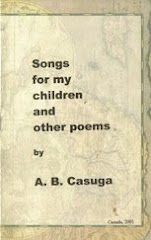
From Songs for My Children

Wednesday, June 24, 2009

A DANCE IN TANQUI TOWN


A HOMECOMING

Tanqui’s supreme conceit is its dread
Of withering grass in the month of the frogs
When rain, like fingers in the night, tread
The lesions gangrened on a hillock’s carrion,
Carcass of a season mourned
As the briefest of them all.

“The rain is on the hill, the dry pond
Is red with clay, the gods are back!
And so must I --- shadow of a past long gone ---
Weeping, running through these deserted streets,
Crouching now in mud pools of childhood fun
When songs were chanted as songs for the dance.
A dance for the grass! My limbs for the grass!
I must dance for Tanqui’s singed grass!”

He dances hard, his body clean and gleaming,
But Tanqui’s rain is on the ashen hill.
Neither his dancing nor his lusty screaming
Will stop this dreaded withering.
Tanqui’s conceit is stranger still
When songs are sung not for her lads and lasses
But for this stranger who, dying, has come back
To dance for black grass, dance naked
For Tanqui’s withered pantheon grass.

--- ALBERT B. CASUGA
June 2009

Tuesday, June 23, 2009

A SUMMER POEM


ONCE UPON A SUMMER SOLSTICE

(For Francisco F. Casuga+)

There is a scampering of grace in the dry woods
and a pulse upon some soliloquy:
it is the rain come as a smooth and forbidding lace
upon the cup of the dead and dying weather.

It is past the season of the grub.

The flirt of the monsoon upon the arid lap of Nara
is caked on the thick napes of children
dancing naked in the mire of the fields,
gaping to catch the fingers of the rain,
slithering like parched serpents guzzling raindrops
cupped in the hollow of gnarled father’s palms.

There will be no songs, for the ritual is not of birth
but of death as summer dies in Nara
and with it every titter bursting from a child’s mouth.

The rain becomes a bloody plot.


--- ALBERT B, CASUGA,
June 2009