My photo
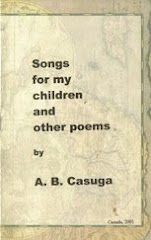
ALBERT B. CASUGA, a Philippine-born writer, lives in Mississauga, Ontario, Canada, where he continues to write poetry, fiction, and criticism after his retirement from teaching and serving as an elected member of his region's school board. He was nominated to the Mississauga Arts Council Literary Awards in 2007. A graduate of the Royal and Pontifical University of St. Thomas (now University of Santo Tomas, Manila. Literature and English, magna cum laude), he taught English and Literature (Criticism, Theory, and Creative Writing) at the Philippines' De La Salle University and San Beda College. He has authored books of poetry, short stories, literary theory and criticism. He has won awards for his works in Canada, the U.S.A., and the Philippines. His latest work, A Theory of Echoes and Other Poems was published February 2009 by the University of Santo Tomas Publishing House. His fiction and poetry were published by online literary journals Asia Writes and Coastal Poems recently. He was a Fellow at the 1972 Silliman University Writers Workshop, Philippines. As a journalist, he worked with the United Press International and wrote an art column for the defunct Philippines Herald.

Tuesday, August 11, 2009

HOLIDAY REQUIEMS


We are back from a 3-week holiday in the old country. Like all the other breaks to the Philippines, I need a vacation from that vacation. Off to Las Vegas next week.

Here are indelibly telling residues of experiences thereat:

A Death in the Afternoon

1. From a 22-hour plane ride, my wife dragged me on the first day to a parlour to get a haircut and a foot scrub. That afternoon was abuzz with fearful banter among the “aestheticians” (haute term for today’s barbers, hair stylists, foot spa attendants, pedicurists, manicurists, and the kibitzers to garner bigger tips) --- “Who will bring that homeless man sprawled near the parlour to the hospital?” The attractively transgendered manager called the barangay tanod (village watch) to come pick up the distressed man whose gangrened leg (from a diabetic reaction to an earlier amputation) precariously dangled from a pushcart he fashioned from scavenged debris or termite-eaten lumber from abandoned houses. The barangay bureaucrats said it was a job for the Department of Social Services and Welfare, not theirs. The security guards at the nearby Jolibee fastfood restaurant harrumphed that something must be done quickly to get the “wreckage of a derelict” out of sight – the munching customers inside are beginning to squirm. Who will help him, the fluttering beauty parlour attendants chimed in with feigned concern (How come even the females talk like tarty maricones (gay)?).

What’s this fuss all about? My foot-spa-treated missus enquired in the busy-body unctuousness of the parlour denizens. It’s about a dying man outside, I barked from the barber’s chair. No one wants to take him to the hospital, the transvestite parlour boss said. No one wants to shell out money to the hospital – before the man is admitted. You know, he’s got a son in the States and another working in Dubai. They must have abandoned him. Or he was too crazy to even get in touch with them. The parlour kibitzers chorused like cackling hens. That’s what’s wrong with our system --- no money, no health care. Even the village officials would rather pass the buck to the distant national government DSSW (they are fond of abbreviated names here) who likewise passed it back to the barangay (village) government. Dios ko, naman, baka mamatay na lang diyan! (Good Lord, he might just die right there!) sighed the outraged parlour overseer.

Done with my haircut and foot scrub (to remove calluses from ill-fitting shoes, my wife prescribed, and “to restore epidermal softness common to the ruling class”! ), I stepped out of the noisy marketplace of rubber-nosing fencesitters. It was about that time that a small crowd started clucking collectively angry tongues. Patay na siya! (He is dead!) Huli na’ng lahat. Saan ang tanod? Ang DSSW? (It is too late. Where is the village watch? The Department of Social Services and Welfare?) Sprawled helter-skelter on the makeshift pushcart is a diminutive, unwashed, half-naked old man who must have finally gasped his final breath begging and waiting for help while balik-bayans (citizens who have come back from their homes elsewhere abroad) like me had their foot-scrubbed into baby-pink like smoothness inside the air-conditioned, perfume-scented beauty parlour. I shuddered at the microcosmic likeness of the “moment” to the macro situation of the Philippines – nobody steps up to answer the critical question: Are you your brother’s keeper?

My wife averted her gaze away from the crumpled body on the pushcart. I heard the Jolibee “sekyu” (security guard) yell at the now het-up barangay representative who has just wheeled in to ask – where is the man who needs to be brought to the hospital? Ayan, patay na siya! Pulutin na ninyo, o kami na ang pupulot sa kanya bago mawalan ng gana ang aming mga parukiyano! (There he is. He’s dead. Pack him up or we will do it ourselves before we lose our clients in the restaurant who will surely lose their appetite from seeing him there!)

A death in the afternoon, I muttered to myself. The crowd dispersed; the transvestite parlour boss went back into the parlour, and asked who’s next in the foot spa.

A Mother’s Death

2. Ninoy Aquino’s widow, Corazon C. Aquino, the military-backed post martial law President who toppled Ferdinand Marcos died August 1, 2009. Her wake became a spectacle despite her family’s rejection of a state funeral --- the mourners from all walks of life – from the abject poor to the disgruntled rich, the ignorant massmen to the academic navel-gazers, the religious to the secular opportunists. The entertainment sectors (the great guns came out to sing: Kuh Ledesma, Lea Salonga, Gary Valenciano, Zsa Zsa Padilla, Dulce, Martin Nievera, Apo Hiking, Jose Mari Chan, etc.) and the broadcast media tried to outdo each other with their hosannas. Are there recordings of those performances one could buy from the enterprising recording industry? The singers did a better job of honouring the cancer-struck Cory Aquino; the wake will be remembered for a long time as that which brought out the best rendition of “Ang Bayan Ko” by Broadway actress Lea Salonga.

The has-been Cabinet members and wannabe Presidential pretenders could not stop stringing high-falutin encomiums about Mrs. Aquino’s simplicity, honesty, and sincerity. They were astounded silly by their pride over her humility.

Past Presidents Fidel Ramos and impeached leader Joseph Estrada, erstwhile military backstop/puppeteer and vehement critic of Mrs. Aquino respectively, joined the photo-op throng to say goodbye to the lady in the unprepossessing coffin. At 4 a.m. on the Wednesday before Aquino’s interment, the present President Gloria Arroyo rushed to the Cathedral (cutting short her trip to the United States, her press secretary Remonde protested), offered a Palace Mass for the fallen former President despite the latter’s pre-demise people-power threats for Arroyo to resign as an interloper President (grabbed power from Estrada). Hiya. The Filipino value of hiya (politesse) came in good stead.

These are symptoms of an unhappy country that needs a hero.

Unhappy, indeed, are the citizens who would even make heroes out of the hapless honour guards who stood ramrod straight all throughout the 9-hour funeral march beside Mrs. Aquino’s bier. They would be promoted in rank and awarded business-donated bonuses of 25 thousand pesos ($520US) each.

In fact, Congress filed resolutions to declare her a “hero”, even before the august chamber of learned men and women could proclaim martyred patriot Dr. Jose Rizal, rebel supremo proletarian Andres Bonifacio, and those who valiantly struggled against Spanish, American, and Japanese colonizers as Filipino national heroes. The expression of grief bordered on adoration so that after her interment, some admirers --- including former Aquino functionary now vaunted public intellectual and economist Solita Monsod – wanted her to be beatified by the Vatican. They wanted a Saint Cory Aquino to boot.

That, of course, crystallized the overflowing expression of fealty, over-reacting brush-fire devotion to the almost forgotten Mrs. Aquino who came back to claim power and fame through her youngest daughter’s revelation that she had terminal colorectal cancer (Kris, the actress and TV personality). The death watch culminated, of course, into the spectacle seen throughout the streets of Pasig, Makati, and Manila. Filipinos made a fiesta out of her wake and burial. They have long needed a semblance of EDSA People Power, a phenomenon admired the world-over that seems to have been squandered through the subsequent years after President Marcos’ dethronement. A week after the interment, the yellow shirts and dresses have vanished, and a Congressional murmur of abandoning the Charter Change resolution of the House of Representatives is now being bandied around as a good manner of honouring Mrs. Aquino’s memory.

If simplicity and humility were Mrs. Aquino’s exemplary virtues, she would have spurned the over-wrought mourning. After all, in the words of her martyred husband, Ninoy, their deaths were an overlapping stream of lives and sacrifices for the “Filipino who is worth dying for.” KISS was Ninoy’s favourite advice as a journalist and speaker: Keep It Simple, Stupid.

Serendipitously, I had a lachrymose moment with my mother, now a decade older than Mrs. Aquino, who realizes she is inexorably joining my father who went home ahead. My visit with her this time had a note of peremptoriness. Bury me with your father, and learn to forgive, she whispered as I kissed her hand.

I will remember Mrs. Corazon Aquino's requiem as a grander version of whatever I would be able to muster for my mother when the inevitable comes. I wept when her youngest daughter repeated her final entreaty to her family: Take care of each other. My mother made the same feisty advice when I bade her goodbye. She has this third eye that might have sensed my anger over not being able to take care of her from this distance, and my disappointment that remaining siblings have not been as understanding and tolerant of her obstinacy and intractable exercise of maternal authority even when she rues that she has probably outlived her usefulness.

The Filipinos could best revere Corazon Aquino's memory by taking care of each other, as intoned in the anthem's final words: Aming ligaya na pag may mangaapi, ang mamatay ng dahil sa iyo! (It is our supreme joy to die for thee (mother Philippines), should any tyranny befall thee.

Next: The National Artist Kerfuffle: A Fly in the Holiday Soup

Thursday, July 16, 2009

BLOG BREAK: GONE ON A HOLIDAY


We're taking a break for the nonce. Will be back.

PART 6: HOW TO ANALYZE A DIFFICULT POEM

Analyzing A Theory of Echoes: A Practicum
(Click on Figures to Zoom in on Text)


Readers give up quickly on difficult poems. What’s the use? Why waste precious lifetime on it? Given equipment to tackle the proverbial “difficult” poem, the reader might find the effort more rewarding than not trying. When this title poem of my latest selection of poems (A Theory of Echoes and Other Poems, UST Publishing House, Manila, 2009) was published by Philippine Sunday Times former editor Gloria G. Goloy, she said it was “intriguing; therefore, might be worth publishing – give poetry corner visitors something to worry about.” After all, she might as well make the miniscule space for poetry look important, at least more interesting than the ad on piles. The only trouble with the next question – What does it mean? – is the threat of its creating a more annoying case of hemorrhoids.

Brave souls have since then tried figuring out what the poem means, but here would have been my response to Gloria. (Here’s the poem. Analyze it. Be daring.)

A Theory of Echoes

1. Axiom

Echoes shape corridors lean
Leaving them a cipher’s silence
Not unlike the axiom of a day:
All things go up to fall the way
Fractured bird wings fall, violence
Met in the loins of wind.

Lean corridors shape echoes,
Silence ciphering them, leaving
A day axiomed as not what is unlike
The way the fall of things strike:
Violence on the fractured bird wing,
Winds loyned with zodiaqual zeroes.

2. Echo

O THAT A FALL MUST GO GO MUST A FALL THAT O
THE WAY A COMET’S TAIL TAIL A COMET’S WAY


Applying the analytical theory in previous parts of this series, I know that even I would understand my poem, if God would no longer bother.

Sensory-Impressionistic Level

Can the beholder approach it as a physical appearance, and gain an impression of a meaning from its formal structure? (The poem-on-the-page at first blush.)

In “1. Axiom”, the reader will notice that the words in lines 1 to 6 are used again in lines 7 – 12 in the last stanzas; only this time, they are used in reversed order. For instance, line 1” “Echoes shape corridors lean”, line 7 “Lean corridors shape echoes”. They are same words, same images, and both are talking about the same thing. And the reader may conjecture: does this not give the impression of the echo concretized in the structural arrangement of words in the lines?

Taking a look at the rhyming words, the reader would realize that the second stanza’s “way” echoes “day” in the first; violence, silence; wind, lean. The second stanza echoes the first; hence, a concretization of the experience of an echo. Like the progression of a sound that is echoed, lines 1-3 move inward centripetally, and lines 4-6 move outward centrifugally – the sound-echo progression. Of course, stanzas one and two are “echoed” in stanzas three and four. The same thing happens in “2. Echo”, but on a horizontal, linear manner.

Cognitive Level

Continuing the analysis of the poem, the reader should now try to confirm his first impressions on the meaning of the poem from the objective elements used by the artist: its imagery and symbols.

What immediately confronts the reader are the following images” the auditory image of “echoes”; the visual image of “lean corridors”; the synaesthetic image (auditory-visual) of a “cipher’s silence”; the synaesthetic “fall of fractured birdwings” (visual-visceral); the kinaesthetic image of “loined winds”; the synaesthetic “zodiacal zeroes”; the visual image of a “comet’s tail” tailing itself in cyclical motion. What looms as the central image?

It appears to be the “echoes in lean corridors that reverberate into cipher’s silences” – the hollow zeroes, the fall of things.

What does this central structural part mean? The reader may have as many interpretations as he had experiences of echoes in lean corridors that peter out to silences which occasion the fall of things – after the fall, silence. One interpretation may be the experiencing of something “hollow”, some vague feeling of emptiness in things, the death of things that end in silence; but these, too, are extensions of what dies in them; viz., like sounds in echoes are simply the extension of the sounds that made them.

As early as this level of analysis, the reader may already encounter some difficulty in pinpointing the experience being concretized by the author. But he has had some impressions earlier of something being “extended in echoes”; now, he has recognized images which concretize the experience of an echo. But what does echo here objectify? What does it symbolize?

One knows that this image must “symbolize” something because the author could not have simply intended to present the objective experience of an echo. Otherwise, that would be without value. It is the experience that the echo symbolizes which assumes a value.

Therefore, the central image as well as the minor images should now be interpreted in the context that they have been used in the poem. Suffice it to point out that the reader has somehow come to a gestalt of the experience from what has been “imaged.”

In other words, these images should now be interpreted in terms of the poet’s selected “content”. This is the step that comes closest to the recognition of the author’s experience. The poet is not always (unlike this instance) around to tell readers what stimulated his aesthetic experience in the poem. The reader is almost always left alone to determine what this experience is, and, consequently, what the author’s purpose (artistic purposes) was. The purpose must be determined so that the reader can criticize how well the author has utilized his medium (style) to concretize his experience and how well he has arranged and presented his selected details (content) in order to objectify the same experience into a virtual reality which could, on its won, stand as an independent, meaningful, phenomenon.

True, the reader has his own private interpretations. If the author were around, perhaps the reader could ask if his (reader’s) interpretations are valid. Although the experience can be gleaned from the context or situation used and the way the words are used in order to denote and/or connote thoughts and emotions, the present writer is describing the original experience which stimulated the composition of “Theory of Echoes”, so the reader may be able to compare his interpretation with the actual experience of the author.

The following is a transcription of the entry made by the author in his journal. This became the material for this poem.

Entry: Re Miss Andrea Alviar’s Death (September 9, 1970)

My math teacher in high school died today. I don’t know what to feel about this. She’s old, all right—and she must die sooner or later. It is sad how she must go. She won’t even be able to use her math, algebra, geometry, and all her equations to get herself to heaven!


But death is nothing else but an extension of life. Just as living, she had her students as simple echoes of her awesome presence. What is an echo but an extension of sound? And language, echo of thought?

Perhaps her death could be a good material for this mathematical idiom and imagery Cirilo is talking about.
Andrea Alviar comes to mind now as that old, church-going spinster who leaves a void in those corridors of the old Gabaldon building in the La Union High School. How the corridors must reverberate with her throaty voice – axioms coming out of her lips sounded like rules of life.

She is dead now---she has fallen---like a fractured birdwing. The end of everything is the Zodiac and the Zero which is our beginning. – From the Author’s Notebook
.
--o0o--

Notice that many of the key images used by the author in the poem are also used in the journal entry. This entry is nothing but a prose description of the experience the author is concretizing in the poem. The main difference would probably be the economy of expression in the poetic version of the experience.

It was pointed out earlier that a meaning close to this would, nonetheless, have been arrived at if the reader studied the fundamental units of the poem – the words (exuding the images; denoting and connoting thoughts and feelings shaped in figures of thought, speech, and language). Now, to a more educated guess at the poem’s meaning on the Associative Level of analysis.

Associative Level

Concluding the analysis of the poem “A Theory of Echoes,” the reader should find a confirmation of his interpretation of the poem’s meaning (gleaned from the imagery and symbolic system) in the context of the poem’s content as well as in the structural composition of its objective elements.
Since there was a sui generis “revelation” of the stimulating experience behind the poem given by this writer earlier, the appreciator should not find the determination of the meaning and purpose difficult.

Nevertheless, the reader may blot that out of his mind; he may assume that such is not available on a silver platter. His reaction to the poem per se need not be delimited by this “revelation.” The stimulus being itself another experience contra-distinguished from the virtual reality of the composed poem, the reader should, therefore, not conclude that the stimulus is the poem. There is no necessary one-to-one correspondence. This makes it possible for the reader to see through and beyond the ambiguities of the poem (assuming the composition possesses such “richness”). Such is, after all, the plenitude of appreciation – earning meaning from the formal “being” of the work of art.

In the poem, there is a concretization of a state of feeling and thought about the “axiom of echoes and the fall of things” in terms of a series of assertions through the objective point of view of a reflecting witness. What is this state of feeling and thought? That “all things go up to fall the way fractured birdwings fall,” like the way “echoes leave lean corridors with the silence of ciphers (zeroes).” The axiom of life: All men die; after death, silence. But why echoes?

The assertive context --- (more figurative and symbolic here than literal – the constructing elements are abstract and universal concepts, consistent to the nature of an assertion) --- equates the cyclic progression of echoes with the rise and fall of things. It seeks, therefore, to explain the “fall of things” in terms of echoes as extensions of sound; that the fall is an extension of a rise and vice versa, or that the fall is a prelude to the rise.

This is the Oriental mystique of the cyclical conception of reality, further concretized in “2. Echo” as a comet tailing its tail in moving through the Zodiac, the perpetual animation of things within a sphere which is algebraically symbolized in the cipher, the mathematical zero. Both concepts – echoes and the life-death phenomena – are ultimately or primordially based on the fundamental structure of things – the atomic universes: electrons centrifugally orbiting around nuclei.

Is the above context derivable from the words and their peculiar “axes of selection and combination”?
From a verbal standpoint, “2. Echo” presents a plainer use of tonal elements to suggest the meaning of the content. The fore and aft use of “O” in the first line suggests the sound-echo phenomenon. Too, it is an orthographic symbolization of the comet’s path, the echo’s path. The predominance of the long sounds in “way”, “tail” is onomatopoeic: the sound is extended by virtue by virtue of its phonemic duration. Even in the first twelve lines, “1. Axiom”, this tonal quality obtains. Rhyme in the poem fulfills a structural function more than a contextual purpose. As an organizing element, it forms the structures that “mirror” each other in the echoes. (See discussion in sensory-impressionistic level, supra.)

Is the basic trochaic tetrameter rhythm helpful in shaping up a meaning? If the context talks about the regularity of things on an axiomatic level, therefore, rigid and routinary, would this rhythm bring this out? It would, if the four beats in the poetic line are simulations of regularity and uniformity. The even-ness of the four beats bespeaks the phenomenal symmetry talked about in the context of the poem. A pentameter (odd in number; i.e., five beats) would not lend itself to this regularity. Robert Frost used the tetrameter in “Stopping by Woods on a Snowy Evening” to concretize the routine in the life of the persona who pauses from his life’s humdrum but is jolted by his horse into proceeding with his daily “promises to keep”. The tetrameter in “Theory of Echoes” serves this same purpose. A dimetre would probably have been more apt save for the nature of the content used.

The rhythm, it appears, serves a distinct structural purpose. It presents graphically the contrapuntal relationship of the lines and the stanzas; viz., lines 1, 2, 3 mirror lines 10, 11, 12; lines 4, 5, 6 mirror lines 7, 8, 9 rhythmically. Line 1 is reversed in Line 7; 2 in 8; 3 in 9; 4 in 10; 5 in 11; and 6 in 12. (See accompanying figures above.)

What about “zodiaqual zeroes”? Apparently absent in the earlier arrangement of words in line 6, these words are actually conclusions of the details which have been asserted in the first eleven lines. Since the context is assertive, it has to conclude in a general observation. All the images, symbols (the structural parts) lead to this general observation of their being details or particulars of the zodiacal zero. Why “zodiaqual”? The medieval version “hardens” the concept of something being “echoed”. The reversion to the medieval spelling is more than a reversion in time. It is also a reversion in spirit. Why does the author revert only as far back as the Medieval Age? This is because the root of the present language is Chaucerian (medieval).

Exploring the objective elements further, the reader notes that the tercets used are actually sestets, where the first two stanzas actually unify into a sestet; the final two unifying into the same structure. The “a-b-c” of the first is “c-b-a” of the second; the “d-e-f”of the third is “f-e-d” of the fourth. The a-b-c-c-b-a combination is reversed structurally in d-e-f-f-e-d. Ergo, the “theory of echoes.”

The structural parts, obviously, are aptly selected (echoes, corridors, silence, ciphers, fractured birdwings, fall, violence, loins of wind, zodiacal zeroes, comet’s tail) and logically combined. A final consideration of the words as fundamental units of meaning in the poem will prove this beyond cavil.
The poem’s meaning depends upon an array of metaphysical conceits which should succeed in making the objective correlative “echoes” an unmistakable symbol for the “fall of things”. To achieve this, the author used personified echoes shaping up corridors that are left “dumb”, if nostalgic, in silence. “Fractured birdwings” are those things alive and free – as birds are free – which meets violence in the “loins of wind” and get outraged. Why loins of wind? The conceit personifies the violence in “wind”. This is the life principle incarnated.

Then, in the last two stanzas, there is a semantic inversion among the key concepts. Now, it is “silence ciphering echoes” (is it the petering out of an echo that defines silence or is it silence that accentuates the echo?); “lean corridors shape echoes” (the reverberation is a travel in time and in space; the memories travel in time and space); echoes and silence define the day, not the axiom that defines the day – “A day is axiomed as not what is unlike/ The way the fall of things strike” (a day is always the day for dying – each day is a reckoning with the cipherhood of all men; each death a returning to the root where the beginning and the end are one in the zodiacal zero).

In “2. Echo”, a fall must always go the way a comet’s tail goes; it tails its nucleus at its beginning until it vanishes into the zodiac having eaten itself out. This is the stillness of Mao Ch’iang and Li Chi of the old Chinese legend when these two attractive women get swallowed by a tiger only to become themselves the tiger – nothing becomes everything; and everything is nothing. Observe the paradox which informs the content of the poem.

In brief, “A Theory of Echoes” is an assertion of the experience of death as the extension of life; echoes the extension fo sound; language the extension of silence.

Having defined the experience and recognized the poem’s meaning, the student may now deduce the artist’s purpose. It is the artist’s achievement in the fulfillment of this purpose which should now be criticized (under the canons of literary criticism).

Questions like the following may, however, still remain in the minds of the appreciator:

Why did the author use abstract concepts to “concretize” his experience? Is this not a violation of the function of words to “image” an otherwise abstract aesthetic experience? How well has the author emotionalized his aesthetic experience in terms of the structural parts he utilized? Are these parts appropriate for his experience? Are the contextual and structural elements adequate in concretizing the experience? Does the technique serve the artistic purpose of concretizing the experience? Are there traditional literary devices used by the poet in the poem? Are these devices necessary for the achievement of the artistic purpose?

These are proper materials considered in the criticism of the poem as a literary work of work.

(Next in the series: Literary Criticism (of Style and Technique) and Literary Evaluation of Literature as a Humanistic Discipline.)

Wednesday, July 15, 2009

PART 5: ASSOCIATIVE LEVEL OF LITERARY (POETRY) ANALYSIS APPLIED


Desert Places: Meaning Analyzed

Earlier in the foregoing discussion of poetry analysis, an analysis on the cognitive level was done on Robert Frost’s “Desert Places.” Analysis on the associative level should confirm the interpretation of images and symbols used in the structural parts of the poem. What seems to have come out as a crystallization of the interpretation was the recognition of an experience bordering on “emptiness, a feeling of ineffectuality, loneliness, and spiritual barrenness.” Is this borne out by the poetic utterance?

Apparently, the interpretation could be proven textually. For instance, the reader will recognize that Frost is concretizing a dramatic experience of a man’s realization (thought and feeling) of how he cannot be scared by external emptiness or barrenness because he himself is barren and feeling empty. This is the ultimate dread that comes to a man who finds out for himself that he is his own graveyard.

How does the text arrive at the above? Consider the context or situation used by Frost. A man looks into a field that he passes by at what appears to be dusk; he sees the snow falling, the ground covered with snow, the weeds choked, only the stubble of vegetable life juts out; the animals freeze to death smothered in their lair. The physical desolation affects him and he realizes that he is absent-spiritedly enveloped in that gloom. But he cannot be scared with this emptiness swallowing him; he himself is empty—he blends with the physical desolation. This is the poem’s literal context. Is there a figurative or symbolic context? Is it not enough to recognize the literal context?

Even from the literal context, the reader can conclude that the choice of images interpreted in the cognitive level was felicitous. There is a confirmation of the reader’s interpretation of the experience in the literal context. Of what use is it then to determine whether or not the author meant also a symbolic context? Since art does not remain as an esoteric expression of something particular to one man, but that it must be made universal by virtue of its being a communicator or purveyor of phenomenal awareness (knowledge) and truth (both universal objectives), it should follow that the subjective experience of the poet becomes objective. Therefore, from the concretized particular, it becomes a concretized universal.

How does one know that the artist has accomplished this? He ordinarily indicates this through the use of his language or medium, and the devices available within that medium – these being themselves universal structures,

In the case of “Desert Places,” the experience of emptiness does not happen only on a physical-literal level. When the persona (the “I”) blends with the desolation of the nature he senses, the emptiness is now experienced on a psychological level. It is, therefore, removed from the literal; it makes a leap to the metaphysical. The artist must use his medium to accomplish this. He should not depend upon the appreciator’s ability to connect meanings obtained from the physical qua the metaphysical.

Besides, the literal experience is not which is of value ultimately to the appreciator. Otherwise, this literary contour of an experience might have been better appreciated if encountered on the real level. Life is always superior to art—value-wise. What is of value to the appreciator is the realized experience synthesized from the literal level. The intellectual delight he experiences from an identification of an experience through the artist’s dexterous arrangement of his objectifying details is also one such valuable wage for the appreciator.

The reader will further recognize that Frost must have intended a symbolic context for the poem because he uses the figures of speech like personification ---

“The woods around it—it is theirs” (italics to emphasize active possession)
The loneliness includes me unawares.
. . .
And lonely as it is, that loneliness
Will become more lonely. . .


A blanker whiteness of benighted snow
With no expression, nothing to express.

. . .
They cannot scare me with their empty spaces.

(All the italics indicate action which inanimate objects would not ordinarily be endowed with.)

--- and synecdoche – the association of the external desolation with the internal desolation of the persona. The personification can only indicate the author’s intention of making the external forces exert their influence on the persona in order to achieve the “leap” from the physical to the metaphysical.

Does this context justify the earlier interpretations made about the significance of the images and symbols? If it does not, then the interpretations are irrelevancies.

Concretizing the state of feeling and thought of the persona, Frost uses a dramatic incident where he shows the man acting and reacting to his state. This culminates in an assertion about his state which reveals the moral persuasion of the persona; i.e., “I have it in me so much nearer home/To scare myself with my own desert places.” Frost articulates these states through the protagonist’s point of view in order to reveal the meaning which leaps from the physical to the psychological, from the external to the internal, or even vice versa. It is the person that feels who is most qualified to talk about an internal state.

The Words Have It

Of course, the foregoing was arrived at by this writer via the words and their peculiar arrangement as well as use in the poem.

The reader recognizes the physical context (situation) in which the dramatic incident happens through the preponderant sounds used by the poet (consciously or unconsciously) that stick out throughout the poem. Why? Could the author have used them to suggest the physical events happening --- the falling of snow, the sound it makes, the sound of the wind that accompanies the fall of snow and night? These sounds become onomatopoeic seen (or heard) against the context. The alliterative quality of these sounds suggest further the literal context; viz.,

Snow falling and night falling fast oh fast
. . . smooth in snow
. . . stubble showing

The continuant phoneme “f” and the sibilant “s”, “st”, and “sh” cannot but produce an auditory image of the physical conditions obtaining in the context of the poem. Suggestive of the wind, “f” is a phoneme which is phonated with a continuing flow of the breath. “S” not only suggests the sound of the snow but also the hush punctuating the desolation the persona is confronted with.

The rhyme scheme approximates both the physical situation and the psychological condition of the persona; i.e., the sound of the elements in nature; the painful numbness that cuts the persona when he realizes it is not the external scene which is desolate and empty – he is empty. Note the rhyming sounds:

1 2 3 4 --- Stanza Number

st s s s

st s s s

o ou o o --- The moaning quality of
this sound suggests pain
(therefore internal)


st s s s

Why is the “s” sound preponderant? Why are the sounds of “o” (snow, count, snow, home) enveloped in the third line of the envelope quatrain? Aside from suggesting the wind, the flakes, the loneliness, does not the arrangement in the structure of the stanza even suggest that internal condition which colours the external realities? Or, if the reader looks at it from another angle, do not these elements assailing him from the outside with their hush and desolation grip the persona in a vise where graphically the stranglehold could look like the following?

A B
st s s s st s s s

st s s s st s s s
{ { { { } } } }
o ou o o o ou o o
{ { { { } } } }
st s s s st s s s

A. The persona looking at the external circumstances.
B. The external conditions “including him unawares.”

“Despair to mock us from above / Despair to mock us from below.”

It is granted that Frost may not even have intended this verbal significance. That does not prevent the reader from drawing a meaning out of the tonal elements. But what Frost may agree with is that, while his choice of words may have been intuitive, it may have been a result of his artistic discipline – his openness (his imagination’s) to the demands of his experience for a medium appropriate to its content; i.e., sounds lending themselves to the creative context because they are the most appropriate partners of the content-experience. Symbolization in the imagination prior to utterance has taken place; the symbols were selected spontaneously by the controlling aesthet5ic experience being concretized by the artist.

Frost uses an irregular rhythm (preponderantly trochaic pentameter). Does this help suggest the meaning? If this is the concretization of a dramatic realization of one’s emptiness made painful by loneliness how does the trochaic beat suggest this? If the trochaic beat consists of the strong stress followed by the slack or unstressed unit of sound (syllable), would not such a combination help in concretizing the intensity of the internal condition of the persona which colours the external signs of desolation? Or it could even be the other way around; i.e., the external conditions (“loneliness includes me unawares”, “they cannot scare me with their empty spaces”) making the persona realize his own emptiness (a feeling of helplessness, hence, slack or lax stress). If the irregular metre pattern is used, it is demanded by the personality of the persona who may --- from the literal context – be judged as any man who reflects on the dread “so much nearer home,” his desert places.

Did Frost intend this? Whether or not he did will not prevent the appreciator from gathering some significance from this rhythm. If Frost did not deliberately choose such a rhythm, this would neither be a reason for declaring the meaning from the rhythm irrelevant. It is a firmly established fact in the articulation of the medium in art that utterance is conditioned and/or shaped by the content. Intuitively, the artist uses a rhythm which is demanded by his experience (assuming that he is sensitive to the energies of his medium – in this case, the energies of the language). The medium in this case becomes a completion device – it completes an otherwise vague or peripheral experience stimulating the artist. This is better explained in the discussion of structure as an “agent” of meaning.

The reader will have, at this point, noticed that meaning may not only be derived from the literary energies of the words. Of course, the significance obtained from the foregoing elements may further be confirmed by the words as content agents.

For instance, the reader should not think it curious that there appears to be a stutter-like repetition of words like “falling”, “it”, “loneliness”, “lonely”, “no expression”, “nothing to express,” “scare.” These are key words that shape the content. All of them connote the experience described through the eyes of the persona – the experience emotionalized through his attitude. The redundancy is deliberate. The stutter-like succession of “it” in the second stanza objectifies the anxiety of the persona; the falling of snow and night is his pall of gloom; the loneliness of the individual who finds his puniness a source of quixotic strength, his defiance his absurd resignation. The paradox is understated.

Aside from the personification with which Frost advances his figurative context, he uses the subtle cogency of an understatement to telescope, as it were, the heroic defiance of the persona. The dread is real, but it is as real only as it is dreadful to the ruling mind of the man. The figure underscores the modern man’s acceptance of the existential curse: he is free to suffer – but with courage and grace!

Structurally, Frost’s choice of a central image is apt. The desert of snow, as has been previously pointed out, is a conceit worthy of the understated paradox in the poem. It is a desert within and without. It is coldness of the empty and the barren which is juxtaposed with this Gobi of dead things. Their structural order concretizes the growth of the realization in the persona. Since it is the external that forces him to react, the physical description in the first two stanzas cannot but be concluded in his (the persona’s) assertion in the final stanza. That means the growth of the internal condition was gradual; i.e., from the external stimulus (first two stanzas) to the internal, subjective reaction (final two). The dramatic context demands a chronological arrangement of details; hence, the internal via the external conditions.

If there was a choice of stanza form, the poet could not have made any better decision. The envelope quatrain lends itself naturally to the suggestion of the persona’s experience; i.e., the angst within which he accepts – something engendered if not reinforced by his apprehension of the physical desolation without. The enveloping lines (first, second, and fourth) bear on the third unrhymed line, aptly ending with the long “o” phonemic sound, one with a mournful colour because it “moans”.

On both contextual and structural levels of meaning, the reader will readily derive the expression of the dramatic realization of a man’s coming to terms with his own desert places. The meaning suggested in the cognitive level by the imagery is, therefore, confirmed by the articulated medium (includes the literary devices). The meaning established, the reader can now point out that the purpose of the poet as artist is the concretization of such experience. Subsequent criticism of the work of art as far as its formal excellence is concerned is pegged on the author’s achievement of this purpose in terms of his medium and content.

Tuesday, July 14, 2009

PART 4: LITERARY (POETRY) ANALYSIS--THE ASSOCIATIVE LEVEL

Meaning in the Poem

(Click onthe figure to zoom in on Text)

What is involved in the associative level of literary (poetry) analysis? Why is it not enough for the reader to interpret the images as he pictures them in order to arrive at the meaning or significance of the poem? What is meant by meaning in the poem?

Perhaps, the foregoing questions could be answered if the third question were clarified first. What, indeed, is meaning?

From the previous discussions, it is plain that what the reader is after is some kind of “significance” from the objective result of artistic activity. This significance is derivable from as many planes as there are experiential levels.

Thus, the beholder may realize a simple sensory meaning (using the word—sensory—loosely to signify organic responses; i.e. the senses responding to their proper stimuli; viz., visual senses to light and its various compositions like colour). This significance is normally derived from the primary materials of the medium; i.e., the colour in painting, the orthographic symbols used by written language in literature, etcetera.

The content or subject matter of the work of art is the proper material for intellectual associations and/or relations; viz., the figures of a mother and child in Picasso’s “Artists” may be responded to by the appreciator apart from the colours used by the artist (in this case, pale grey for the flesh, and cool colours for their clothes). The figures provide a shape to the articulated medium. It is this element which provides the intellectual meaning of the physical structure coming to the beholder as a painting. (Intellectual, because the figures are those chosen by the imagination and interpreted by the intellect as appropriate to the artist’s aesthetic experience). Intuitively, an appreciator may respond forthrightly to a discerned form – and sans sensory apprehension or intellectual comprehension of the form (as unified in a gestalt), he feels a significant reaction. Thus, the age-old “goose pimples”, “chill”, or “thrill” criteria for “good” art. This may be categorized as the emotional meaning of the work of art.

It is normally this “significance” which satisfies the aesthetic attitude (taste and experience of beauty).

Strict interpretation of “meaning”, however, demands the three levels co-functioning with each other in the unified form concretizing the artist’s aesthetic response to any type of stimulus he “takes fancy on.”


Ultimately, meaning will depend on how the appreciator recognizes the elements articulated in the form; what significance he associates to these (a meaning qualified and delimited by the context or the content he perceives in the form); and, finally, on what value he assigns to the feeling he has for the defined experience which should, anteriorly, have satisfied his taste.

While the beholder may be able to respond aesthetically to a work of art according to his private and even esoteric interpretation (which may even be irrelevant to what was purposely shaped by the artist), this may not come any closer to the ultimate function of art which is to come closer to truth (knowledge), the distinct awareness and understanding of things, conditions sine qua non to the perfection of man’s essence (the end of art being things realized in the rational nature of man). This restates the classical view of the function of art:


“…that art is formative in the most valuable sense by assisting man to fulfill his own end. For man’s end is to complete himself; to carry out, to the fullest extent, what is best and most distinctive in him. And what is best in him as an aware creature, is the capacity to realize what is without, to profit and grow by means of this knowledge, and to react and desire in accordance with the awareness that has informed him. ‘Freedom and self-fulfillment arise’, in Samuel Johnson’s noble phrase, only as the mind can ‘repose on the stability of truth.’”


In the associative level of analysis, the appreciator abstracts the meaning of the object of art from the recognized elements articulated in the form. This activity involves familiarity with the materials articulated in the medium, qualities and significance reflected in them which ordinarily should satisfy the aesthetic attitude when recognized an interpreted; the peculiar semantic energies of these materials, their emotional and intellectual meaning (assigned by the appreciator) structured by the artist, and such other free associations coming from the environmental influence or communal awareness of things.

The outline in the accompanying chart assumes that the appreciator understands the meaning of the elements included under the Contextual and Structural Meaning of the object of art (the poem). It also assumes that he understands how each element contributes to the definition of the art’s meaning.


Contextual elements refer to the content or subject matter chosen by the artist to objectify or concretize his experience with, and to all other devices or materials pre-figured or formed in the content. Structural elements refer to all objective forms recognized in the physical structure of the object of art from which significance related to the artist’s experience may be derived. These elements delimit the range of meaning to be assigned by the appreciator. It confines the boundaries of meaning to that configurated in the text or unified form. Any significance that strays from these boundaries is irrelevant, consequently, misleading, confusing, and will ultimately not serve the art’s formative function.


(Next: Associative Level of Analysis applied in Frost’s “Desert Places.” (A Practicum)

Monday, July 13, 2009

PART 3:LITERARY (POETRY) ANALYSIS: THE COGNITIVE LEVEL

The Cognitive Level of (Poetry) Analysis


The impression of a meaning from the preceding level (sensory-impressionistic) of analysis will at best be an “uneducated guess” at the meaning or point of the poem. This impression must get a confirmation from the objective elements used by the artist in concretizing his experiences; namely, the images and symbols used as objective correlatives of the erstwhile abstract experience.

What is involved in the derivation of a meaning from the imagery of the poem and the symbols it uses? How is the meaning derived from these cognitive elements?

The words used in the poem evince certain pictures or phantasms in the mind (imagination and intellect) which when recognized by the reader assumed significance. This depends on what these images remind the beholder of. He interprets their significance in terms of what these images represent or symbolize to him. These images belong to a system of objective correlatives (1) which, structurally, compose the symbolic being (body) of the poem.

The central or major image (which can be pictured consistently throughout the poem and around which other images revolve) is the primary structural part of the poem. It is the principal objective correlative of the thought-emotion combination being conveyed or concretized by the poem. It is this central image which looms as the primary concretizer of the artist’s vision. All other images should have a logical and functional relationship with the primary image – they should make the central image clearer and richer as a symbol. The coherence of these images into a single experience engenders the reader’s recognition of a gestalt. This is the springboard for the assignation of a “meaning”.

These images may be visual, auditory, gustatory, olfactory, thermal-kinaesthetic, erotic-sensual, visceral, and synaesthetic. The external senses become the channels from which these pictures proceed. Lumps of images may be put together and assume the linguistic form of a figure (of speech, thought, or language). (2) The reader should also be able to recognize these figures so that he may see or sense the unified experience in the poetic gestalt.

(2) For a definition of these devices, see Freidman and McLaughlin, Poetry: an Introduction to its Form and Art. Harper & Row, N.Y. 1963.

The Figures

Speech: 1) comparison: simile, metaphor; 2) Association: synecdoche, metonymy, personification; 3) Objectification: allegory, symbol, parable, apostrophe.

Thought: 1) Pun; 2) Irony: of statement, or of a situation; 3) hyperbole; 4) litotes or understatement; 5) periphrasis; 6) ellipsis; 7) paradox, conceit, oxymoron.

Language: 1) inversion; 2) balance; 3) antithesis; 4) parallelism; 5) parataxis; 6) hypotaxis


The appreciator should be able to single out the primary structural part of the following poem so that he may experience a gestalt of the poetic expression. Upon this picture will depend his interpretation of the meaning or point of the objective elements used by the artist in the poem.

Interpretation refers to the reader’s assignation of significance to those images and symbols he comes to recognize when confronted by the structural composition of the poem. This definition is necessary in order to distinguish this activity from the reader’s other activity of determining the context or situation chosen by the artist to couch in his experience. The latter, termed “poetic utterance” for want of a better word, is the “content” (subject matter -- as distinguishable human experience or expression of the human condition) selected by the artist to objectify his aesthetic experience with. It is this “context” which qualifies, conditions, or even delimits the interpretation or the range of significance given by the reader to the poem’s objective elements – images and symbols. In other words, recognition of this context will not permit a running away of the beholder’s interpretation (which is after all based on his stock of experiences, something which could easily degenerate into a mnemonic irrelevancy – the attribution of meaning which is not based on the textual material, but “inspired” by private bias or prejudice.

DESERT PLACES
By Robert Frost

Snow falling and night falling fast oh fast
In a field I looked into going past,
And the ground almost covered smooth in snow,
But a few weeds and stubble showing last.

The woods around it have it – it is theirs.
All animals are smothered in their lairs.
I am too absent-spirited to count;
The loneliness includes me unawares.

And lonely as it is, that loneliness
Will become more lonely ere it will be less—
A blanker whiteness of benighted snow
With no expression, nothing to express.

They cannot scare me with their empty spaces
Between stars—on stars where no human race is.
I have it in me so much nearer home
To scare myself with my own desert places.

Looking at the structural parts of the poem in order to arrive at a gestalt, the reader will easily be confronted by the looming primary image of the “desert of snow” (a conceit). It is the central picture which suffuses the four stanzas. What does this image mean? Does it concretize an experience? What is the experience? Whose experience is it?

From certain vicarious if not stock experiences, the reader will conjure in his imagination the picture of a desert which he invariably should associate with the barrenness, thirst, petrified skulls of dead animals, vultures, cacti, heat, twilight, coldness, frigidity, even Western movies. The “snow” should also be associated with dead things, biting frost (no pun intended on the author’s name), emptiness, the blank whiteness of snow (not the snow of Christmas). As a conceit, the primary image, therefore, should concretize an experience of emptiness, barrenness, the gloom of desolation and destruction.

What about the minor images used by the artist? Do they harden the primary image in such a manner that it becomes clear enough to impinge on the reader’s ken? The visual image of falling snow, the few weeds and stubble showing last, the blank whiteness of snow, the empty spaces, do they all suggest the emptiness, barrenness, physical and psychological desolation suggested by the primary structural part – the desert of snow.

Are the preceding interpretations correct? Do they come close to the identification and recognition of the experience? These questions can be answered by the appreciator’s going through the poem again and finding out for himself in what context the artist used those major and minor images. (3)

NOTES

(1) An objective correlative is ordinarily a verifiable and observable physical structure which represent or concretizes an otherwise abstract idea or feeling. In the course of selecting his materials, the poet singles out certain correlatives which are normally associated with the emotion of idea being objectified. Images are classified as objective correlatives. These images may belong to a system of unified images called imagery. Imagery is the system of images used by the poet in order to concretize or objectify the subject matter or experience. Images must be precise, clear, familiar, and hard. They must be consistent to the theme. They must conform to a logical design. To be interesting, they must be fresh and original.

The structural parts of the poem and its unified design may also serve as an objective correlative most specially in Imagism where ideographic devices are used.

(3) Context refers to the situation (the who, what, when, where, why, and how of a situation) used by the poet to objectify his aesthetic experience with. It could be a dramatic event, an assertion, or an argument. (Friedman and McLaughlin, op. cit.)

(Next: Part 4: The Associative Level of (Poetry) Analysis)

Saturday, July 11, 2009

PART 2: LITERARY (POETRY) ANALYSIS; THE SENSORY-IMPRESSIONISTIC LEVEL

POETRY ANALYSIS: THE SENSORY-IMPRESSIONISTIC LEVEL

The poem, as an objective result, must preferably be confronted as a physical (printed) structure capable of suggesting meaning from its visual appearance. The sensory-impressionistic level in analysis, therefore, is the appreciator’s first concession to the oft-neglected premise that the work of art is itself an independent entity with a structure defining (physically) its “being”. It is a formal appearance. Just as the physical appearance of a man can exude all types of impressions about his character, so can the poem which appears on the page (assuming that the artist has shaped up his work’s structure to functionally concretize the experience or reality he is creating.)

What is involved in this level of analysis?

The Sensory-Impressionistic Level

This analytical level consists of:

1. Impressions from the printed text on the page can be derived from: a) the use of typographic symbols—the arrangement of the letters in the words of the poem; b) the arrangement of lines; c) length of lines and words; d) punctuations; e) ideographic aspirations resembling those of Chinese or Japanese characters; f) other visual devices peculiar to architecture, sculpture, and painting.

2. Impressions from the verbal composition of the poem: (In reading a poem, one is assumed to read it aloud first so that its melodic character may be appreciated. This simply follows the literary tradition of poems being composed for verbal/oral recitation.) a) sounds of the letters or phonemes (conventional significance of the sounds attached by the users of the language; viz., sibilant sounds like “s”, “sh”, “z” suggest silence, solemnity, sarcasm, etc.; b) organized sounds used as melodic devices in the poem: alliteration, onomatopoeia, assonance, consonance, reversed assonance and consonance; c) rhyme as a melodic element (differs from rhyme as a structural element unifying the poem into stanzas); d) rhythm as a melodic element (differs from its structural function – poetic feet and meter; viz, iambic pentameter, etc.)

To illustrate the above, take a look at the following poem by e.e. cummings (Barry Marks, E.E. Cummings, pg. 21, College and University Press, New Haven, Conn, 1964):


l (a

l (a

le

af

fa

ll

s)

one

l

iness

-- e.e.cummings

Impressions: From the appearance of the typographic symbols on the page (medium), one is obviously impressed about something going down, something descending rather gracefully (not a plummeting because of the spaces between letter-symbols). Visually, therefore, the beholder can see a descent of typographic symbols resembling the figure “L” or “l” (one) and the article “a” (one), the preponderance of the liquid sound of “L”, the continuant sound of “F” and the sibilant “S”. What do these mean? One can get the impression that “one” is being wafted by something in “F”, “S”, “L”.

Looking at the Cummings poem as a structural appearance, the beholder may get any of the following impressions from both the printed text on the page and the sounds: impression of a state of feeling or mood characterized by “one-ness” or being alone, therefore, lonely; impressions of a falling of something carried as it were by some wind or breeze which is suggested by the predominance of the continuant, sibilant, and liquid sounds (f, s, l).

One gets these impressions from the associations he makes of these visual and auditory elements. What does “one-ness” or “alone-ness” suggest? What does a “fall” or a “falling” mean? But these are questions properly answered in the associative level of analysis.

Would the following version give the same impressions mentioned above?

l (a

l (a leaf falls) oneliness

What about the following version?

l (a

l

a

e

a

ff

a

l

l

s)

one

l

i

ness

If Cummings was tracing the descent of a falling leaf, would the above version not be better than the original version? Why or why not?

Can the following be analyzed on this level?

_________________________

The Emperor’s New Sonnet


-31-
________________________

_________________________

The Bashful One


,

-32 -
_________________________

Both the above were created by Jose Garcia Villa, a Philippine-born poet who is considered that country’s foremost exponent of the ars gratia artis dictum. The first one above is an empty page save for the title and the page number. The following figure bears the title, a solitary comma on a corner of the page and the page number. Would analysis result into a recognition of that which is artistic in these creations?

Of course, not all poems deliberately intend their structure to concretize the experience of the poet. Some poets, while not deliberately intending the structure to render an impression of a mood or a meaning, may intuitively – or by reason of artistic discipline – infuse such energy. Artistic discipline here refers to the craftsman’s intuitive grasp* of his medium such that his choice of details automatically includes their suggestive values, their functional significance. (*Jacques Maritain, Creative Intuition in Art and Poetry, pp. 75-85 et seq. The World Publishing Co., Ohio, 1961.)

For instance, Robert Frost in “Stopping by Woods on a Snowy Evening”** might not have intended his envelope quatrains to give the impression of continuity and movement (which is the physical as well as the psychological situation he used in his dramatic content of a man who rides through the snow, stops by the woods, and realizes that he must go on with his journey). But the rhyme scheme as an element of structural unity may suggest these impressions.

It goes this way: aaba, bbcb, ccdc, dddd. Notice that the unrhymed third line in each stanza is used by Frost to move as well as unify the entire poem. The “b” of the first becomes the tying primary sound in the second, and the “c” in the second becomes the tying sound in the third stanza, and the “d” in the third becomes the continuing “d” in the final stanza to concretize the “moving along” of the persona.

** STOPPING BY WOODS ON A SNOWY EVENING

Whose woods these are I think I know
His house is in the village though;
He will not see me stopping here
To watch the woods fill up with snow.

My little horse must think it queer
To stop without a farmhouse near
Between the woods and frozen lake
The darkest evening of the year.

He gives his harness bells a shake
To ask if there is some mistake
The only other sound’s the sweep
Of easy wind and downy flake.

The woods are lovely, dark and deep,
But I have promises to keep,
And miles to go before I sleep,
And miles to go before I sleep.

(Next: Part 3: The Cognitive Level of Analysis)

Friday, July 10, 2009

A THEORY OF ANALYSIS IN LITERARY APPRECIATION: PART 1


A THEORY OF ANALYSIS IN LITERARY APPRECIATION

Too often, the word “analysis” – when used a s a tool for literary appreciation – is misunderstood by the teacher and/or student as either equivalent to abstracting moral lessons from the piece under scrutiny (despite the absence of any indication that these could indeed be gleaned), or as a simple attempt at interpretation by the student regardless of whether or not this activity is preceded by recognition and understanding of content-bearing media, literary devices, and the like.

The same student or teacher would, as a result, be prone to equate “appreciation” of literature with “love” for literature, such that the latter invariably becomes an objective of a literature course even in higher education. This objective, of course, cannot be measured conclusively nor can it be achieved within the constraints of a semester’s work because it is hardly observable and it is highly relative to individual sensitivity and attitudinal responses. Furthermore, it does not fall within the purview of the former; as “love for literature” is an effect which is caused by the achievement of valid appreciation, a mode adopted to study literature as a fine art with.

These anomalous situations could result into any of the following: 1) analysis would cease to be a tool for appreciation and would become itself an end, therefore, becoming a tedious and mechanical process; 2) literary appreciation would be based on impressions rather than on facts empirically obtained from the text. Therefore, literature would have defaulted on its formative function of helping man fulfill his end – to perfect his rational essence; 3) literature courses would then become entertainment or amusement programmes rather than humanistic disciplines; 4) consequently, unable to compete with superior modes of entertainment, literature courses would become increasingly irrelevant to students in higher education.

An outstanding fact readily observable from the exposition on the nature of appreciation (see preceding entries), is that analysis is a verifiable base for criticism and evaluation of literature. In the absence of this basis, the latter would be unfair and unsubstantial.

How should analysis be understood then, short of taking it as one tedious and mechanical manner of abstracting meaning from a work of art? What is involved in analysis that is consistent to art’s function of defining reality (phenomenological function) and knowledge/truth (epistemological function)?

This process involves the recognition of the elements articulated by the artist in his medium and subject matter-content (unified in the Form) which are responsible for the configuration of a distinctive meaning. In brief, this involves the abstraction of meaning from the work of art as an objective form. This meaning is the proper source and stimulus of the appreciator’s experience of that which is satisfactorily delightful – the experience of beauty which satisfies the aesthetic attitude.

Analysis is ordinarily based on an accepted (because functional and clear to the appreciator) literary theory or a set of principles by which one can understand the nature of a literary form. The literary theory is derived from a liberal reading of representative works in a given form. The reading should result into an understanding of what makes each form succeed as a literary structure engaged in the concretization of an otherwise nebulous and abstract experience.

Each literary form, of course, has elements peculiar to its composition. The elements of fiction would vary from those of poetry. For instance, if one were to analyze a short story, the first element to consider would be the subject matter of the narrative. The appreciator would, of course, come up with this after he has gone through the actions of the story as executed by created characters in a locale where their actions could naturally take place. The determination of the subject matter (usually of human experience which may either be universal or particular) would lead the appreciator to an underlying idea, mood, or attitude. It is this focal point or theme which is being conveyed by the artist in a concretized, structured form. Recognition of the subject matter would lead the appreciator to a study of the characters, setting, and actions of the plot. Since these are determined by the subject matter, the appreciator would have to appreciate these elements in terms of whether or not these three main elements conform to the demands of the same subject matter as used by the artist to couch in concrete form his otherwise abstract aesthetic experience.

In analysis, the reader will have to determine how the elements are used in order to transport the significant experience in his ken. In fact, it is from this activity that he formulates the criteria which he shall use in the criticism of the work’s artistry. For example, he may shape up criteria like the following in order to judge how characterization (a process classified as a function of the author’s technique) has contributed to the achievement of the artistic purpose of concretizing the emotionalized experience (objectified and subjectified):

1) Do the characters follow the logic of the theme?
2) Do they conform to the demands of the subject matter?
3) Do they generate the action thereby advancing the story?
4) Are they plausible or believable characters?
5) Do they, therefore, contribute to the creation of a verisimilitude of the virtual reality being represented?

Analysis in fiction, therefore, involves an understanding of the nature and function of characters, the setting, and the actions vis-a-vis the artistic purpose of creating a verisimilitude out of the subject matter which is the central material for the objectification of the otherwise abstract focal point or theme.

There is a more complicated process involved in poetry, since there is a wider range of language usage. Take a poem, for instance, and analyze it with the end in view of appreciating how its elements (medium and content) are articulated in order to concretize or objectify the poet’s aesthetic response to an experience. Several key concepts and elements are involved in this activity.

I. Levels of Analysis for Poems. Always the first step in poetry appreciation, the abstraction of meaning from formal elements --- articulated medium and distinguishable content --- according to T.S. Eliot, is one of the chief tools of the critic (whose critical occupation is moored in analyzed material). (See T.S. Eliot, “Criticism”, Selected Prose, pg. 19, Faber & Faber, London, 1963, Peregrine Book edited by John Hayward).

A. Sensory-Impressionistic Level of Analysis (Directed at Medium): 1) impressions from the poem as a printed text; 2) impressions from the predominant sounds and other verbal devices. This level of analysis results in the apprehension of mood, atmosphere, movement, tone, emotional content, music, emphasis, and intensity – an “uneducated guess” at the poem’s meaning.

B. Cognitive Level (Directed at Medium + Content. A combination of both creates the form.) 1) Imagery and Symbols – a study of the images suggested by the words. The images are the objective correlatives and elements. They may be classified into images sensed externally or internally. Internal images are sensed through certain association in the imagination; external images are those sensed by the external senses (eyes, ears, nose, tongue, touch, etc.). This level of analysis results in the recognition of a concretized form that presents a “virtual reality.”

C. Associative Level (Directed at Medium + Content). Meaning of objective elements vis-à-vis the created or re-created experience derived from:

a) Contextual elements: 1) reader’s interpretation of the meaning of the images (stock experiences are the bases of interpretation); 2) poetic utterance or point of view of the artist (context or situation which he uses as content of the poem, emotional response he is concretizing, and his point of view through persona/e; 3) verbal and literary significance or words shaping up content;

b) Structural elements – selected details, scale or extension of materials, order or arrangement of structural parts (stanza forms, rhyme, and meter).

The associative level of analysis results in the pinpointing of the “provable” meaning of the poem.

Neglecting a valid analysis is a curious “leap of faith” not unlike a wild guess at what the artist is trying to communicate. Barring an intuitive estimate of his message, the guess would likely miss the “many splendored things” in literary utterance. It would be unfair to the author and a loss to the unsuspecting reader.

(Next: Part 2. The Sensory-Impressionistic Level of Poetry Analysis. Each of these levels will be applied in the actual analysis of sample poems.)

Thursday, July 9, 2009

PART 6: APPRECIATION OF POETRY – A SUMMARY

APPRECIATION OF POETRY – A SUMMARY*

*(See July 1 entry on Language of Poetry for details.)

ANALYSIS

1. Sensory-Impressionistic Level: a. Printed Text, b. Sounds (Phonemes)
Results in impressions of mood, atmosphere, feeling, tone, and is usually termed as an “uneducated guess.”

2. Cognitive Level: a. Imagery, b. Symbols
Results in:
a. Recognition of a Gestalt or a complete picture from disparate images and symbols.
b. Apprehension of the experience being objectified
c. Educated guess at the point of the poem

3. Associative Level: a. Contextual, b. Structural
Results from:
a. Reader’s interpretation
b. Poetic utterance
c. Literary and verbal devices
Results in: Comprehension of the meaning or significance of the experience or the point of the poem. It confirms the impressions and interpretations from the cognitive level.

Analysis Results in: Synthesis or realization of poem’s point or theme which is equivalent to the recognition of the artistic purpose (poet’s intention of objectifying and subjectifying his aesthetic experience).


CRITICISM

Style
Use of language: a. Diction, b. Selected Details, c. Symbols, d. Linguistic devices
-- Words: denotations, connotations, figures (thought, language, and speech), history of meanings.

Do they serve the artistic purpose of objectifying and emotionalizing the experience?

Technique
Order and arrangement of structural parts and images.
-- Presentation of structural parts; Scale of structural dimensions; Point of view; other techniques from other poets and other traditions

Do they serve the artistic purpose of concretizing and subjectifying the experience?

Renders a judgment on how well the author used his primary materials—poetic devices. Results in the experience of pleasure or the aesthetic attitude of recognizing “beauty” (in the perceived object of art).


EVALUATION


Universal Values: Intellectual, emotional, spiritual, permanence, universality, artistry
Answers: Is it good literature?

Formal Values: Artistry of style and technique peculiar to the genre.
Answers: Is it a good poem?

Personal Values: Moral, philosophical, psychological, sociological, archetypal, historical.
Based on personal bias provided it is based on empirical, observable, measurable text

Results in: a valuative judgment on the worth of the poetic/aesthetic experience objectified in the poem.

The appreciator, having gone through these levels of appreciation, should find this a thorough experience of literature as a humanistic discipline. The literary theory behind this mode of appreciation can liberally admit of other trends and other theories without being unnecessarily truncated or compromised as a system of educating artistic "taste".


Wednesday, July 8, 2009

PART 5. LITERARY THEORY: GUIDE QUESTIONS IN THE APPRECIATION OF FICTION (SHORT STORY, NOVEL, DRAMA)

GUIDE QUESTIONS IN THE APPRECIATION OF FICTION


ANALYSIS (Common to all three forms)

A. Subject Matter. What is the subject matter of the short story/novel/drama? Does it deal with a universal or particular experience? Explain why you consider it either universal or particular.

B. Fiction Type. What type of novel/short story/drama is it? Story and Novel: Novel/story of Plot, of Setting, of Character, or of Idea; Drama: Comedy, Tragedy, Melodrama, Farce, Tragi-Comedy, and Satire. Why did you classify it as such? Based on this recognition, can you “guess” at the purpose of the author? Explain this purpose.

C. Setting-Atmosphere-Mood. Do you have a clear picture of the locale of the fiction? Describe it. Is it justified?

D. Plot. If it is a fiction of plot, can you summarize the series of events that are used to objectify (concretize) the subject matter (content)? What event do you consider as the initial or inciting action of the story? Why? What is/are the conflict/s or complication/s being presented? Why do you consider this/these the complications? What event/s do you consider as the turning point or crisis of the story? Why? What do you consider as the climax or discovery of the plot? Why? What event/s do ou consider the denouement or resolution of the novel/story/drama? Why?

E. Characters. (Protagonist, Antagonist; Foil; Typical Characters or minor characters; confidante/s). Who is/are the protagonist/s of the story? Describe and classify him/them (round vs. flat; developing vs. static) into one of the types. Explain your classification. Who/What is/are the antagonist/s? Why? Describe and explain briefly the characterization and roles of other characters in the fiction.

F. Theme-Idea-Thought. What is the primary/secondary theme/s of the work? Why?

CRITICISM (Style and Technique)

A. Style. How does the author’s style serve the artistic purpose of objectifying and subjectifying (emotionalizing) the experience (theme?)?

1. Diction. (Dialogue in the Drama). What type of diction is used by the author in creating a virtual reality of the theme? Is the diction of each character consistent to their natures and roles? Is it consistent to the demands of the subject matter? (For Drama) Does the dialogue move the story forward? How? Does the dialogue characterize the personae? Does the diction/dialogue help achieving a verisimilitude?

2. Imagery-Symbolism and Other Language Devices. Does the author use images or narrative events as allegorical symbols for the objectification of the theme or aspects of the theme? Illustrate (quote from the text). Why does the author use these? How do they help in creating a verisimilitude of human action and/or situation? Does the author use figures (of speech, thought, or language) in objectifying moods or attitudes in the narrated events? Why does he use these? Illustrate (quote from text.)

B. Technique. How does the author’s technique serve the artistic purpose of objectifying and subjectifying the theme or experience? (Answer to this depends on the answers to the following):

1. Selection of Details. Are all the details (incidents, events, actions-reactions, attitudes, moods-feelings, characters) in the Plot-Action necessary? (Meaning: Do they fulfill the demands of the subject matter? Do they contribute to the creation of a verisimilitude? Do they help in objectifying and subjectifying the otherwise abstract theme? Do they follow the logic of the Plot? Are they consistent to the nature and roles of the characters? ) Illustrate (quote from the text.)

Is the initial action or exposition necessary? Why? Is the inciting force appropriate, adequate, effective, and necessary? Why? Is the complication or rising action properly motivated such that they spring from the nature of the characters? Why? Is the crisis or turning point necessary and effective? Does it proceed as a logical result from the complication? Why? Is the climax or discovery a logical conclusion of the incidents or events in the preceding actions --- initial, complication, crisis? Why? Is the denouement necessary and effective? Why? Are all these actions carried out by the characters as they interact among themselves? Do all these actions help in the concretization (objectification) of the theme or experience? How?

Order. Describe the order or manner of unfolding events used by the author. Why does he use this order? Does this order help in creating a verisimilitude? Is this order artistic? Why?

2. Characterization. Why did the author shape the characters the way he did? How does this characterization of the protagonist, antagonist, and minor characters help in creating a verisimilitude of the experience? Does the dialogue of each character help in making a more vivid and convincing characterization? How? What other modes of characterization does the author use? Why does he use these? How do they help in achieving a believable characterization (suspension of disbelief).

3. Point of View. What point of view is used by the author in the narrative parts of the story/novel? (Omniscient, controlled-omniscient, witness-narrator, Protagonist-narrator, dramatic-objective narrator). Is this a qualified point of view? Why? Why does this choice help in creating a virtual reality of the novel’s/story’s plot-story?

4. Scale. Length of story, episodes, paragraphs, sentences, words, dialogue lines, expositiory narrations. Pacing of actions in the story.

5. Other techniques. (Novel/Short Story only). Do you find evidence of other artistic techniques like “stream-of-consciousness” (James Joyce, Virginia Woolf) in the story? “Automatic Writing” or “Surrealism” (Norman Mailer, Jack Kerouac, Antonin Artaud)? “Centripetal-Centrifugal Poetic Method (Wilfrido Nolledo’s technique)? Does the story’s technique remind you of any other author’s technique? Why does the author use such a technique? Does it help in carrying out the artistic purpose?

(For Drama). Do you find any evidence of other artistic techniques used in the play; i.e., classical techniques of the use of masks, asides, chorus; the Elizabethan techniques of films or moving pictures to project flashbacks; Absurdist techniques of minimizing sets and maximizing bodily movements, and their use of nonsensical speech? Do these things help in concretizing the play’s theme? How?

EVALUATION

A. Is the fiction (short story, novel, and drama) artistic? Does it have formal excellence? Why?

B. Does it have the marks of a good Novel? Play? Short Story? Explain your judgment.

C. Is it good literature? Does it reflect the literary values?

D. What is its value to you? Did you find the aesthetic pleasure in appreciating it? Why or why not?


(NEXT: Continuation of the series: Theories of Literary Analysis, of Literary Criticism, and of Literary Evaluation of Literature as a Humanistic Discipline.)

(See the previous entry on The Language of Poetry for Guide Questions in the Appreciation of Poetry.)