My photo
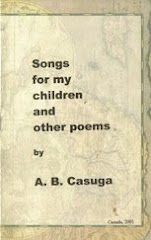
ALBERT B. CASUGA, a Philippine-born writer, lives in Mississauga, Ontario, Canada, where he continues to write poetry, fiction, and criticism after his retirement from teaching and serving as an elected member of his region's school board. He was nominated to the Mississauga Arts Council Literary Awards in 2007. A graduate of the Royal and Pontifical University of St. Thomas (now University of Santo Tomas, Manila. Literature and English, magna cum laude), he taught English and Literature (Criticism, Theory, and Creative Writing) at the Philippines' De La Salle University and San Beda College. He has authored books of poetry, short stories, literary theory and criticism. He has won awards for his works in Canada, the U.S.A., and the Philippines. His latest work, A Theory of Echoes and Other Poems was published February 2009 by the University of Santo Tomas Publishing House. His fiction and poetry were published by online literary journals Asia Writes and Coastal Poems recently. He was a Fellow at the 1972 Silliman University Writers Workshop, Philippines. As a journalist, he worked with the United Press International and wrote an art column for the defunct Philippines Herald.

Sunday, September 13, 2009

PART 3 LITERARY CRITICISM: CRITICIZING STYLE IN FICTION

PART III LITERARY CRITICISM: CRITICISING STYLE (FICTION)

What is style?

In an essay on What is Style, F. L. Lucas said: “Style has got bad name by growing associated with precious and superior persons who, like Oscar Wilde, spend a morning putting in a comma, and the afternoon (so he said) taking it out again.”

But that is obviously abuse of style.

“For the word means merely “a way of expressing oneself in language, manner or appearance; or, secondly, “a good way of so expressing oneself.’ “Lucas wrote.

If then style is a manner of expression, in literature it must be the use of the medium --- language --- and the selection of concretizing details which find their base in the author’s experience, his way of life, and his entire personality. The medium must be so used to unmistakably objectify the aesthetic experience which the artist would like to communicate. The details used must likewise be necessary and adequate in carrying out the same purpose.

What kind of language is used? Is it the language that could best express the experience being objectified? Are the verbal and literary energies of the language so manipulated and articulated as to objectify and emotionalize the experience being communicated through the objective form (artistic result)? Is the diction used appropriate? Effective? Adequate? Does the artistic use interesting and original manners of symbolization in order to objectify the experience? Is there clarity of expression, such that the meaning is derivable unmistakably from the various words, sentences, paragraphs, or stanzas, and the entire composition? Is there integrity or coherence? Is there a harmony of parts or materials used?

These are questions that are normally answered in the criticism of style or the use of medium and content. Of course, as was explained earlier, the criteria for judging the effectiveness, adequacy, and appropriateness of language devices vary from Art Period to Art Period in the various stages of literary development. (Literary history classifies these into: Classicism, Medieval (Gothic), Renaissance, Naturalism, Impressionism, Symbolism, Expressionism, Surrealism, Vorticism, Futurism, Dadaism, Existentialism, Populist Art, Revolutionary Art, etc.). 1

Therefore, the critic must find his standards from those criteria which were used during the time the work under consideration was done. Of course, there are common denominators of how well they serve the artistic purpose as devices of media. This stems from the fact that all art from Classicism to the present still engage in the objectification of the artistic experience.

To illustrate the above, the critic might come across legislative criticism like the following during the Elizabethan Period (Renaissance Humanism abounded):
“Our proportion poetically resteth in five points: staff, measure, concord, situation, and figure.” --- George Puttenham, The Arte of English Poesie (1589)

“Frame your stile to perspicuity, and to be sensible.” --- George Gascoigne, “Certain Notes of Instruction Concerning the Making of Verse,” Poesies (1575)

“We should not so soone yield our consents captive to the authoritie of antiquitie, unless we saw more reason; all our understandings are not built by the square of Greece and Italie. We are the children of nature as well as they.” --- Samuel Daniel, “A Defense of Ryme,” a reply to Campion in his Panegyrike to the King (1603) 2

Then again, the criticism of style varies according to the type of criticism the critic is employing. If he is using legislative criticism, it is possible that he would be dictating how the work should have been written according to well-established standards; if he is using theoretical criticism, he would be discussing the nature of the work in general and comparing how the wok under consideration stands vis-a-vis other pre-existing forms; if he is using descriptive criticism, he would be analyzing the use of medium as well as judging the content in the selected details and showing the reason why they were used at all. (See George Watson, The Literary Critics, Penguin Books, for extensive discussion of these types.)

The type of criticism one would find profitable in the formal approach would probably be a cross between theoretical and descriptive criticism since the analysis will have to depend on a literary theory as a springboard of dissection.

Legislative criticism is hardly functional in this approach because the use of media and content varies according to the purpose of the artist as well as the demands of the experiences being objectified. Besides, legislative criticism is deductive, while the formal approach is inductive.

Notes:

1 For workable definitions, consult any dictionary of art or literary terms. See Beckson & Ganz’s A Reader’s Guide to Literary Terms.

2 Elizabethan Critical Essays edited by G. Gregory Smith, 2 vols. (Oxford 1904) I, 53, 212; II, 68, 330-1; 366-7.


Next: Part IV Literary Criticism: The Elements of Style in Poetry and Fiction

Friday, September 11, 2009

PART 2 LITERARY CRITICISM: DISCOVERING THE ARTISTIC PURPOSE

LITERARY CRITICISM PART 2: DISCOVERING THE ARTISTIC PURPOSE AS A BASIS FOR CRITICISM

The preceding discussion on the nature of criticism singles out as its first step the definition of the purpose of the work of art from the work itself. Inductively, the appreciator arrives at this during analysis.

The question is, will he arrive at this? Will not the induced purpose vary from that of the artist’s? If what he induces varies from that avowed by the artist, will this render appreciation invalid?

In the first place, what is that purpose supposed to be? For our purposes – in the empirically-based appreciation of literature – it is what the author intended in presenting the work for appreciation. But is that information not derivable only from the author? If it were, then criticism will be of no moment – it will have started on the wrong footing, and would naturally end up with the wrong conclusion; hence, it would be futile and useless.

Literary history, however, provides ample evidence that the activity has prevailed to complete the tripartite relationship that must be endemic in any activity that involves literary appreciation: the artist, the critic, and the appreciator. The critic is the man in the middle whose function is to assist the undiscerning appreciator. This has become imperative because the growth of the artist’s awareness of things has not been in direct proportion to the growth of the appreciator’s. In many cases, critics have shown a more rapid development in this regard than even the artists themselves – because many of these critics are also creative artists (T.S. Eliot, Robert Penn Warren, Edgar Allan Poe, Archibald MacLeish, Gemino Abad, Edith Tiempo, to name a few).

To answer the first question, it is important to believe with F.R. Leavis that this purpose is derivable --- and the source may not be the author but the objective artistic result itself, the work of art that confronts the appreciator.

“But what I have to insist on is that intention in the important sense can only be determined by the tests applied in literary criticism. The analysis and judgment of works of literary art belong to the literary critic, who is one in so far as he observes a disciplined relevance in response, comment, and determination of significance. He is concerned with the work in front of him as something that should contain within itself the reason why it is so and not otherwise.

“The more experience --- experience of life and literature together --- he brings to bear on it the better, of course; and it is true that extraneous information may make him more percipient. But the business of critical intelligence will remain what it was: to ensure relevance of response and to determine what is actually there in the work of art.

“The critic will be especially wary how he uses extraneous knowledge about the writer’s intentions. Intentions are nothing in art except as realized, and the tests of realization will remain what they were. They are applied in the operation of the critic’s sensibility; they are a matter of his sense, derived from his literary experience, of what the living thing feels like --- of the difference between that which has been willed and put there, or represent no profound integration, and that which grows from a deep centre of life. The tests may very well reveal that the deep animating intention (if that is the right word) is something very different from the intention the author would declare.” (Leavis as quoted by H. Coombes in Literary Criticism. Page 9 (Underscoring supplied). 1

In quoting the above, Mr. Coombes is practically assuring the reader that such a purpose may be derived from the work. And this purpose, as has been stated earlier, is ordinarily pegged to the common purpose of all works in fine art: To objectify and subjectify (concretize and emotionalize) an otherwise abstract aesthetic experience for the purpose of soliciting or engendering aesthetic delight in the artist as well as in the appreciator.

It is the achievement of this purpose which is judged by the critic. Quite obviously, the purpose includes within its purview the achievement of that which is artistic --- that which is objectified to convey an aesthetic experience to the appreciator (or even to the author-artist himself) so that he may experience a satisfaction of his aesthetic attitude (taste). Therefore, the appreciator is judging the achievement of the artist along the lines of artistry --- the skill he applied into the work of art.

This is the purpose which becomes the basis for what Mr. Leavis terms the “relevance of response,” something the critic must work for in his readers. This “relevance of response,” according to Mr. Coombes, is the central point in literary criticism: it is in the words of the writer, in his choice, ordering, and organization of language, that his worth shows itself --- as a literary artist expressing experience worth our deepest attention, he matters there or not at all.” 2 (Ibid, Pg. 11)

In other words, in the Style and Technique. How is the artistic purpose achieved by the artist in terms of his style and technique?


Next: Part III Literary Critcism: The Criticism of Style and Technique

LOL Literatures in Other Languages: Azade Seyhan

LOL Literatures in Other Languages: Azade Seyhan

WRITING OUTSIDE THE NATION

Thursday, September 10, 2009

A THEORY OF LITERARY CRITICISM IN AN EMPIRICALLY-BASED APPRECIATION OF LITERATURE: PART I, SECTION 1: CRITICIZING FICTION

The following series resumes the serialized discussion of the Levels of Literary Appreciation based on the author’s The Aesthetics of Literature: the Concept of An Empirically-Based Appreciation of Imaginative Literature.

Preceding discussions in this blog were on literary analysis as a basis for criticism. The final part will be on the theory of literary evaluation as a by-product of literary appreciation in the study of literature as humanistic discipline.


A THEORY OF LITERARY CRITICISM IN AN EMPIRICALLY-BASED APPRECIATION OF LITERATURE: PART I SECTION 1: CRITICIZING FICTION

In an empirically-based appreciation of literature, criticism is a mode of evaluation which involves the rendering of a judgment on the formal value of the artistic oeuvre.

In other words, while it is a form of evaluation, it is different from the third level (Evaluation) in that it is a critical judgment on the excellence of the artistic effort involved in the articulation of the various elements of the medium and content in order to achieve the artistic purpose of objectifying and emotionalizing an aesthetic experience. The third level focuses its attention on the worth of the experience or reality which was shaped up through a certain style and technique.

The artistic effort being judged here refers to the artist’s application of skill --- his style and technique. These are ultimately the repositories of what is considered artistic in the wok. Artistry is not found in the experience being configurated. It is reflected in the formation of the experience, in the application of artistic skill. Therefore, artistry is reflected in the artist’s style and technique.

Criticism in an empirically-based appreciation of literature is primary formal in its approach; i.e., it begins a posteriori (inductively) with the objective form – the art work (a phenomenon with a definite, particular “being” concretized by the objective elements of medium and content).

Because it is formal (i.e., addressed to the concrete form – the poem on the page, the sculpture in the round, etc.), it is often referred to as “objective criticism.” “Objective criticism of literature is criticism based upon qualities demonstrably present in the literary work, not qualities present in the writer or reader… Such a criticism requires that a reader know what the literary work was intended to do, whether it succeeded in doing it, how its various parts contributed to or hindered that operation.” (Duhamel & Hughes, Literature: Form and Function.) 1

The requirements mentioned in the directly preceding paragraph demand that analysis precedes criticism, because it is in analysis where the appreciator would get acquainted not only with the meaning of the work, but also with the purpose or intention of the artist and the various parts utilized in achieving his artistic purpose.

After the analysis, the appreciator normally arrives at a synthesis of what the artist has been trying to convey (the idea, the theme, the experience); he (the appreciator) will also recognize that ordinarily the purpose of the artist is to objectify or concretize this experience so that it may be transferred to the beholder in a palpable fashion since it is only in this form that the experience becomes specifically meaningful.

If the purpose of the artist is to objectify his aesthetic experience so that this may be perceived by the appreciator for his delight, it follows that criticism of the work will have to be based or whether or not this purpose was achieved in terms of the artistic materials (medium and content) available to the artist and recognized by the appreciator in the course of analysis. In brief, the appreciator will now make a judgment on: l) how well the artist’s style served the artistic purpose of objectifying the aesthetic experience which is being conveyed to the beholder; and 2) how well the technique served the artistic purpose of objectifying the same experience.

As common denominators, the outstanding qualities which become the criteria of how well the style and technique serve the artistic purpose are: whether or not the various media-elements are (1) effective (capable of exciting aesthetic delight – which is ultimately personal in that it appeals to the educated taste), (2) necessary (that they are a sine qua non to objectification), and (3) adequate; and whether or not the formulation and presentation of these elements are necessary, effective, and adequate.

These qualities, however, vary from art form to art form, from Art Period to Art Period. In other words, there are particular genre standards that are peculiar to each of the different stages of literary history; for instance, the qualities of an artistic style during the Classical Period may be radically different from that of the Romantic Period.

Because of the preceding, it would be imperative for anyone who might want to criticize literature for a keener appreciation of the art to (1) have a clear conception of what literature is (literary theory) and what it can do (its function); (2) to know his literary history; (3) and, to understand the aesthetics of literature – the modes of literary appreciation, the qualities to appreciate in good literature, and the criteria for valuable literature on three levels: universal values, formal or genre values (what makes a good poem, short story, novel, drama, and essay), and personal values (those peculiar to the biases and prejudices of the reader who has had a liberal sampling of literature in the different literary forms. 2

This preparation is necessary because a “good literary critic, when he is practising his art – that is to say, when he is committing his criticism to paper—is characteristically engaged in doing two things: he gives us, as completely and as clearly as he can, his considered response to a short story, to a play, a novel, a poem, and essay, so he can help us to a fuller enjoyment and understanding of the experience in and behind the writing; (and/or, he reveals, by examining a piece of writing in detail, the elements in the writing which combine to make its particularly quality.” (H. Coombes, Literary Criticism) 3

Such a preparation will naturally make criticism fair and intelligent, because, after all, the work of art – it is assumed – was done in fairness and with great intelligence. Of course, before one should waste one’s time on criticizing the work, he should at least have been able to determine through analysis if there is reasonable significance in the work which is worth spending one’s precious lifetime on.

Then again, in the words of T. S. Eliot (“The Use of Poetry and the Use of Criticism,” Selected Essays) “criticism must always profess an end in view, which, roughly speaking, appears to be the elucidation of works of art and the correction of taste” 4

One cannot hope to explain the beauty of an artistic product if one does not know what makes it beautiful; nor would one be capable of correcting misguided or unguided appreciators’ tastes, if one does not have an impeccable and intelligent taste in the first place.

But why should one engage in criticism in order to appreciate a work of art? Is that not making the process more complicated? Rather than think criticism is a complication, the student of literature should take it as an effort towards making the appreciation keener and more intelligent as appreciation must be keen and intelligent. (only man can appreciate. He is not about ready to default on this virtue which distinguishes him from the primates). If it is a rational activity at all, it might as well be a reasonable and reasoning one. In higher education, it is the student’s proper activity anyway.

“Especially for the beginning student of literature today, faced with a rapidly growing diversity of literary works and qualities, and too often introduced to them only through a hasty and meaningless survey of names, titles, and other routine external data, the main value of studying criticism is that it may arouse in him the desire to think through what he is reading in literature generally, and sharpen his ability to do so. Its first and most important fruit is to make him realize that evaluation – seeing things for what they are, seeing them in their importance – it is not a matter of caprice, custom, or affectation, but that it can emerge from intelligently conceived premises and aims … Criticism can thus bring into activity the noblest of human qualities: namely, the quality of sinceritiy, the desire to discern the truth, to see some point in what one is doing or thinking, and to keep penetrating until the answer is found.” (Walter Jackson Bate, Criticism: The Major Texts). 5

It must be emphasized that criticism’s classification as a rational and human activity is by no means a manner of patting the homo sapiens on his back. It is concededly a proper activity of his species. Besides, it should be taken as one of those means by which man could realize his differentia --- his rational potentialities towards knowing – because man, among all beings, has been “condemned to know.” Inasmuch as he does not yet know everything (in spite of the millions of years he has been around), he might as well go on knowing – synthesizing – and hope that someday he will wake up fulfilling the requirements of his perfection.

Notes:

1. Duhamel & Hughes, Literature: Form and Function, Prentice Hall, N.Y., 1969. Introduction.

2. Levels of Evaluation discussed in succeeding parts of this series.

3. H. Coombes, Literary Criticism, Penguin Books Lt., Hammondsworth, Middlesex, 1963. Page 7.

4. T. S. Eliot, “The Function of Criticism” (From Eliot essay of the same title) Selected Prose, John Hayward, Ed. Peregrine Books, Penguin Books Lts., Hammondsworth, Middlesex. 1963. Page 18.

5. Walter Jackson Bate, Criticism: The Major Texts. Doubleday Anchor Books, Garden City. 1959. Introduction.


Next: Part II Literary Criticism: Discovering the Artistic Purpose as a Premise for Criticism

Monday, September 7, 2009

POETRY: A HARVEST OF NEW POEMS AND OLD (REWRITTEN)


A HARVEST OF
NEW POEMS AND OLD


LOVE IN THE BUTTERFLY GARDEN

--- The female carries the male butterfly on her back while they reproduce, and then the female eats the male while waiting for the pupa to become another butterfly, and then she dies shortly after. --- Bohol Butterfly Farm Guide Felix.

1.


How a butterfly farm can turn
an upside down imitation of life,
haunts me still this side of art as life
or life as art as transfixed visions
of what we must be now:
like the gravid mariposa luring its mate
in a flight of duty -– she must bear
the male of her specie on her back
while they consummate a dance on air
not unlike our act of mating ---
she enamouring her mate
with scents purloined from blossoms
as, conjoined, they flit from flower to leaf
tumbling on air in ecstasy
not unknown to us when wild and young
and brave with joie de vivre,
for they must breed their kind
in a chrysalis of quiescence hurriedly,
urgently, before an inexorable end
where the male must be consumed
as her victual while clinging
to bramble branches bearing her pupa
seen to us now, voyeurs of unfolding
beauty and arresting splendour,
as the preening papillon bestirring
the dry air into a flutter of magic
sprung from throes of death and dying,
for she, too, must soon perish
after this function of issuing
a magnificence that for us can only be
borne of love and loving, yes,
perhaps also onto death and dying.


2.

The poet’s refrain, “how do I love thee”,
is supercilious here, cher ami,
it cannot match the male butterfly’s sacrifice,
nor this mariposa’s dying
to bear life, beauty, and splendour.
Alas, beauty is an omen here.


A RIVER'S RUSH

--On a cruise along Lachine, Quebec

It is the river as mother to the sea
Entraps us into this womblike feeling of ease;
It is the river draws us to this discovery
Of need, our quiet helplessness.
We are the river ran its course
Into an engulfment of restless sea.
How far have we gone from our rivered Nara?
Or how long have we gone astray?
Does the river current come full circle
From the breaking waves of sea?
Do we meet each other, dreamlike,
In the endless stream of the world’s Lachines?
When do we come back as rivulets
In some hidden rock spring?
The river runs full circle, and we discover
We have not even halfway met.
When will my currents break into your rocks,
You distant sea, you entrapment of need
And engulfment of ease?
When will the sea create the river?
When will the river create the sea?
Where they meet in the trickle of a little garden,
Who laves the riverstones?
Who laps the greening shores?
The river’s rush is also our question.


THE FINAL TEMPTATION


…and from his rib sprung Eve to ease his loneliness.--Sunday school tale.


Adam names grass whatever they may be,
but does he feel their caress on the navel gently
pressed where pressed they ought not
on afternoons like this? This afternoon is hot.


Blue skies have virtues all their own seen through leaves.
O, blue skies, what new birds bring you? What eves
Bring you when evenings are soft wind on my cheek?
Twitter of unnamed birds, tremor of eel in some creek?


If I only knew what Adam is abroad about all day,
I would not ask you, black boughs, which way
To Adam, O which way?
Afternoons darken like this and soon it will rain.


He will have new tales tonight. I know that;
but that tale about the Tree, I will get him tell me again.


A STRIVING AFTER WIND


--- All things are full of weariness; a man cannot utter it.
(Ecclesiastes)


Malaise stamped on evenings like this ripens romance:
Wisdom becomes our sad bohemia, and we are clowns.
We laugh at what night disgorges --- the gilded askance


But night defines shadows twixt dancer and the dance;
We are cynics grown old, now satyrs of the lounge
Malaise-stamped on evenings like this. Ripens romance


When we, Simon-like, doubt wine and whore’s relevance?
They, too, have time who walk the streets, liven towns
We laugh at. What night disgorges (the gilded askance)


Hounds us, we them, arguing the grip of night and trance
Makes of us involuntary heroes but our bravura drowns,
Malaise-stamped, into evenings like this. Ripens romance.


Romance is talk of God and lady’s drink, a dash of Launce-
Lot, which, too, has time as we have time for cups and daunce
We laugh at. What night disgorges (the gilded askance)


This painful laughter? This wastefulness of remembrance?
We have become martyrs of meaning yet must be clowns
Malaise-stamped on evenings like this. Ripens romance.
We laugh at what night disgorges: the gilded askance.


WHERE THE FINAL WEAPON IS A CHAIR


Ah, to be old and a mariner come upon that restful cove,
to be old, cher ami, is a gallant slouching on that chair –
where the final weapon is the chair not love,
some porch of the heart grown insensitive to care.

This must be the reverie of a changing season;
We never knew quite well how far we had travelled
before we ceased to chant our rising songs:

O we have blanched at the rustle of dried leaves
O we have quaked at the fullness of a street’s silence
O we have hushed at the coyness of echoing eves
O we have known the crag flower’s quintessence!

It is no longer Nara beyond this echo-call.
Where am I? Where are we?
If the morning never becomes an afternoon,
will it always be a waking into a moment
of disfigured song, a dawn of perpetual clocking?


A LESSON ON BUBBLES

Bubbles burst when you catch them,
Much like your wildest dreams:
The blowing is good while it lasts;
Soon the suds run dry, the bubbles fly
From your grasp; elusive illusions
Remain like tombstones. You were
Here once, but just that once
Until bubbles fill the rooms again,
Fly, and burst while catching them,
Much like your fondest dreams.
Catching bubbles, bursting bubbles,
Popping bubbles while you can;
It is a game grown old in our hands,
We tire of it and let the suds run dry.


BAILEY’S BALLOON


---The boy stuck a message to his balloon: If you are there,
God, show me where you keep your miracles. And he let it fly.


However high it goes, it will come down --–
Wrinkled on a branch, its message undelivered.
Harsh spring winds will blow it out of town
Before its whimsy, nay, its prayer is discovered.
Why play crapshoot among the clouds, my boy?
Could God be there, or does he hide elsewhere
Among the stars, or in some bramble being coy
Lest he expose himself as burning bush in fanfare?
Let your balloon fly shorn of its couriered burden
Of finding him sheltered in some unlikely heaven
Where heaven is not — for he never left your side
As you let it go to look for where his miracles abide.


DIES IRAE: A POEM FOR OLD MEN

1.

Halfway, between this river stone and many rocks after,
Nara shall have gone from our echoes-call.
We have wandered into a sunken mangrove and wonder:
Is it as silent there? Are there crabs there?
What quiet mood is pinching bloodless our spleens?
This is another pool –-- navel upon the earth.
Always, always, we cannot be grown men here.

After the white rocks, after the riverbend,
Nara becomes the dreaded dream.
We have put off many plans of soulful revisiting ---
We will go on re-stepping beyond the white stones,
Each step becoming the startled rising
Into a darkened city farther downstream
Where we once resolved never to die in.


2.

Do we wake up then afraid of Nara?
But rising here is the nightmare come so soon,
Treason in the daytime, maelstrom at night:

The nightmare was of cackling frogs
And serpents rending skulls and cerebrae
Of kitemakers who sing while termite logs
Burn and children, chanting the Dies Irae,
Mush brainmatter, pulling out allegory
Like unwanted white hair, stuffing black grass
Where brain was, casting tired similes
Into dirty tin cans where earthworm wastage was:

River swells drown us where, surfacing,
We wake up knowing our days have become
Termite nights and decaying metaphors.


A HOMECOMING


Tanqui’s supreme conceit is its dread
Of withering grass in the month of the frogs
When rain, like fingers in the night, tread
The lesions gangrened on a hillock’s carrion,
Carcass of a season mourned
As the briefest of them all.


“The rain is on the hill, the dry pond
Is red with clay, the gods are back!
And so must I --- shadow of a past long gone ---
Weeping, running through these deserted streets,
Crouching now in mud pools of childhood fun
When songs were chanted as songs for the dance.
A dance for the grass! My limbs for the grass!
I must dance for Tanqui’s singéd grass!”


He dances hard, his body clean and gleaming,
But Tanqui’s rain is on the ashen hill.
Neither his dancing nor his lusty screaming
Will stop this dreaded withering.
Tanqui’s conceit is stranger still
When songs are sung not for her lads and lasses
But for this stranger who, dying, has come back
To dance for black grass, dance naked
For Tanqui’s withered pantheon grass.


ONCE UPON A SUMMER SOLSTICE

(For Francisco F. Casuga+)


There is a scampering of grace in the dry woods
and a pulse upon some soliloquy:
it is the rain come as a smooth and forbidding lace
upon the cup of the dead and dying weather.


It is past the season of the grub.


The flirt of the monsoon upon the arid lap of Nara
is caked on the thick napes of children
dancing naked in the mire of the fields,
gaping to catch the fingers of the rain,
slithering like parched serpents guzzling raindrops
cupped in the hollow of gnarled father’s palms.


There will be no songs, for the ritual is not of birth
but of death as summer dies in Nara
and with it every titter bursting from a child’s mouth.


The rain becomes a bloody plot.


THE BRUSHFIRE WHILE IT LASTED


---They called it People Power, kuno!
Leery Smokey Mountain scavenger.


It is the hunger on brown wrinkles
lined in the irony of parched lips
parted in smile that convulses
the clot of flames violent in the blood
of these gnoméd comrades now
crouched in the muck of this burning river.
The anger was good while it lasted.


--- ALBERT B. CASUGA
Mississauga, 2009


Friday, September 4, 2009

FICTION: A HARVEST OF TALES SO FAR

A HARVEST OF TALES:
4 SHORT STORIES


1.

THE FIRST REPORT

He came in from the cold.

She asked the usual questions when he came in to help her with her youngest daughter’s children: was it cold out there? Still minus-minus? Did we get some mail? He kissed her hello and said, Yes, it is cold. Yes it is still minus 12 Celsius. Yes, I got your mail – bills and statements from our banks. Junk mail. One for me, though. Reader’s Digest’s announcement that I am finally a contender for the million dollar jackpot, and another, I think, from Old Age Security, or pension, or something, he mumbled. He tried to be cheerful, but he mumbled.

His 30-minute walk through the chilling streets from their townhouse left him breathing hard. Like a wheezing old man. Like the wheezing old man he has become, really. He called it his “constitutional”, but everybody knew (his family in Canada) that he had to be there before lunch so could eat with her, and be off with her car to the other daughter’s house to sit for still another set of grade school girls. Saucy ones who were always fighting.

He did not have his own car, and he must depend on the functional Japanese car parked where she left it, coming in earlier to relieve her youngest-teacher-daughter who must run to her class. She’s late. The engineer-husband had to commute. Bad traffic. He’s late.

The walk did him good, though. He needed the long, daily walk, to cut through his enervating depression. Or to take his mind off his ageing ailments, his aches, his IBS, his occasional chest pains, tingling left arm, crinkly fingers, forgetfulness, and obsessive compulsive symptoms of Alzheimer’s, etcetera. He goes through this list with his bemused physician, the Chinese family doctor at the mall, every time he consulted him. It was often, of course, because it was free. Won’t get this in the old country, “un ventaje, hombre!”, his wife would drill this health-care advantage into his head – if she was lucky to say it to a good ear. He did not wish to immigrate to this cold country, in any case. Nor dreamt of it.

He said he also needed it to think. To keep his porcine heart valve working, he must do all that walking, his only son would tell his kibitzing sisters.

He coughed. He came in from the cold. He will be fine.

His “tesoro”, the one he calls Nicky 2, stopped her “Dora the Explorer” TV session, and ran into his arms " ‘Lolo! ‘Lolo! I’m watching “Dora”! She ran back as quickly as she appeared at the door. Where’s, the big, bad boy, he asked, pretending to look for the younger sibling, his “assignment” in this babysitting partnership.

The chubby boy remained motionless in front of the idiot box, ignored his inquiring abuelo (No ‘Lolo!-‘Lolo!- yelled-greeting this time. No hugs, no kisses. Just a mindless act of ignorance that felt like a freezing icicle between his testicles. Watching Dora, he protested when the old man made his mock-call: O, Louie, whey ah youoooo?

Have you had your merienda, he asked the reception line, now transformed into a puttering woman rushing through the preparation of a pot of chicken stew. Not yet, not yet, was the harried response. She called out to the boy: go kiss your abuelo or no cookies for you! No! was the prompt retort from the motionless boy in front of the idiot box.

He saw she saved some of the crispy fried chicken skin for a snack. She plunked the saucer of skin on the table, muttered for him to sit down for his snack, and, with an unctuous tone she said, after lunch, let’s talk. Let’s talk. That was like a stalactite shoved up his frozen ass. It occurred to him that she was issuing another warning: Let’s talk, asshole!

He knew this was coming. One of those “fearsome” ones. She lay sleepless last night, fuming that he had this talent of taking the joy out of everything, even out of the late television show. I know it’s late! I know I’d be sleepless. But do you have to harass me? He promised that they would not go to sleep fighting. Well, she hated him, she said last night.

Let’s talk. He did come in from the cold.

After a perfunctory, ominously silent lunch, he quickly washed the pots and pans, dishes, utensils, the children’s’ bibs, and anything she thought should be in the sink. Gary’s job, he muttered. Huh? She challenged. He snickered, snorted really, and said, that’s the South Afrikaner’s name, remember? The Disney Cruise waiter, remember? He hastened to explain lest she fly the handle for his insolence. Huh! The guy who did not do a good job, she said. I’d get that label as his second fiddle, she said, she being the Mario, the main waiter on table 137 at the cruise. Some baby waiters, he said. Caregivers, hombre! She shot back. Besides, don’t you love your grandchildren?

Let’s talk. She said, we should get it over with before the children woke up from their mandatory naps. (A downtime for the sitters, uh, caregivers, all right?) It was going to be a long, painful one, he suspected. The last time she required this communication, she demanded that the almost 50-year marriage be done with, over – kaput. She said she could not take the moods anymore. Why are you so unhappy? Why have you become a hermit? You would not even want to socialize with your children. We have no friends in this country at all!

As soon as he slumped on the leather sofa which doubled as her napping bed, she asked the same questions again. This time, however, they were surprisingly doleful. What, no fury, he thought and got confused. The last time those questions were asked, he thought he lost his keys to the house. He was left twisting in the wind. She did not see the keys, she harrumphed. Was she getting ready to kick me out? If she changed her mind in his favour that time, she did not let on. A homeless husband is harder to explain to the children and grandchildren. Maybe.

He felt so ineffectual. In the old country, he was a brilliant academic, a writer, a journalist, and author of books and scholarly papers. Now, I could not even write my epitaph! He sighed.

Even the children make fun of me. They speak to me like I was out-of-it, dumb. Or suspect that I only choose to listen to what or who I wanted to pay attention to.

And do we still touch each other?

He felt a tug at his sleeve. Are you sad, ‘lolo? Are you crying? I will protect you. The little girl’s voice was gentle and strangely solicitous. Those were words he whispered to her one summer when she wept over a dead bird in the now snow-bound yard. Then, she went back to her strewn toys, books, cups, saucers, plastic things. She was singing a French ditty. She was counting in Spanish. She was saying “mahal kita, mahal kita” to her rag doll. A quadrilingual delinquent one day? She must be listening. Little ears. But at three, she will remember. Why is she not napping yet, he asked the woman who had just wrapped an arm around him.

You have to move on, darling. Past is past. What you have achieved then is a large part of your life. But move on. There are more poems to write, more stories to tell. What about children’s books? She surprised herself with her mellow coaxing.

The tears were there. There were affairs. But they got back together. In this new country, she promised to build a new life for both of them. This was his covenant, he pledged likewise.

Why don’t we get you occupied with something you have always loved? Write me something everyday or every moment you get. It does not have to be a poem, a story, or play. Remember your notebooks? What about journals. Why don’t you start a memoir? Or just get into the business of writing once again. I’ll tell you what…Do your writing. Send me a copy of anything you have done. One click on the computer. Every day. You know, like writing a report. She stroked his wrinkled temple.

Because he could read the plea in her conches-like eyes, and the old ardent faith she would tell him about when his blocks would torture him no end, he asked: What could I give you in return for this kindness?

What about a 10-minute massage before we go to sleep? That should help me go to sleep. I do not sleep well, darling. I need to sleep.

The little girl kneeling by the fireplace let out a sudden shriek: I am not tired, ‘lola. I don’t want to sleep.

She took her little hands into hers and said: Go kiss your lolo, nighty-night. When you wake up after your nap, we will have hot chocolate. Deal?

Nicky 2 moved hesitantly to the wheezing old man and said: Abrazo! Beso beso, abuelo.

He came in from the cold again the next day.

From the curve, he could see her and the little bobbing heads. They were waving at him. Blowing him kisses.

When he got to the door, she did not ask for the mail. Nor the weather. She wanted to know if he had the “report.” See your email, he said.

When they sat down for a snack, precious minutes before the tandem feeding of the children, he asked: Do you know that the first time I saw your undies was when we were chatting in the living room of your old San Juan house ? You were wearing a striped pair of grandma panties. Your thighs were silken white, my mestiza!

She gasped. Aiee, que loco de cabeza! The children will hear you. She snickered.

He knew she blushed, but he continued: And my most cherished moment was that time you asked me while we kissed saying our stolen, endless goodnights, before your father would come down those stairs to signal my leaving, it’s midnight-you-know…was when you asked me if what you felt down there was a hard-on, and I said: it was a tumescence. You asked to see it. But it was dark, and we heard your father’s footsteps.

But that’s for another “report.”

March 2009


2.

MR. TEAGUE

Are you ready for your morning stroll, Mr. T? In a minute, he bristled unable to get his arm into his heavy cardigan.

It’s not that cold, you know, the Filipina caregiver reminded the harrumphing octogenarian.

He was in the process of making a 180-degree turn, trying to fix the pictures atop his credenza while he struggled with his sweater.

Did anybody move these pictures around, Luisa? Er, Maria, is it?

Dolly, Mr. T, she introduced herself as she does every morning now, her conches-like eyes widening in a bit of apprehension; he did not particularly like these pictures rearranged. That would ruin his day. He would have to be re-oriented to the east-west-north-south co-ordinates of his room. He was a “topgun” fighter pilot in WWII in the Pacific war, in Corregeedoor. You know, in your country. He never tires of reminding her or any of her Filipina compatriots who work at Erin Mills Lodge for Seniors.

I particularly like the picture of my late wife on this spot, Luisa, uh, Maria, or whatever you called yourself --- sorry --- It points me to where I get my underwear. You know -- undies? He tried to smile the scowl from his face away.

She’s just taken over. The nurse from Trinidad just upped and went complaining loudly that she’s sick and tired of being groped by demented perverts who should stop hoping they could still do it.

Dolly, Mr. T. And by the way, your walking partner, Mr. Alex, called while you were in the washroom. Said he will wait for you at the lobby. He said the sooner you get out today, the more sunshine you both would get. You’d have to get back quickly for a late breakfast.

Thanks for letting me know, Luisa. He must have something going for that name Luisa, she figured. But always a gentleman, he would say thanks for anything helpful coming his way. After a fashion, though. This is a community of civilized old farts, he would say.

Alex is always late anyway. His cane trips him up when I tell him to walk a bit faster. Between us we’ve got six feet, you know. Four crumbling ones and two wooden ones. Get it?

She laughed, relieved that he had been distracted away from the misplaced picture. She’s pretty, she remarked, by way of thanking him for not exploding. My son says, I use it to scare the mice away, he giggled.

At the lobby, that morning, his buddy and next door neighbour, and fellow three-legger, waited with a pained look on his face.

Got boils on your derriere while waiting, Alex? What’s with the face?

Don’t even go there, Teague, the bent, scowling man sprawled on the lobby steps snapped.

It can’t be that bad, old chap.

My son did not pop up again. He’s got this wife problem, my daughter says. It’s been two months now. He’s still in the Philippines, you know. Teaching at that protestant university in the southern Philippines. Dumaguete.

He could pronounce Philippine words better than his buddy – he’s been there, too, in Corregidor, in Bataan, the last stand of General MacArthur. They were GI soldiers from Michigan. Both immigrated to Canada after WWII (so that their sons would not have to go to war -- Korea, Vietnam, Iraq and all that s...)

Yeah? I have a son there, too. Teaching fine arts, painting, you know.

Of course, he got my son in there, too. Reverse brain drain. Canadians teaching the little brown people. Remember? Oh, no, you don’t. It figures.

Let’s walk. Oh, wait. Here’s the slow mailman. Doesn’t he look like Robert De Niro?

The ambling postie greeted the gentlemen with canes, and said he’s got only one letter for youse, gents. For you, Mr. Teague, sir. Urgent . Express Post. From the Philippines. The last syllable pronounced like “pines”. Paayns.

Teague knew it must have come from his son, the painter in the Silliman University school of fine arts. He cracked it open. He fell silent.

I’m going upstairs, he said.

What about our walk?

I’m going to my room.

Wait up, Teague. What’s wrong?

Dolly was still there when he got back. Please leave me alone, Luisa.

What’s wrong, Mr. T?

He sobbed into his pillow as his panting partner ambled into his room.

Did we have to take separate elevators, Teague?

He showed the half-crumpled letter.

God, no! Alex grimaced and fell silent. I’m going back to my room, Teague. You don’t need me here now.


* * *

Both men stayed up that night. They did not answer calls.

The following day, at the breakfast table, they exchanged envelopes.

Read it before your nap, they almost simultaneously prescribed.

When Alex opened his envelope, he read:


Mr. Teague of Siquijor

Teague’s sandbox at Lo-oc beach spills
over to the slopes of Siquijor –
a kind of walking out on infancy
or bright courage, the carcass marching
nude to humour a carrion God
astride Siquijor’s dark mountain loins.
“O, when will the lad get out of his sandbox
to walk towards the mountain slopes?”
By the way, Teague’s body was fished out
of Lo-oc the other day, near Siquijor.


It is a poem from my son. Teague signed his single-sentence note.

In his room, Teague used a magnifying glass to read Alex’s note. A former CanLit professor, his partner wrote:


The Habit of Mountains: A Dirge

It was his grief pursued the habit of mountains:
It moved the world with quietness. Quietness moved them.
No dearer madness there is than which he died for:
A will to perish in time and manner he chose.
It could not have been any kinder than this falling,
A manner of bargaining one’s way
Into a choice between a kind of dying and feeling dead –
No option for us who learn, too early perhaps,
That death prorogues a dream of fancy
Or a prayer of willing our pain stay
The ramrod poised to rend out days descending
Foglike upon us decreeing silence for our bed.


Earlier that day, Alex received a call from his son in the Philippines, a colleague of Teague’s son at the Silliman University. Dad, Teague Junior committed suicide the other day.

Why? Asked his buddy that evening. There was just the two of them like crumpled shadows beneath the dining room light.

He could not abide his being different. He went away, as far away as he could from me. He was gay, Alex. He promised he was going to see me here before accepting that teaching job in Mexico. He said he will exhibit his paintings here at the Lodge.

Nuts.

He fell in love with one of his male students. There was a case filed against him. Corruption of a minor.

They don’t have same sex marriages in the Philippines, do they?

Nope.

-o0o-

April 2009


3.


REQUIEMS


From eyewitness reports, the Governor cowered behind the outhouse. He did not bother to plead for his life, nor remind the young man that they were fighting for the same thing. He remained ominously silent on his knees as his executor emptied the home-made pistol into his head.

He had stepped out of his boathouse office for some air; his weeping wife told the military commander who arrived at the scene an hour after. Preciosa and her six-year old birthday girl curled up on their rattan papasan chair. She said the Governor suggested they celebrate their daughter’s birthday simply – just the immediate family and abuelo and abuela – at his office. The river was calm and police security was available.

There was no sense flaunting his in-laws’ wealth by celebrating at their Negros mansion out of town. Times were hard. Unverified security problems bothered the Governor who had just pronounced fiercely in the papers that the assassination of the President’s avowed rival at the Manila International Airport was dastardly, cowardly, and as sure as the damned military can make certain, the martial law dictator had him killed.

Pain in anybody’s ass, this local, Jesuit-schooled, politician – a governor by the grace of his in-law’s blood money squeezed out of the brown backs of the measly-paid hired hands and farmers in their hacienda – was the Governor’s capsule resume among the province’s officialdom. He was a lone-wolf, a maverick. Not even his father-in-law could get him to pipe down about criticizing the martial-law strongman.

* * *

Who shot Vel? The commander asked the police chief who was nowhere near the scene of the shooting.

Our initial investigation, sir, points to a kid maybe in his twenties. Could be NPA. No ID.

Who shot him?

My men, sir. Police sergeant Kalima, sir. He was patrolling near the office of the Gob when people started running and yelling that the Gob was killed.

Keep these from the press. By the way, we are taking over the investigation on orders from National Defence.

Yes, sir.

* * *

Evelio Falco had just passed the Bar when he ran against the ten-term governor of the province. He was popular with the university students and generally the restless youth who practically abandoned their classrooms in favour of the streets. They wanted the martial law government to give way to honest and clean elections. Poverty and injustice must be eradicated. Corruption in the government and in all levels of society must never be a way of life.

Avenge the murder of Ninoy! Throw the military rulers out! Down with dictatorship! Kill the bastards!

Falco took to the streets, marched with them, stoked their anger, and organized cadres among the young men and women who trooped to his office to volunteer their services and battering sticks disguised as placards..

He was their champion, their hero. He beat the incumbent governor to his father’s chagrin because the old and doddering politico was also his own uncle, his father’s eldest brother.

Disinherited, he found an unlikely supporter in his father-in-law who could not bear to see a pregnant Preciosa bring home a loser for a husband.

They met at the university, and she was curious about how a rich man’s son could also rant and rave about the rights of the poor and the exploited labourers in the wealthy encomiendas, the enclaves of the idle rich. Born to one of the oldest families in their region, wealthy landowners who raked in money from their vast rice and sugar cane plantations, he was himself an ilustrado.

Come to think of it, she would muse, the Philippine Revolution against the Spanish colonizers were hatched by the Filipino ilustrados, the students who won scholarships to study in Spain and in the Spanish-run Royal and Pontifical University of St. Thomas, a Dominican bastion of intellectual and religious colonialism built by the Papacy in Manila.

* * *

He was about to smoke one of those American cigarettes he resolved to give up, when this gaunt, shaggy-haired, swarthy and unwashed young man pointed a gun at him.

Traidor! You betrayed us! We believed in your land reform. We got you elected. Putang inamo, Mamatay ka! (Die, you son-of-a-whore!)

Falco yelled for his bodyguards, but only Preciosa came running from the boathouse. He bolted and ran through some houses across the town’s main street. The young man, in relentless pursuit, saw him hide behind a well-built outhouse with one of those cemented vertical culverts serving as its main pipe – a two-storey wonder of an outhouse – and cornered his fugitive then kneeling for cover behind the massive concrete pipe.

After pumping all the bullets into the Governor, he ran from the outhouse like someone about to suffocate from the stench of the septic tank.

Earlier, he had taken the ferry from the other end of the island province, dropped by the Jesuit-run University for some last-minute arrangements, filled his knapsack with canned goods, and took time to scribble some notes. He got to Falco’s office by noontime and saw him struggling to light a cigarette; gusty wind from the bay made him cup his palm over his face. Caught unawares, he got startled by the shriek of the young man with the pistol.

The police could not find any contacts, they reported to the military commander. Sergeant Kalima was passing by when he heard the confrontation. He saw the Gob run through the fences and the houses, lost sight of him, and finally heard the rapid cracks of gunfire.

Almost running into the assailant, the portly constable shouted for the young man to stop; he would not. Kalima shot him, and was surprised he got him.

Searching for an ID while rummaging through the youth’s knapsack, Kalima found some dried fish and canned sardines. He also surrendered a notebook to the military commander who leafed through it, and fall eerily silent, when he came across what was later described as lyrics to a song.

Song

Dawn is red on this ruddy face
Sun dogging his craggy trail,
The song deep in his throat:

“The last best fight, my brother;
Our blood on the tip of steel!”

Brother to the pulsing spring,
To the bushes and rocks, the wrath
Of days, of quietness descending.

“The last good fight, my brother;
Our blood on the open trail.”

A song arrested in his throat,
The steel tensile in grace,
His still point is a point of steel.

--- by Ka Ric Fernandez, University of San Agustin

He was a student, the military man whispered. Must be one of the cadres in town. But why Evelio?

* * *

News of Falco’s killing spread like wildfire throughout the province. Students from the capital city’s schools poured out of their classrooms, burned tires in the streets, and accused the martial law government of having their hero assassinated. Domestic fury was, indeed, in use.

Falco’s office television, turned on it seemed throughout the days and nights (as was the Governor’s standing instruction), blared with harried, continuous coverage:

Evelio Falco was gunned down today by elements of the military according to student activists now marching around the capital city of Silay because of his opposition to the martial law regime.

At the boathouse, the Governor’s widow wiped his riddled face as she absently wailed: Why? Why? You were right again, Vel. We are ourselves our war!


* * *
April 2009
4.

A Death in the Afternoon


From a 22-hour plane ride, my wife dragged me on the first day to a parlour to get a haircut and a foot scrub.

That afternoon was abuzz with fearful banter among the “aestheticians” (haute term for today’s barbers, hair stylists, foot spa attendants, pedicurists, manicurists, and the kibitzers to garner bigger tips) --- “Who will bring that homeless man sprawled near the parlour to the hospital?”

The attractively transgendered manager called the barangay tanod (village watch) to come pick up the distressed man whose gangrened leg (from a diabetic reaction to an earlier amputation) precariously dangled from a pushcart he fashioned from scavenged debris or termite-eaten lumber from abandoned houses.

The barangay bureaucrats said it was a job for the Department of Social Services and Welfare, not theirs. The security guards at the nearby Jolibee fastfood restaurant harrumphed that something must be done quickly to get the “wreckage of a derelict” out of sight – the munching customers inside are beginning to squirm. Who will help him, the fluttering beauty parlour attendants chimed in with feigned concern (How come even the females talk like tarty maricones (gay)?).

What’s this fuss all about? My foot-spa-treated missus enquired in the busy-body unctuousness of the parlour denizens.

It’s about a dying man outside, I barked from the barber’s chair.

No one wants to take him to the hospital, the transvestite parlour boss said. No one wants to shell out money to the hospital – before the man is admitted. You know, he’s got a son in the States and another working in Dubai. They must have abandoned him. Or he was too crazy to even get in touch with them.

The parlour kibitzers chorused like cackling hens. That’s what’s wrong with our system --- no money, no health care. Even the village officials would rather pass the buck to the distant national government DSSW (they are fond of abbreviated names here) who likewise passed it back to the barangay (village) government.

Dios ko, naman, baka mamatay na lang diyan! (Good Lord, he might just die right there!) sighed the outraged parlour overseer.

Done with my haircut and foot scrub (to remove calluses from ill-fitting shoes, my wife prescribed, and “to restore epidermal softness common to the ruling class”! ), I stepped out of the noisy marketplace of rubber-nosing fencesitters. It was about that time that a small crowd started clucking collectively angry tongues. Patay na siya! (He is dead!) Huli na’ng lahat. Saan ang tanod? Ang DSSW? (It is too late. Where is the village watch? The Department of Social Services and Welfare?)

Sprawled helter-skelter on the makeshift pushcart is a diminutive, unwashed, half-naked old man who must have finally gasped his final breath begging and waiting for help while balik-bayans (citizens who have come back from their homes elsewhere abroad) like me had their foot-scrubbed into baby-pink like smoothness inside the air-conditioned, perfume-scented beauty parlour.

I shuddered at the microcosmic likeness of the “moment” to the macro situation of the old country --- nobody steps up to answer the critical question: Are you your brother’s keeper?

My wife averted her gaze away from the crumpled body on the pushcart. I heard the Jolibee “sekyu” (security guard) yell at the now het-up barangay representative who has just wheeled in to ask – where is the man who needs to be brought to the hospital? Ayan, patay na siya! Pulutin na ninyo, o kami na ang pupulot sa kanya bago mawalan ng gana ang aming mga parukiyano! (There he is. He’s dead. Pack him up or we will do it ourselves before we lose our clients in the restaurant who will surely lose their appetite from seeing him there!)

A death in the afternoon, I muttered to myself. The crowd dispersed; the transvestite parlour boss went back into the parlour, and asked who’s next in the foot spa.
August 2009

Sunday, August 30, 2009

LOVE IN THE BUTTERFLY GARDEN (A First Revision)

Four days ago, I wrote one of those rare love poems that I hazard to create with considerable trepidation. Not only are love poems difficult to write, but they also turn out to be risky business. “Love in a Butterfly Garden” is one of the only two love poems I have ever dared to write for my wife of almost half a century. Now I am revising it.

Revising it? Why and what for?

Although rewrites and endless revisions are part of the artistic discipline, in this case, one risks being asked: What was wrong with it? Not enough sincerity in it? Was it for real? How about the raw feelings that spontaneously gave rise to the amorous and poetic utterance? How authentic were they? Did I mean it at all? The love element at least?

This late in life, I like to believe that would not be the trigger for the rewrite. It is, as it has always been, a case of the critical mind vetting the initial pristine utterance -- once upon time, this was the sacred core of the creative process. What initially issues from the depths of the balance of thought and emotion was THE creation. Frequently, out of artistic arrogance, the first draft is THE poem until a revisiting in the tranquility of post-creation would reveal possible sections that could come back to embarrass the poet because he could have done a better job with those essentials of style and technique.

What if revision resulted in the stultification of the original aesthetic experience? What if the strictures of style and technique would only obfuscate the fervour of the initial poetic utterance? Revision could certainly be a result of artistic dread. Nevertheless, it is always accepted as the artist’s exercise of creative prerogative – the art remains unfinished until the artist says he is done and is happy with it. His divine right, like it or not.

In this revision, however, I thought the first version’s long lines dulled the function of the internal rhymes, and obscured the subtlety of the feminine rhymes that control otherwise effusive outbursts of verbal effluence (maybe even of periphrastic effluvium). The shorter lines serendipitously objectify the shape of the papillons involved in the act of love and immolation, of birthing and dying. The sensory-impressionistic ideograph of the poem-on-the-page could suggest the butterflies, the flitting female bearing the pupa (in stanza 1.) and the supine male (resigned as victual; i.e., food for post maternity) in a force majeure ordaining its supreme sacrifice of becoming food for the short-lived birthing mariposa, all for the grand design of issuing another butterfly to go through the same process (stanza 2.) ad infinitum.

The tonal impressions from the preponderant sounds of b, p, f, ing, and alliterations shaped out of these phonemes suggest the process of flight and birthing, the reproductive ritual, and the eventual “pfffttting” of all that effort.

This being merely the beginning of a string of revisiting and hopefully not eviscerating revisions, I leave the reader to his preference. Did the revision do the poem any good? At this point, which do you prefer?


LOVE IN THE BUTTERFLY GARDEN: A POEM FOR V.

--- The female carries the male butterfly on her back while they reproduce, and then the female eats the male while waiting for the pupa to become another butterfly, and then she dies shortly after. --- Bohol Butterfly Farm Guide Felix.

1.
How a butterfly farm can turn
an upside down imitation of life,
haunts me still this side of art as life
or life as art as transfixed visions
of what we must be now:
like the gravid mariposa luring its mate
in a flight of duty -– she must bear
the male of her specie on her back
while they consummate a dance on air
not unlike our act of mating ---
she enamouring her mate
with scents purloined from blossoms
as, conjoined, they flit from flower to leaf
tumbling on air in ecstasy
not unknown to us when wild and young
and brave with joie de vivre,
for they must breed their kind
in a chrysalis of quiescence hurriedly,
urgently, before an inexorable end
where the male must be consumed
as her victual while clinging
to bramble branches bearing her pupa
seen to us now, voyeurs of unfolding
beauty and arresting splendour,
as the preening papillon bestirring
the dry air into a flutter of magic
sprung from throes of death and dying,
for she, too, must soon perish
after this function of issuing
a magnificence that for us can only be
borne of love and loving, yes,
perhaps also onto death and dying.

2.
The poet’s refrain, “how do I love thee”,
is supercilious here, cher ami,
it cannot match the male butterfly’s sacrifice,
nor this mariposa’s dying
to bear life, beauty, and splendour.
Alas, beauty is an omen here.


--- ALBERT B. CASUGA
(Revised August 28, 2009)

Wednesday, August 26, 2009

LOL Literatures in Other Languages: Literature in a colonial language

LOL Literatures in Other Languages: Literature in a colonial language

LOVE IN THE BUTTERFLY GARDEN


LOVE IN THE BUTTERFLY GARDEN : A POEM FOR V.

--- The female carries the male butterfly on her back while they reproduce, and then the female eats the male while waiting for the pupa to become another butterfly, and then she dies shortly after. --- Bohol Butterfly Farm Guide Felix.

1.
How a butterfly farm can turn an upside down imitation of life,
Haunts me still this side of art as life or life as art as transfixed visions
Of what we must be now: like the gravid mariposa luring its mate
In a flight of duty -– she must bear the male of her specie on her back
While they consummate a dance on air not unlike our act of mating,
She enamouring her mate with scents purloined from blossoms
As, conjoined, they flit from flower to leaf tumbling on air in ecstasy
Not unknown to us when wild and young and brave with joie de vivre,
For they must breed their kind in a chrysalis of quiescence hurriedly,
Urgently, before an inexorable end where the male must be consumed
As victual for her while she clings to bramble branches to bear her pupa
Seen to us now, voyeurs of unfolding beauty and arresting splendour,
As the preening papillon bestirring the dry air into a flutter of magic
Sprung from throes of death and dying, for she, too, must soon perish
After this function of issuing a magnificence that for us can only be borne
Of love and loving, yes, perhaps also onto death and dying.

2.
The poet’s refrain, “how do I love thee”, is supercilious here, cher ami,
It cannot match the male butterfly’s sacrifice, nor this mariposa’s dying
To bear life, beauty, and splendour. Alas, beauty here is an omen.


--- ALBERT B. CASUGA
August 26, 2009 (From the Writer’s Notebook of a Visayan Vacation, 2009)

Thursday, August 13, 2009

ABOLISH THE PHILIPPINE NATIONAL ARTISTS AWARD

(Click on image to zoom in on text and pictures).


There was a lot of dying to do in August during my holiday in the Philippines.

Philippine heroine and former President Corazon C. Aquino succumbed to colon cancer August 1. The grief and nation-wide angst over her demise just about obscured another death or dying --- that of the National Artist Award, a presidential recognition for Filipino artists who have distinguished themselves as assets of Philippine culture and patrimony. We will not even mention those who died in the landslides and floods triggered by yet another typhoon pummelling this archipelago in the season of the storms. Drowning of kids in fetid, bloated esteros and murky rivers around Manila and its environs excite scant column inches in the papers and desultory sound bites on broadcast media. Insurgency in Mindanao rounds up the death count with citizens, soldiers, and rebels snuffed out in the hands of territorial wars. Dying is de rigueur here.

“At a ‘necrological service’ for the award (National Artist Award)---a protest action held yesterday afternoon (August 7)---four National Artists ‘buried’ their gold medallions to protest what they said was a mockery of the recognition given to exceptional Filipino artists,” a daily, Philippine Daily Inquirer reported.

The kerfuffle resulted from President Gloria Arroyo’s appointment of a film director and “funnies “writer Carlo J. Caparas and National Commission on Culture and the Arts executive director and stage and theatre artist Cecile Guidote-Alvarez, who runs the recommending body for the awards. Their appointment did not go through the nomination process of the joint recommendatory boards of the Cultural Centre of the Philippines and the NCCA. Nothing, however, in the process precluded the President from appointing her own nominees.

“We want to show our disgust. We will not use our medallion until the issue is settled,” National Artist for Literature awardee, poet Virgilio Almario told the Inquirer.

“It‘s really frustrating how some people like (Mrs. Arroyo) disregard the real essence of the award,” Bienvenido Lumbera, another awardee for literature, protested.

National Artists for Visual Arts Benedicto “BenCab” Cabrera and Arturo Luz also laid their medallions to rest in a symbolic funeral ceremony in front of the CCP in Pasay City. National Artists (for Sculpture) Napoleon Abueva, (for Cinema Arts ) Salvador Bernal and Eddie Romero were “also in attendance” according to the paper.Novelist and National Artist for Literature Francisco Sionil Jose was among the leaders of the protest who lambasted President Arroyo’s exercise of her prerogative.

They all heaped umbrage on Caparas’ and Alvarez’s nomination. In the process of lambasting President Arroyo for her choices, they also attacked the awardees -- Caparas as not up to par and Alvarez’s as “inappropriate” or without “delicadeza” (sensitivity to niceties), simply crass.

None of the protesting awardees, however, returned their medals, a hundred-thousand-peso lump sum award, or waived a 24,000-peso monthly pension, health benefits, and ceremonial place of honour prerogatives in state functions. A genuinely no-holds-barred grand gesture of dumping the award altogether, a surrender of these perquisites was the logical conclusion of their loss of faith and disgust over the Presidential “mockery” of the process of selecting awardees. A symbolic funeral for the awards sufficed for the “insulted” National Artists. Some branded it as a theatrical “palabas” (show or spectacle). Former Censor Board chief Manuel Morato alluded to this as “so much falsehood, insincerity, and hypocrisy have infected our culture…it is indicative of the culture of hatred that is so embedded in our society today,” Morato said in the course of lamenting the violent reactions to the President’s award of the title to his friends Carlo J. Caparas and Cecile Alvarez, the paper reported.

Caparas, who said he did not ask for the award, called a press conference and labelled his critics as “elitist”, and his wife said “if you don’t belong to their cliques, you are declared unqualified.” The issue cracked a wide chasm between the “elitist” and the popular “mass” artists, and exposed an essential flaw in the awards. Critic Lumbera invokes the sanctity of the “real essence of the awards” as a source of frustration, disgust, and insult. Is not the award a recognition of artistic achievement whether it is “high brow” or “low brow” art as long as they are a contribution to the national patrimony and cultural heritage? Are these critics prepared to denounce popular art (like stage burlesque, soap operas, exportable scenery paintings of the Ermita Impressionists) as flotsam and therefore not contributory to national culture? Is Dolphy not an artist on his own? What about the late Chichay and Tolindoy, Pogo and Togo, et al as stand-up comics of pre-and-post-war years?

Alvarez said she did not have anything to do with her selection. A pioneer in educational theatre, she is deemed in various artistic quarters as eminently qualified, but why did she have to be appointed to the order outside of the normal process? The NCCA chairman, Dr. Vilma Labrador said President Arroyo was attentive to Alvarez’s “lifetime dedication to the arts … in leading the movement for a national theatre and its development to forge our cultural identity and preserve our heritage.”

Who is an artist? If he comes from the disparate regions and not Manila-based, what are his chances of being considered for the title? Is he a fine artist or an artisan? What has he contributed to the culture of the nation? Who will pass judgment on his particular art? Is there a standard state yardstick for what a national artist must be? Will this not delimit the universe of celebration of the creative artist who must hew close to “national aspirations” as opposed to free expression and creative imagination? Why must there be a national artist, but not a national teacher, scientist, biologist, pharmacist, farmer, businessman, overseas worker, salesman, or call-centre expert? Reductio ad absurdum, it is pretentious, superfluous, and discriminatory to recognize only the national artist.

If the awards are calculated to compensate the artists for their work, why not create a National Arts Council that would determine the subsidy for the artist’s work. That is a more substantial recognition of his work than any photo-op award or medallion. That guarantees continued production of art as part of the stockpiling of treasures that form part of the nation’s cultural heritage. Otherwise, the artist will be pigeonholed as destitute and deserving of a pension to continue supporting him throughout his lifetime. Why limit it to artists? Are there no other contributors to culture who deserve the financial support?

It is just as well that the protest took the form of a funeral and necrological tableau. Let the National Artist Award die this ignominious death.

When it was first conceived during the rule of deposed President Ferdinand Marcos, its exponent, Mrs. Imelda Marcos, saw it as a manner of getting the art community behind the Marcos regime. Then Presidential Strategic Services Institute director, the late Adrian E. Cristobal, saw it as an opportunity to recognize Philippine artists, some of them expatriates like Jose Garcia Villa. A noisy critic of the Marcos regime, the late lamented writer Nick Joaquin was a hesitant awardee who saw it as a chance to create leverage for petitioning the martial law government to free incarcerated writers and journalists.

Hatched in one of those Cristobal-led meetings of artists and intellectuals in the 70s, the award offered a P75.000 prize for the winning artist, a medal, and a chance to grace all state functions as an honoured guest. In one of these meetings at the Solidaridad Bookshop of author and now National Artist Francisco Sionil Jose, Joaquin said he might consider to receive the award if the martial law government would release political prisoners like poet and journalist Jose F. Lacaba, imprisoned for vitriolic articles in the Philippines Free Press against the Marcos regime.

Throughout the subsequent years, the Award metamorphosed into a pension fund for the awardees who would then consider themselves beholden to the leader who appointed them.

Because there was money behind the award, it became a sought-after award; lobbying for it became a game of chance for whoever felt like an entitled artist. (What would prevent graffiti artists to lay claim?) Cliques of artists considered others outside of the ambit of the award. Those in the academic circles felt those practising their art in the “market” (Ermita art shops, script writers, commercial movie directors, fashion designers) were not of the same league as they were who preen in the ivory towers of the academe. Academics doubled as cushioned poets, novelists, and avant-garde authors whose works got published by their university publishing houses. They provided for their own health benefits and pension funds. Meanwhile those in the “palengke” had to scrounge to please the bakya (wooden clogs) crowd to support their popularized by-products.

Hence, Carlo Caparas cannot be an “artist” within the ambit of the National Artist Award, if Virgilo Almario and Bienvenido Lumbera were consulted. Who has the right and the imprimatur to determine who is a qualified artist who might compete for the awards? Dare other artists do that? When did art hew only to the line of the Parnassian? What is so base about the artistic aspirations of massmen or the great unwashed? What is art for, but also for those among the benighted that they may edify their small lives in the slums of unforgiving poverty? Arts gratia artis (art for art’s sake) died with Aristotle, Cervantes, and Shakespeare and the authentic artists who lifted their audience from the depths of ignorance to the light of celebration. Art is for all men. Art will be democratic, like it or not. "Let the artist beware" is his own caveat in a world of diminished sensitivity.

Davao City Writers’ Guild president, poet, and university professor Ricardo de Ungria wrote the NCCA and CCP a comprehensive set of proposals to improve the selection process and policies of the National Artist Award last May 2009 to forestall the looming disrepute and disenchantment over the awards. His suggestions were not acted upon. Author Jose Dalisay, Jr. said in his Penman blog, had the NCCA and CCP acted on de Ungria’s suggestions, the imbroglio that has become the “other death” in tandem with Corazon Aquino’s would not have happened.

Artists as contributors to a distinct patrimonial, cultural heritage deserve to be honoured. The country’s now moribund Republic Heritage Award would have been a better vehicle for this award. Artists are not the only contributors to a heritage worth living in the Philippines for – there are as many sectors as there are Filipinos who believe that greatness abides in this nation. If heroes have to be “emulated” by the restive populace, a system of recognition could be developed by the Philippine Government that is free of partisanship, political opportunism, and spurious image building. The Filipino as a hero in his homeland need not be a puffed-up “bayaning huwad” (fake hero) na karaniwa’y hubad” (often stripped of value). The Filipino as hero is a paradigm of Citizen Juan de la Cruz, but not at the expense of authenticity.

Leave the artists to carve their own monuments among the people. No Government award can do that. If Caparas’ komiks and movies are more cogent communicators of Philippine culture and values, they will be supported by art’s consumers, the masa, the Philippine everyman. The authentic culture of a people is what they develop and live by. Neither Presidential award nor isolated artistic persuasion (artistic cliques, salon artistry, boutique and haute couture, ad nauseam) can beget this. Besides, awards for those who strive to create beauty in their souls are nothing but craven vanities -- a refuge of the shallow and vacuous poseurs who strive for the wind -- vanity of vanities. Art remains as the artist’s life blood. Awards or none.