My photo
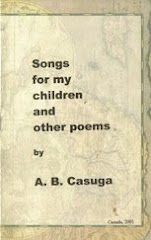
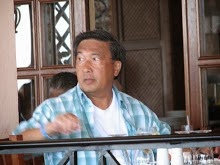
ALBERT B. CASUGA, a Philippine-born writer, lives in Mississauga, Ontario, Canada, where he continues to write poetry, fiction, and criticism after his retirement from teaching and serving as an elected member of his region's school board. He was nominated to the Mississauga Arts Council Literary Awards in 2007. A graduate of the Royal and Pontifical University of St. Thomas (now University of Santo Tomas, Manila. Literature and English, magna cum laude), he taught English and Literature (Criticism, Theory, and Creative Writing) at the Philippines' De La Salle University and San Beda College. He has authored books of poetry, short stories, literary theory and criticism. He has won awards for his works in Canada, the U.S.A., and the Philippines. His latest work, A Theory of Echoes and Other Poems was published February 2009 by the University of Santo Tomas Publishing House. His fiction and poetry were published by online literary journals Asia Writes and Coastal Poems recently. He was a Fellow at the 1972 Silliman University Writers Workshop, Philippines. As a journalist, he worked with the United Press International and wrote an art column for the defunct Philippines Herald.

Sunday, April 14, 2013

THE BIG QUESTIONS, 14: GETTING BLANK BACK ( AM I FREE TO MAKE A MESS OF MY LIFE? WHOSE LIFE IS IT ANYWAY?)

Poem #14 in my poem-a-day National Poetry Month (NaPoMo, April 2013) responds to essential questions like "Am I Free to Make a Mess of my Life? Whose Life Is It Anyway?"


GETTING BLANK BACK


How efficiently convenient it would have been
if we were born with erasers in both hands:
ones which could quickly rub out anything
irrelevant or inutile to a life made in the stars.


Would one miss the struggle that colours days?
Would one etch a restful stroll under the palms?
How easily could a hammock be hung on walls
when weary of a senseless shift of acts, and rest?


The start and stress of little lives is enough
to wish for all-purpose equipment to work life
out just as we want it. Aren’t we our own masters?
Why let others outside mould our lives inside?


Are we not free to sculpt our haunches, paint our
portraits, pare our own earthen jars, exist as us
regardless of them? Why not use those erasers
to blank out every misstep, every dread, and live?


How conveniently efficient it would have been
had we been able to erase the ineffectual lines
that make us shadows instead of bright forms
exact on the blank sheet we were made to draw on.


---ALBERT B. CASUGA

* Inspired by a poem, "Removed, " written by Columbus, Ohio poet Hannah Stephenson  published in her poetry blog, The Storialist.

Erasing is not/not drawing,/ just moving/ around what/ you think you/ didn’t mean..../ We can’t get/ blank back,/ just as good as/new but not/ the same as/ before you drew.---From “Removed” by Hannah Stephenson, The Storialist, 06-19-12


Saturday, April 13, 2013

THE BIG QUESTIONS, 13: OCCUPYING THE GARDEN: A HUNGER (WHAT IF I WAS MADE FOR THE OTHER? WHAT DO I NEED? AM I MY BROTHER'S KEEPER? AM I DECEIVING MYSELF?)


This is Poem #13 in my Poem-a-day project to celebrate National Poetry Month (NaPoMo, April 2013) in response to life's Big Questions posed by philosophers like Simon Blackburn in his essay "How Can I Lie to Myself? (Self deception and Motivation)", and such related questions like 
 
"What Do I Need? What I If I Were Made for the Other? Am I my Brother's Keeper? Am I Deceiving Myself?"

 
Photo by Bobby Wong
 
 
OCCUPYING THE GARDEN: A HUNGER

What do I want, what do I need? Later, I tell myself, later. There’s plenty of work, the hours full of obligation. But I know I am not virtuous: I am always my hunger. ---From “Hunger” by Luisa A. Igloria, Via Negativa


What if this place were made only for the other?
You are yourself, but you are also others’ other.

Were you conceived for yourself, or for a specie?
Someone must extend the process of evolution.

Your first act out of the womb was to let out a cry.
Was it not to alert the birthing other you’re here?

And you will bring joy to a union forged in dreams,
but you could always be the unwanted obligation.

What if you were the inevitable happenstance
come from the aches of groin and gravid reasons?

Are you an issue of love or lust? An afterthought?
When did you start to even aspire to be yourself?

Dare you grow then to even ask: What do I want?
What do I need? Selfish angst? No. Must-ask ones.

One cannot give what one does not have, operatio
sequitur esse. Find and feed your hunger to know

what you are here for. Are you a brother’s keeper?
Or does a lover keep you? Either way, a hunger.

If you were for the other, you must be provident;
but fill your tills first before giving a ruddy cent.

Is your neighbour the village thief? Love him.
Clothe the naked, as you would with a fig leaf.

Before long, you would have guessed how little
you are without the other, and learn to whistle

in the dark, and wait, and build, and gather
behind walls, until, one on top of the other,

you begin to climb beyond your pauper space
to occupy a lost garden, a haven, as your place.

---ALBERT B. CASUGA

Friday, April 12, 2013

THE BIG QUESTIONS, 12: TRANSFIGURATIONS: IS BEAUTY AN OMEN? (WHAT IS BEAUTY? WHAT IS IT FOR? IS IT AN INTIMATION OF IMMORTALITY?)

This is Poem #12 in my series of poem responses to the Big Questions posed by philosophers, scientists, theologians, artists, poets and even village cranks, to help celebrate National Poetry Month (NaPoMo, April 2013).

What is beauty? What is it for? Is it an intimation of immortality?


TRANSFIGURATIONS: IS BEAUTY AN OMEN?


A condition of complete simplicity/ (Costing not less than everything)---Little Gidding, The Four Quartets, T.S.Eliot


Cocooned in a condition of utter simplicity,
the silkworm will not stop oozing out its tapestry
onto the point of death which is also its beauty.

How much beauty can be eked out of pain?
Like the hurt bivalved flesh of the grimy oyster,
would the papillon wings glisten like a pearl?

But this one is spun out of patience: there
must be radiance out of a cocoon’s dark
confines. It can only break into mobile light.

Colour the mariposa green, would that matter?
Dye the silk out of its consumed gossamer nets,
would that stop its flying out of a crude beginning?

Arrested from its final transfiguration, the worm
turns and it is on a table–the grub of culinary
quintessence! Quite like an earlier challenge:

“Eat of my flesh, drink of my blood. This covenant
shall not be broken. I will be with you again when
the radiance of this goblet dims into a eucharist.”

A condition of simplicity? Bear beauty and perish?
Offer an unending dream in a kingdom, and be slain?
The tale of the supreme sacrifice is also immolation.

What does it matter that I die then, if I flew out
of a trellis like the monarch butterfly, that started
as a wormed-out silkworm then food for the hungry?

I would be the worm, the injured mother pearl,
the crucified madman who asked that his flesh
be eaten, his blood quaffed, and live forever.

Beauty is an omen. Destroy this vessel of clay,
and it can only spill the reddest of wine, the
stoutest of ale: a dangerous promise of eternal life.

—ALBERT B. CASUGA


Ref.: The Big Questions, Philosophy by Simon Blackburn, "What is Beauty? (The fatal attraction of things.), pp 150 etseq., 2009, Quercus Publishing Plc., London, UK.

Wednesday, April 10, 2013

THE BIG QUESTIONS, 11: HIS WAILING WALL (IS THERE A NEED FOR GOD? WHY IS THERE A NEED TO BE GOOD?)

This is Poem #11 in my series of poem responses to the Big Questions posed by philosophers, scientists, theologians, even village cranks, to help celebrate National Poetry Month (NaPoMo, April 2013). Do We Need A God? Why is there a Need to be Good?---Simon Blackburn 


HIS  WAILING WALL
 
Ubi solitudinem faciunt, pacem appellant --- Tacitus*
 

Either way, distance finds me
looking up or down this cliff,
an unlikely sanctuary I escape
into aching for scarce solitude.

How can one be alone among
the darting seagulls? Or silent
with lost memories jarred by
blasts of breaking waves below?

Here, gods revel in their haven
of whistling winds and clouds,
down there fishermen cackle,
chewing sargasso, guzzling gin,

while their thrown nets fill up
with flotsam floating around
moss-gowned boulders staring
at the sky like dark green eyes.

Is it this vast and empty space
between that scares me now,
when I should be murmuring
secrets to messenger winds?

I would scream unbearable
pain, holler down bitter anger;
I must share muffled grief,
loosen taut shackles of despair.

Either way, I find wailing walls
in air, water, rocks, and wind;
like Job I weep for peace, hope
to gently fall in the cup of palms

waiting to catch my carrion
now carved out of a shattered
world of faithlessness and fear,
unable to hold on to life or love.

On this piece of jutting rock,
have I not found the little place
where I could reach His Hand
quickly were I to fall, either way?


---ALBERT B. CASUGA
 
 
Simon Blackburn is a philsophy professor at the University of Cambridge in England. His essays "Why Be Good?" (pp. 94 etseq) and "Do We Need God?" (pp. 159 etseq), are included in the The Big Questions, Philosophy, 2009, Quercus Publishing Plc, London,  UK.

THE BIG QUESTIONS, 10: LITTLE QUESTIONS? (WHAT ARE MY RIGHTS IN A SOCIETY? IS THERE SUCH A THING AS SOCIETY? AM I FREE?

This is Poem #10 in my series of poem responses to the Big Questions posed by philosophers, scientists, and even "village cranks", to celebrate National Poetry Month (NaPoMo, April 2013). Is there such as a thing as society? What are my rights in this society? Am I free? What does it mean to be free?


LITTLE QUESTIONS?

Is there such a thing as Society? What are my Rights? Am I free?---Simon Blackburn, The Big Questions, Philosophy*
 

There must be a little door
that will not end in a room.
Space is all. Is there an end
to these rooms? An exit
into a free space all my own?

I require a room-less door
to step out of when leaving
would finally mean being
unbound, no walls to fence me
in, no house to shackle a home.

For what would a sky be for?
Why would suns set over hills?
Suns rise from the edge of seas?
Why do springs expand to falls?
Why is beauty is own excuse?

Whence come this splendour,
what does it mean for a flower
to bloom? When all questions
have been answered, where
ends he whose end is a question?

Or are answers simply next door?

--- ALBERT B. CASUGA


*Simon Blackburn, The Big Questions, Philosophy, "Am I Free? (Choices and Responsibility)?". pp. 28 etseq., "Is There Such a Thing as Society? (The individual and the group), pp. 66 etseq.. Quercus Publishing Plc, London, UK, 2009.
 

Tuesday, April 9, 2013

THE BIG QUESTIONS, 9: CHANGES (PROBLEMS OF CONSTANCY AND CHAOS)

This is Poem #9 in my series of poem responses to the Big Questions posed by philosophers, scientists, and village cranks, to celebrate National Poetry Month (NaPoMo, April 2013) Why are things in constant flux? Why do times change and we with them? Everything is relative then? Relative to what? Are you here or are you there? As Blackburn asks: why do things keep on keeping on? Is Eternity in another life a myth? A placebo? Another world? Why struggle then for Eternity?


CHANGES

O, the times a-changin’…Times change, an’ we change with them!


Changes, as constant as they are intriguing,
slither through as coldly as serpents move
into crevices not unlike meandering fog.

Inexorable patterns, they are the unchanging
streams running through the cherished fables
we tell and retell until they become a reality

we cannot escape however sanguinely we try
to build walls to ward them off chambers
of fear housing our hapless lives. Hopeless.

Every sunrise fades into a sundown, all lives
dwindle with discarded days, anguish turns
into ecstasy and loops around like a storm.

What grows in spring withers in summer,
then, like twigs blown off in autumn’s fall,
get buried in winter frost, a carrion of a year.

Why struggle then for eternity? Nothing lasts.
That story about a lost paradise is still grit
for an unchanging story once upon a time.

Could changes have been that fruit in Eden?
An apple stuck in his throat, it bobs forever
like an intruding promise that everything

must perish even in paradise. The rot here
then is forever. Flotsam of ruined homes,
debris of broken lives, all tombs of betrayal.

Would a morning ever come, as we sip tea,
when like a wave laving the shore, it ebbs
only to crawl back at all sunrises and sunsets,
never ceasing, never leaving, never changing?


---ALBERT B CASUGA

Monday, April 8, 2013

THE BIG QUESTIONS, 8: BEING ON TIME (DOES TIME GO BY? THE STRANGE RIVER OF TIME)

This is Poem #8 in my Poem-a-Day celebration of National Poetry Month (NaPoMo April 2013). It is a response to one of the Big Questions posed by Simon Blackburn in his The Big Questions: Philosophy essay on Time and Being, "Does Time Go By? The Strange River of Time." (pp.115-123), Quercus Publishing Plc, 2009, London UK. This series is an attempt at using poetry to pin down knowledge and truth about the big questions of existence.
 
 
Painting by Salvador Dali


BEING ON TIME


When Time equals Being,
That would be the End.

Nothing would get past
The edges of ephemera.

What would the end be,
When Being equals Time?

There will not be a bang
Anywhere, nor a whimper.

There can only be trumpets
Of the winged proclaiming

An arrival in a regained
Haven where Death is dead;

At which time, no time
Marks being on time. Ever.

All will be late for the birth
Of God on Judgment Day.


---ALBERT B. CASUGA

Sunday, April 7, 2013

THE BIG QUESTIONS, 7: WHAT MEANING MEANS


Poem #7 for National Poetry Month (NaPoMo, April) responds to the big question: What do we know? Virtual Realities and Valuable Authorities.* (What is knowledge? Do we know what we know? How do we know what we know is the truth? Do we need to go through the rigours of epistemology?)


WHAT MEANING MEANS


Giving up on giving up is a better choice,
when being sensible and clear are futile.
Words would lose meaning, ours will not.

Where you see a vine leading its tendrils
up to a broken branch shedding a last leaf,
you make me see its undulant plummet

to the parched pond mottled by blackened
and brittle leaves long dead even before
the end of this long hot summer. It is real.

Is this not our faultless way of knowing
what we pretend to know when we can
no longer see the dancer from the dance?

Would not the falling of that lonely leaf
trace the slower climb of a clinging vine?
Like seeing both sides of the wall at once.


---ALBERT B. CASUGA


*To celebrate this Poetry Month, we thought of collecting a series of poems that would respond to these Big Questions posited by Simon Blackburn, Professor of Philosophy at the University of Cambridge, in his book The Big Questions Philosophy, 2009, Quercus Publishing Plc, London, UK. pp.38-47. He says about knowing: "...we need our confidence to match what happens. That is the gold standard for knowledge and truth alike." (Ibid, pg.47)
 
Painting: Adam and Eve in Paradise by Ian Brueghel the Elder.
(The apple from the Tree of Knowledge? What does that mean?)

Saturday, April 6, 2013

THE BIG QUESTIONS, 6: MEANING AS AXIOM


NaPoMo Day 6: Here's a poetic response to the Big Question: Why is There Something and Not Nothing? (The Strange Ways of Being)*


MEANING AS AXIOM


If another twig falls in the night,
as silently as it grew as a sapling
toward the sky, would that mean
anything anyway to anyone?


The graveyard of a fallen tree
may tell untold stories that stay
untold until a struggling stray root
breaks through dry rot and ground
for yet another flushed cherry tree.

 
The inexorable is also axiom here:
life begins in death in a spun gyre
twirling into flowers, forever moving.
Nothing is everything here, but there
where leaves had once fallen, broken
twigs spring back as fluttering birds
twittering on branches like new leaves.


—Albert B. Casuga
*Simon Blackburn, The Big Questions: Philosophy, Quercus Publishing Plc, London, UK, 2009.