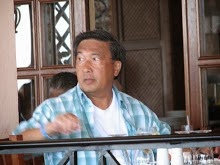
My photo
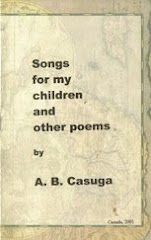
ALBERT B. CASUGA, a Philippine-born writer, lives in Mississauga, Ontario, Canada, where he continues to write poetry, fiction, and criticism after his retirement from teaching and serving as an elected member of his region's school board. He was nominated to the Mississauga Arts Council Literary Awards in 2007. A graduate of the Royal and Pontifical University of St. Thomas (now University of Santo Tomas, Manila. Literature and English, magna cum laude), he taught English and Literature (Criticism, Theory, and Creative Writing) at the Philippines' De La Salle University and San Beda College. He has authored books of poetry, short stories, literary theory and criticism. He has won awards for his works in Canada, the U.S.A., and the Philippines. His latest work, A Theory of Echoes and Other Poems was published February 2009 by the University of Santo Tomas Publishing House. His fiction and poetry were published by online literary journals Asia Writes and Coastal Poems recently. He was a Fellow at the 1972 Silliman University Writers Workshop, Philippines. As a journalist, he worked with the United Press International and wrote an art column for the defunct Philippines Herald.

Monday, April 22, 2013

THE BIG QUESTIONS, 24: WHEN WORDS COME BACK (WHY APOLOGIZE FOR THE MANNER YOU LIVED?)

This is Poem #24 in my series of poem responses to the Big Questions to celebrate National Poetry Month (NaPoMo, April 24). This poem-a-day project is an effort to use poetry to define what one needs to know as truth that are matched by reality we have confidence in.


WHEN WORDS COME BACK

(For my Children: That They May Forgive)

 
There are no lessons deep enough, clear enough,
that they could hold on to or use to decipher,
or understand, or even to respond: Of what use?

Of what use are murmuring creeks that turn
blue when they flow into the river’s mouth
as it meanders to an open sea, itself a tributary

to all that is deep and dark and dangerous
in these untamed oceans, beginnings and ends
of life, the vast expanse of all our explorations.

What does it matter that the moon swings low
over pine branches, or that the urgent calls
to trek back to forgotten origins are inexorable?

You can only counsel them enough of beauty,
because this earth makes it more often an omen
of regrets, or even an augury of faithless betrayal.

When the words you lisped--as they turned
somnolent in your arms--come back to haunt them,
they will rush back to you and pray for strength.

When that time comes, do not mumble an apology,
because this has never been needed nor accepted.
 

—ALBERT B. CASUGA


THE BIG QUESTIONS, 23: CONTRA MUNDUM (WHY SHIELD HEART, HEARTH, AND HOME WITH DEFIANCE?)

This is Poem #23 in my poem-a-day responses to the Big Questions to celebrate National Poetry Month (NaPoMo, Apeil 2013). What price life if it were merely a wading through the gentle streams of a lotus land?


CONTRA MUNDUM

The world is charged with the grandeur of God.—Gerard Manley Hopkins, God’s Grandeur
 
Like silt at the bottom of creek boulders,
wading against the current must be residue
of a proclaimed apostasy, a paradise lost,
somewhere East of Eden. But it was good.


There would be toil and a struggle for love,
and upon his progeny an edict of suffering
pain at the birth of all begotten offspring.
But does this act not bring exquisite joy?

What price life if it were merely a wading
through the gentle streams of a lotus land?
Why flaunt dominion over all that grows
or dies for these where nature is never spent?*


Let me shield my heart, hearth, and home
with all the strength and defiance I can hold.

—ALBERT B. CASUGA

*Hopkins


THE BIG QUESTIONS, 22: YEARNING FOR THE OTHER SIDE (WHAT DOES IT MEAN TO "KICK THE BUCKET"?)

This is Poem #22 in my series of poem-responses to life's Big Questions, a poem-a-day project to mark National Poetry Month (NaPoMo, April 2013). Of course, death and dying are always significant questions.
 
 
What does it mean to die? Has anyone come back to tell us what really lies beyond? It is an inexorable truth, but aside from the clinical meaning of dying, what emotions are felt at the critical moment? Has anyone come back from the other side to confirm certain romanticized beliefs about eternity thereat, or infinite bliss with one's Maker? Is it true that beyond it lies "the nobility of man, and beyond it the only hope?"


YEARNING FOR THE OTHER SIDE

When I am dead, my dearest,/ Sing no sad songs for me,/Plant thou no roses at my head,/ Nor shady cypress tree:/ Be the green grass above me.---Christina Rossetti


When death and dying are lumped together
as “kicking the bucket,” there seems little
reason for a lachrymose ritual that will cost
a lifetime’s nest egg. And yet, and yet.

A send-off at sea is as good as any–one
is flushed off the starboard to become part
of whence life came, or where it ends. Debris.

Do not send for whom the bell tolls, some
tired man holding a ready bucket of waste,
warned the unready, unprepared, or untidy.
Inexorably, inevitably, the bell takes its toll.

Like a confusing game, kicking the bucket

is nothing but a tiresome waiting game.
Let the jasmine bloom where they may,
when they may; no one has yet come back
to say if they, too, were enriched by manure
from the overturned pail, nor say, when the day
the game ends, they had no bucket of waste.


—ALBERT B. CASUGA

Sunday, April 21, 2013

THE BIG QUESTIONS, 21: A SUN-DRENCHED ELSEWHERE (WHERE WILL I GO WHEN I AM OLD AND GRAY?)

This is Poem #21 in my series of poem-responses to the Big Questions. Where Will I Go When I Am Old and Gray? Where Would I Find the Leftovers of Life? (To help celebrate National Poetry Month, NaPoMo, April 2013.)


A SUN-DRENCHED ELSWHERE

"Now more than ever do I realize that I will never be content with a sedentary life, that I will always be haunted by thoughts of a sun-drenched elsewhere."---Isabelle Eberhardt
 

Sometime soon, I must swing down
from my sundown hammock,
get back to those unpasted pictures.

Albums have more life here than I need.
They can be nagging, flogging,
their bursting sunshine smiles nailing

time and love in sun-drenched elsewhere:
there, a place for lost seashells,
here, a cliff to dive into lost memories from.

Where have they all gone? Or faded into?
These walls are blank now,
where they hung mute on nailed frames.

Where shall I go from here when shadows
would no longer grow tall?
Will I even be able to talk to mottled walls?

I must go back somehow to a sun-drenched
refuge, wherever elsewhere
they have frozen into these dead pictures,

carrion of wonder in yellowed album pages.
Where have they gone, what place
awaits to return the days I have yet to shape?

I must find that one sun-drenched place
that haunts me now and see you
there before I abscond into those shadows.

---ALBERT B. CASUGA


Saturday, April 20, 2013

THE BIG QUESTIONS, 20: GETTING OUT TO GET IN (WILL I BE MY OWN HEALER. MY LAST AND FINAL GOD?)

This is Poem #20 in my series of poem-responses to the Big Questions posed by Prof. Simon Blackburn in his The Big Questions, Philosophy, 2009, Quercus Publishing, Plc. 2009, London, UK. Prof Blackburn teaches at the University of Cambridge in England. This hopes to help celebrate National Poetry Month (NaPoMo, April 2013).

Will I mould myself any which way I am pleased to behold as my own creation, not in the image of someone who chooses to be absent or gone?


GETTING OUT TO GET IN


One way or the other, we will get out to get in.
There are no borders here, nor limits, no doors
To slam. I am my own clay, brittle now, but I
Will mould myself any which way, I am pleased
To behold as my own creation, not in the image
Of someone who chooses to be absent or gone.


But who cares anymore? There are no measures
Nor beats I must march by, breathe by. I am free,
Am I not, to perish any which way I live or err?
Like my own moulder, shape or reshape my face
The way I want to meet all the same faces I meet,
And I will be my own healer, my last and final god.


Idle now, I am meant to dance at full throttle.
One way or the other, I will get in before I get out.


---ALBERT B. CASUGA

This poem was prompted by: "Who pays heed anymore? Three birds in succession thunk against the glass. Which/ one is pursuer, which pursued? Danger and excitement. Dance at full throttle."---From “Throttle Ghazal” Luisa A. Igloria, Via Negativa, 07-19-12

Friday, April 19, 2013

THE BIG QUESTIONS, 19: DISCARDED DAYS (ARE OUR LIVES MADE OF DISCARDED DAYS? IS THIS OUR BEST SHOT AT STAYING ALIVE?)

This is Poem #19 in my series of poem-responses to Life's Big Questions as posed by Simon Blackburn in his The Big Questions, Philosophy. Prof. Blackburn teaches at the University of Cambridge in England.
 
 
What does it mean to stay alive? Why stay alive, when dying is easier?


DISCARDED DAYS

What have we discarded, cutting through tunnels
we must have plodded, to quarry from lives we
might have been accidentally given? What loves
have we found, what hearts have we lost? Layers
of clay, cracked stones, and silt could build us our
houses of hurts and ruptured dreams. Not a home.

But we take care to wake up to days we can shape,
to moments we could mould like delicate bowls
whence we share victual and drink for our hungry
and thirsty souls. When travel becomes a burden
of faithlessness or pain, we call each other out:
Be brave, hold on, take on the world if we must!

When these passageways fall dark, we walk on.
After all, our lives are not made of discarded days.

---ALBERT B. CASUGA


This poem was inspired by  a poem written by Norfolk VA poet Luisa A. Igloria. "Time teaches a lighter tread: or/the body bound to gravity must shed/layer after layer. What progress is tracked, /comes only in the manner of what’s discarded: "---From “The Road of Imperfect Attentions” by Luisa A. Igloria, Via Negativa. 07-30-11

Thursday, April 18, 2013

THE BIG QUESTIONS, 18: LESSONS ON THE LEAP OF FAITH. (WHY AND HOW CAN ONE BELIEVE? WHY BELIEVE IN LIFE, LOVE, LETTING GO?)

This is Poem #18* in my series of poem-responses to the Big Questions of Life and Living. Why must one believe? How can one believe? Why believe in Life, Love, and Letting Go? Why and when must one make his leap of faith, or not at all?


LESSONS ON THE LEAP OF FAITH


When the torch of desire burns clean
you would have learned all there is to learn:

To give, Datta. To feel and care, Dayadhvam.
To own and control, Damyata.Therefore,

To love beyond all loving because it is pure
like the mother suckles her infant. Give.

To know when caring will make things grow
like the raindrops nourish but will not sting.

To have and to hold even when that lashes
irreducible hurts to weary hearts that care.


It is for this that, naked, we halloo in the rain,
Let it come! Let all desires fill our dry vessels.


Then we wake to the warm caress of the Sun
for the day is always new, the flower lovely.

Is not the rose lovelier when its thorns sharpen?
Does not the potter’s knife need its razor edge

to pare the lips of the wine jar and smoothen
its mouth that lovers may drink to full desire?

Bare your body then to its wild abandon, salve
it with the cool spring water now welled

from the earth, and open your mouth to kiss
the sunlight, defy the anguish. Never say, not yet.


Let it come! Let the leaves fall on this Upanishad,
because the leap of faith is never to say Not yet.
 

—ALBERT B. CASUGA

* To help celebrate National Poetry Month (NaPoMo April 2013), I thought I would write and cull poems from my archive which focus on my take of the answers I might give to those posed by Prof. Simon Blackburn in his The Big Questions, Philosophy, 2009, Quercus Publishing, Plc,, London, UK. Mr. Blackburn is a philosophy professor at Cambridge University in England.

Wednesday, April 17, 2013

THE BIG QUESTIONS, 17: STAYING ALIVE EVEN IF WE DID NOT PLAN TO BE BORN---A JOIE D'VIVRE

This is Poem #17 in my series of poem-responses to the Big Questions to celebrate National Poetry Month (NaPoMo aAril 2013).

What does it mean to Stay Alive? Even if one did not plan to be born, why is it preferable to make a go of living it up with elan and joie d'vivre?


STAYING ALIVE---A JOIE D'VIVRE


Because what we now have is a life
we will never have again, something
as unrepeatable as living or dying,
we drink to it as often as we turn down
an empty cup, and learn to forgive
what was given or not, noblese oblige,
coming as we do to this strange place
without as much as a warning or even
our consent. We did not know.

Because we did not plan to be born,
is it too vexing to learn--perhaps
to revel in--the myriad acts of loving,
of living, and in return be grateful
to perform the surprisingly magical art
of shaping life, nurturing it, finding it
where no one would lead us, blind
as we are to this fire in our weak loins?

Was that left behind by a rushed maker,
like a spare screw, and we had to find
where it would fit snugly, divinely apt
and delicately, deliciously, our manner
of staying alive when dying is better?
 
--- ALBERT B. CASUGA
 
The Big Questions, Philosophy by Simon Blackburn, 2009, Quercus Publishing Plc, London, UK. Prof. Blackburn teaches philosophy at the University of Cambridge in England.

Tuesday, April 16, 2013

THE BIG QUESTIONS, 16: ODDS: WHY LOVE THEN OR LIVE AT ALL? HOW TRUE IS OUR EXPLORING?

This is Poem #16 in my series of poem-responses to the Big Questions---Why love then or live at all? How true is our exploring? How certain is this mock-up for staying alive?


THE ODDS: HOW TRUE IS OUR EXPLORING?

For us, there is only the trying. The rest is not our business/ ...Love is most nearly itself/ Where here and now cease to matter./ Old men ought to be explorers/ Here and there does not matter/ We must be still and still moving/ Into another intensity...From “East Coker, The Four Quartets, T. S. Eliot
 

Because we could not hold on to love
As it must be held, given pure and free,
We can only try to find what is most
Nearly itself, until we get to a still point.


Time does not define where that may be,
But it must linger in the mother’s breasts,
When she suckles her infant into a life
Where there is nothing but uncertainty.


How precariously certain is this mock-up
Of staying alive when it is impermanence
That most resembles it? A will-o’-the-wisp
Or a cruel mirage hounds us, it is there


But not here. Why love then, or live at all?
When uncertain weather is most certain,
Why dare fritter precious lifetime on this
Uncharted clearing? It is our yoke to try.


We will perish trying, measure dying by
How true our exploring must be, we
Cannot stop, we simply move into another
Space, with flaming eagerness or anger.


---ALBERT B. CASUGA

Monday, April 15, 2013

THE BIG QUESTIONS, 15: QUESTIONS---NOW AND THEN. WHY BOTHER ANSWER THESE QUESTIONS, WHEN THEY COULD NOT BE ANSWERED NOW?

This is Poem #15 in our series of poem responses to the Big Questions (as defined by Philosophy Professor Simon Blackburn) to celebrate National Poetry Month (NaPoMo, April 2013). As an interregnum, this poem should bring the reader back to what the series was all about---the task of man as a homo sapiens is to ask questions while he is around, because his effort to answer them also defines whether or not his existence is meaningful, as transient as it is while it lasts.

Why bother to ask these questions, when they could not be answered Now?


QUESTIONS: NOW AND THEN

1.
What good is a brilliant question,
If it could not be answered now?

Of what use is an inchoate answer,
That begs the essential question?


It is the cat catching its tail, a snake
Swallowing itself, it is the circle
That will not break, a spinning gyre
Spitting back unanswered riddles.


Is not time past after all the now
We worry an answer for? Is it time

To be anxious for, when tomorrow
Has not gone past the hurdle Now?


A condemnation by circuit pulses,
Is always an unanswered curse.


2.
That is precisely the imprecision
That presides over the fate of man

Who must answer for a finitude
He did not want nor grovelled for.


Why must time past be time future,
When there is no now save a passing

Passion for all that looks beautiful
For just a little while, a vanishing

Vision---a grand mansion of thought,
A perishing still point, a broken
Promise of eternity he cannot know,
Nor understand for its briefness?


He will ask all the bright questions,
But they cannot be answered now.


---ALBERT B. CASUGA


* This poem was inspired by a post by Ohio poet Hannah Stephenson. "How do we know/ what now is /if it’s always passing/ through us/ before we can get a good/ grip on it. ---From “What Do You Have in That Headlock”, Hannah Stephenson, The Storialist

Simon Blackburn, The Big Questions, Philosophy, 2009, Quercus Publishing Plc, London, UK. Mr. Blackburn is a philosophy professor at the University of Cambridge in England.