My photo
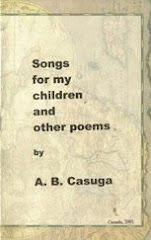
ALBERT B. CASUGA, a Philippine-born writer, lives in Mississauga, Ontario, Canada, where he continues to write poetry, fiction, and criticism after his retirement from teaching and serving as an elected member of his region's school board. He was nominated to the Mississauga Arts Council Literary Awards in 2007. A graduate of the Royal and Pontifical University of St. Thomas (now University of Santo Tomas, Manila. Literature and English, magna cum laude), he taught English and Literature (Criticism, Theory, and Creative Writing) at the Philippines' De La Salle University and San Beda College. He has authored books of poetry, short stories, literary theory and criticism. He has won awards for his works in Canada, the U.S.A., and the Philippines. His latest work, A Theory of Echoes and Other Poems was published February 2009 by the University of Santo Tomas Publishing House. His fiction and poetry were published by online literary journals Asia Writes and Coastal Poems recently. He was a Fellow at the 1972 Silliman University Writers Workshop, Philippines. As a journalist, he worked with the United Press International and wrote an art column for the defunct Philippines Herald.

Friday, December 27, 2013

A LOVE AFFAIR


HIS LOVE AFFAIR


Sit. Feast on your life. ---Derek Walcott “Love After Love


Although this invitation will prolong our wait
in the cold antechambers that we surround
ourselves with, we will cautiously accept it.


Why not? Sitting here, staring at a kaleidoscope
of the many faces we have constructed to meet
other faces, I celebrate a love affair with myself.


Who else will do that for me? There were lovers,
and there were lovers, but they held on to their
own chisels to pare and scrape their own image


of what they could have and hold not unlike
a wild-eyed Pygmalion sculpting flesh onto his one
desire, a Galatea of his rawest wants and dreams.


I will sit and wait for the feast of all feasts
to be served on my table, my head on a platter,
my heart seasoning a bowl of hope, a soupcon


of little mercies that lovers often do: a salving
of hurts, a troth of endless fealty, a promise
that the image on the mirror is finally, only mine.


---ALBERT B. CASUGA


Saturday, December 21, 2013

LIKE A PRAYER TO WHAT IS EMPTY


DISASTER POEMS. What is it like to pray and be unheard, benignly ignored, suffered? Defile this Earth and despoil its treasures. Its sky, on a clear day, will remain empty; blank, unflinching, taking all wounding of its loins as a rhythm of a day. The sky better not be falling. But it is. It is late.
 

 LIKE A PRAYER TO WHAT IS EMPTY
The sky has taken its place/ leaning against the wall. / It is like a prayer to what is empty. / And what is empty turns its face to us/ and whis...
pers.../ I am not empty, I am open. ---From Vermeer, Tomas Transtromer

1. The Buried
All they could have done was to stitch slices
of their picture of the sky, its blank expanse
their thin measure of what feels free and safe.

Buried for days on end under buttresses
that could no longer hold despoiled walls
of dirt, they prayed for a glimpse of the sky.

They did not need to: even in the starkest
gloom of that dark and black tomb of gold,
they each had a share of that absent sky.

O, for a smell of that dry air in Chile’s hills!
But this black hole, now a cloying dread,
is it all that is between them and raw despair?

2. Open, Not Empty
Where is the sky when we need it? Or do we?
Even if it is there for the taking, will it answer
our prayers? It will empty itself of rain before

we can be saved. It is closed. It is empty. Pray
to the rocks, as loud as an intoning bishop,
it throws the entreaty right back. But you hear

an echo, a whisper from an unseen face: I am
the refuge of all the winged who roam spaces
for the free and unafraid. It is your little voice.

Like those darting sparrows, your unbound
soul will storm the abandoned bolted gates,
save that these doors are abundantly open,

and have always been agape; and the garden,
once lost has always remained open, the sky
its door, waiting for all who want to till it.
 

 --- Albert B. Casuga


Friday, December 20, 2013

AFTER AFTER: A LONGING


AFTER AFTER: A LONGING
1.
After after, is there anything or anyone
left to sing the hammock songs? After after,
will you still be there waiting,  a warm blanket
in your hands, to throw the flannel on my lap,
lest I drool myself to a sundown slumber
and promptly forget it gets cold in the winter?
Aiee, amor mio, despues de nuestros amores,
when love is gone, after all the countless days,
where shall we find that place called after?
If it is lost, too, will there always be another?
Will this longing for the warmth of a gentle caress,
when nights and beds are cold, find its answer?
Will it be a knowing touch on my back after after?
2.
Tomorrow, I will walk through an abandoned garden in the rain:
I will tilt my face to some grey sky like an agape earthen jar, catch
myself some nourishing rain. Must I, on my gnarled knees, beg
for these hurts to set me free? My hummingbirds will fly off
leaving me this mansion of joy, but oh, a finite hint of eternity.
Sometime soon, I must frolic in this uncertain weather, dash
through this shower of grace, sate my parched throat in the rain,
drink myself deliriously happy.  But after after, will you be there?
--- ALBERT B. CASUGA

Tuesday, December 17, 2013

THE QUIET DISTANCE: TWO POEMS ON HER CHRISTMAS MANGER (BELEN DE PASCUA)


The Manger recalling the Nativity scene in Bethelem was the true symbol of Christmas that no Christmas tree (pine or prefab faux sapling)could replace. These poems recall a time when making it for the holy day was quite an often quietly revered enterprise for the faithful. Those days are gone. Although we have the year-round "belen" in our family room to remind us of the central theme of our faith, we see less of it even in the Christian churches of our congregations. Why?

THE QUIET DISTANCE: TWO POEMS
ON HER CHRISTMAS MANGER
 

 1. Her Noche Buena

Did you wake up for Noche Buena?*
Lit the balled candle on the belen?*
Do you still put those candles away
for another Pascua de los muertos?*

I can almost see you cranking open
the heavy lid of that narra trunk
at the foot of your bed where his
picture stands sentry while you sleep.

How long did it take you this time
to rearrange the animals around
the manger? Reposition, you’d say
but they’re always in the same place.

The lamb snuggles closest to the box
you stuff with dried grass for hay,
the ass farthest, the horse between.
Why? I would always ask while I,

insolent tot, handed you the wrong
fauna at a time. You would laugh
at how San Jose landed on your palm
when you asked for the donkey, an

angel when you yelled for a shepherd,
a magus when you barked for a burro,
and on and on until you’d pitch me
the hard-packed ball of saved candle

drips from father’s grave on the one
other fiesta you’d get up from sick bed
for---but Noche Buena is a rare treat:
you’d eat pan de sal, a whole banana.

2. Her Belen de Pascua

“Para mi fuerza, para mi belen de pascua,”*
you would sheepishly explain an appetite
we plead for each day you’d remember
father building the manger with you long
after he had the last laugh when, like me,
he would give the dingiest animal figure
instead of a king, a shepherd, or an angel,
and simply did not get up from a crumple
laughing at you when you threw him
back the make-believe cow dung, manure
for the grand project of a straw stable
that father said was wrong: it was a hole
in the city of Petra in that Bethlehem hill,
and there were no inns to take Him in.

You buried him with that Belen de Pascua,*
Mother, and could not quite remake one
you would delight describing to a devil’s
detail to polite and knowing neighbours,
who would drop by to gawk at your porch
where the only clay image in its right place
was the baby in the manger whose name
you kept on muttering was father’s name.
On nights like this, I scare myself, Mother,
with the spectre of the quiet distance.

---Albert B. Casuga

*Noche Buena, Christmas Eve; belen, Christmas manger; Pascua de los muertos, Feast of the Beloved Departed; Para me fuerza, para mi belen de Pascua, for my strength, to build my Christmas manger.

Photo by Bobby Wong Jr., Philippine Photo Artist


Monday, December 16, 2013

THE WEE LASS IN THE SNOW: YOKED HAIKUS


THE WEE LASS IN THE SNOW: YOKED HAIKUS

The lass on my lap
Said: I won’t play with snow
Today, abuelo.

Even snowmen
Will freeze, will crack in two.
Can’t play tomorrow.

On the frozen pond,
Dead frogs and birds on icy
Snow are broken, too.

Use paper for fire,
Abuelo, the lass offered.
Nodding approval

I muttered wryly:
The snow is my newspaper,
Your eyes my fireplace.

---Albert B. Casuga

Thursday, December 5, 2013

REMEMBERING FATHER: TWO SEASONS


REMEMBERING FATHER: TWO SEASONS


1. A SWIMMING LESSON

 For Father (Francisco F. Casuga+)

How much of those happy times
would you bring back, like the waves
ebb but must always rush back?

It is the sea that returns you intact
into my now empty days, windy days,
your laughter always a raw memory.

You threw me into those restless
waves, cried out a challenge: Swim!
Kick hard, swing your arms! Swim!

And I never stopped, not for hurts,
not for lost dreams, nor for losses.
You warned me never ever to cry.

--- ALBERT B. CASUGA

I was not able to say goodbye to my Father when he passed away December 5, 1975 at the Bethany Hospital in San Fernando City, La Union Province, the Philippines. Just as well. He is still with me.


2. DOWN THE SLOPE

(For Francisco F. Casuga+)

Yet all the precedent is on my side:/I know that winter death has never tried/The earth but it has failed;.../It cannot check the peeper’s silver croak. --- Robert Frost, The Onset

I would run down the slope and catch myself
a rolling ball of snow before it falls into the ravine,
but walking through the silently falling snow
at the trail is a choice for these creaking knees---
no more gossoon games defying gravity for me
or flying off the hillside edge into fluff below
among the stiffened bramble and wild apple tree.

There’s warmth in the silence of falling snow:
I feel his gentle hands on my nape, I hear him,
I ask him if he would drink a pint with me
if I had reached beer-guzzling age before
he’d make his final trek, before he’d leave,
but I hear his whistling for the wind instead
and tug at his wayward kite now puncturing
some sombre summer sky in San Fernando.

O, how I’d run down the barren slopes to catch
his fallen kite among the burnt logs of the
kaingin,*
but these are flakes I find myself catching
and whipped out twigs that break the silence
of falling snow. O my father.

__________

*Clearings made by burning forests

--- ALBERT B. CASUGA


In Memoriam: Francisco Flores Casuga, b. January 9, 1921-December 5, 1875


Sunday, November 24, 2013

THAT I MAY...AN UNFINISHED POEM FOR THANKSGIVING


An unfinished poem for Thanksgiving. An attempt to include digital language, for which I am grateful (as one of the obscured or "disguised" gifts.)
Escribo para vaciar mi mente y llenar mi corazón.--- Paulo Coelho

THAT I MAY ...

Vacate this tormented eye
that stares at savaged lives,
and fill all that is empty
in this arid and old heart
with what I pray is still left
of that spark that makes me
call myself a standing man
unbowed and still unafraid.

Thank you, for all these gifts,
Seignor, however obscured
they have become in disguises
I will try to understand. Merci.

That I may finally fill my heart
with the vigour of this Mind.
Salamat. Namaste. Shalom. <3 font="">


--Albert B. Casuga

Thursday, November 14, 2013

SOMEWHERE A QUERY: AM I MY BROTHER'S KEEPER?


Photo by Philippine Artist Bobby Wong Jr.


SOMEWHERE

So we reverberate to each other’s calling: /silence is a desert hung with midnight stars, /the thrum of quiet waking. Somewhere a wing, /rippling air that the other breathes. --- From “Charms” by Luisa A. Igloria, Via Negativa, 8-27-11

It is what we have absently forgotten,
that we still abide in a strange gyroscope
of happenstance of giving and taking,
of coming and going, visions and revisions.

Or there simply is nothing to remember
from the darkness whence we came except
the pain of pushing or pulling out of a hole
into a yet more fearsome cave of struggle.

Is it dread then that is left in our satchels?
This journey has neither maps nor diviners
to guard against a free fall into an abyss
of irreducible gloom and cold desert silence.

Is this dome of midnight stars also a strum
for a quiet waking into a space of loneliness?
Or are these spaces our own echo chambers
where ripples of our calls are heard by others?

Somewhere a wing roils the air that the other
breathes. Somewhere the tremulous murmur
of a prayer is answered. Somewhere an old
question is asked: Am I my brother’s keeper?

---Albert B. Casuga


Friday, November 8, 2013

THE HOWLER POEMS ! and II


A Time Online picture


THE HOWLER  I

1. Who has seen the Wind?

 Always the uninvited guest, the wind
pushes through the porch into the house,
and scatters leaves collected in its wake,
like a shower of crackling seeds freed
from pods that do not come from here.

Strange, how it barrels through rooms
disturbing spiders spinning webs busily
before the storm ebbs, safety nets strung
among sepia-tinted pictures on the wall.

What did it miss along the way? Winds
as interlopers are blind levellers–the rich
run for supplies as quickly as the poor do.

In New York, as in Virginia, the howler
brought in the flood, and left laughing.
 

2. The Strongest Typhoon on Earth
 

Yolanda, like the woman scorned,
Brought down wrath as wrath can:
Leap-frogged from south to north
Wrecking the City where Imelda
Rose from the sea like a Venus d’Milo
And now must weep over a mayhem
That will not spare even the loveliest
City that she swore to love but left
In favour of a city in the North
Whence a lover grew tall as hillocks,
Only to be pursued by this Yolanda
Bitch that threatens more wreckage
Before it gets to Viet Nam to flog
Unrepentant Viet Cong, Viet Minh,
“Viet-erans” of an American-exported
War that came as the Earth’s wildest
Wind that will also leave laughing---
An untamed howler that must sink
The reincarnation of the lost continent
Of Lemuria, once magical. A relic now.
A relic of the pillaged mendicants
Who have learned in turn to pray.
 

---ALBERT B. CASUGA
11-08-13, Mississauga


THE HOWLER  II


3. End Times? It is here. Stop It. It is late.

 
On its tail is another wild wind to mop
Up, where the living would rather be dead
Than build sandcastles on islands gobbled
By the hungry sea that must claim dominon
Over the Ring of Fire, and Mother Earth
Can only yell: Damn it, why puncture the sky,
To heat her armpits, with radioactive leftovers
Of Hiroshima, and the galloping horsemen
Of an unbridled Fukushima paying back
The land of Enola Gay and the hangar of a dark
Dirigible, a Negro Saviour, whose Eastern name
Will not stop the death and dying of civilisation
In Atlantis and now the rigour mortis of Mu?


4. Beware the melting of the Arctic.

A Deluge comes. Only this time, we have no Arks
Nor Ararats to salvage all who hope to find
Another Blue Planet in an extended Univese.
No one has applied to be a Noah. They are all,
All retired and tired of saving a ruthless specie,
The homo viator whose journey brings nothing
But a discovery that he has lost the Love he had
For all the meek who shall inherit the Earth.

—ALBERT B. CASUGA
November 9, 2013, Mississauga


Monday, November 4, 2013

A HOMECOMING DREAM: WHERE POEMS HAVE NO DOMINION


THE DEATH OF A POET:
OPHELIA ALCANTARA-DIMALANTA +

Ophelia Alcantara Dimalanta,
Poet (1932 – 2010+)


A HOMECOMING DREAM

...I regret to inform you that our dear Ophie Dimalanta passed away shortly before dinnertime in her Navotas home due to hypertension-related illness....she got out of the house, returned promptly because she was not feeling well. She died in her sleep. --- Nov. 4, 2010 E-mail from Wendell Capili, poet and University of the Philippines professor:

To die, to sleep; / To sleep? Perchance to dream. Ay, there’s the rub,/ For in that sleep of death what dreams may come/ When we have shuffled off this mortal coil, /Must give us pause.
--- Hamlet, Prince of Denmark, William Shakespeare


The dreams must include a salon of jesters
Belting throaty ululations announcing her coming
To the party of outpouring angst and crippling blocks.

Are you all poets here? Yarn spinners maybe? Ah,
Sparrows wounded in flight bogged down by fear
Of rejection slips and rancid rancorous reviews!

She will touch them ever so lightly, giggling a little,
Having been there, flying, dying, having done that,
All figures waylaid on her poems’ wake bleeding.

Why write at all when raucously rabid living
Is raunchy enough for the sad and unfulfilled
Who find themselves eunuched by etudes and song?

The salon erupts into muffled moans and laughter,
Crowning its homecoming poet and doyenne,
Proclaiming life and love will trump poetry this time.

Are you all poets here? What rhymes tie you down
When verse and breath and beat must go on flowing,
Or perish with them entangled in death and dying?

A gaping satyr perched on a rock, waits and wails:
Monarch of dreams, lover of lust and life, Ophelia,
You have come home where poems have no dominion.

---ALBERT B. CASUGA

Mississauga, Nov. 4, 2010