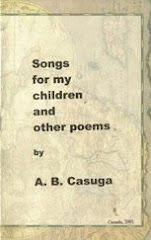
My photo
ALBERT B. CASUGA, a Philippine-born writer, lives in Mississauga, Ontario, Canada, where he continues to write poetry, fiction, and criticism after his retirement from teaching and serving as an elected member of his region's school board. He was nominated to the Mississauga Arts Council Literary Awards in 2007. A graduate of the Royal and Pontifical University of St. Thomas (now University of Santo Tomas, Manila. Literature and English, magna cum laude), he taught English and Literature (Criticism, Theory, and Creative Writing) at the Philippines' De La Salle University and San Beda College. He has authored books of poetry, short stories, literary theory and criticism. He has won awards for his works in Canada, the U.S.A., and the Philippines. His latest work, A Theory of Echoes and Other Poems was published February 2009 by the University of Santo Tomas Publishing House. His fiction and poetry were published by online literary journals Asia Writes and Coastal Poems recently. He was a Fellow at the 1972 Silliman University Writers Workshop, Philippines. As a journalist, he worked with the United Press International and wrote an art column for the defunct Philippines Herald.

Friday, March 13, 2015

UNTIL MEMORY FADES


IN MEMORIAM: Former Chief Presiding Justice of the Court of Appeals of the Philippines. God speed, Choy. Your job is done here. In pace requiescat.


UNTIL MEMORY FADES


(For Justice Conrado "Choy: Vasquez, Jr. + March 12, 2015)


You have gone before another sunrise,
Choy, but you have chosen to take its place.
You will not need hills or seas or horizons
to rise from; by leaving us, you have risen
where you have caught His hand on time
to bear you up where He presides. Eternity.

Has anyone come back from this defiled form
and mapped out ways to get back to that eternity
we claim as heirs to, where days are as chartless
as the river stream that must flow to an endless,
ceaseless fountainhead which has no beginning?
There is no other way back except by destruction.

When every rampart has been carted away, we
do not pine for them like those we cannot lose
because we store them in vaults of our memory:
they are our milestones of an afterlife we choose
to build from achieved desires, fulfilled dreams--
these chambers of a heart that will not crumble.

What, indeed, do we know of eternity? Save this:
We are never away from it. Until memory fades.
"Habang may buhay, hindi ka namin makakalimutan."


---ALBERT B. CASUGA


Sunday, March 1, 2015

WHAAT IS IT (lIFE) ALL FOR? THREE POEMS


MY THREE POEMS ON FINDING MEANING IN MEANINGS. What is the meaning of life? These are poems as answers to the Big Questions. This post was prompted by Brain Pickings link on Leo Tolstoy's "Finding Meaning in a Meaningless World."


WHAT IS IT (Life) ALL FOR?

(For All Who Care to Find Meaning)


1. IN SEARCH OF MEANINGS

Missing the many splendored thing
is one way of looking at this search.
How really far out there do we need
to fly, or espy for the god particle we
seemed to have lost in the process?

Why look behind the stars or in them?
Did we not lose our angels coming off
the crib or the direst cranny for shelter?
They do not grow with us, nor guide us.
Absconding, they quietly creep away.

Courage and devilment open our eyes
to what stories we could live with or by,
or what places to board up or occupy.
Orphans at birth, we are alone at death.
What we mean here is what we make.

The womb is a meaning we cannot do
without: our final breath is a call:
Mother, hold me. Our first cry is a call:
Mother, love me. And then we grow old
shaping up all excess purposes and ends.

The tomb is yet another meaning we
scarcely begin to understand before it
pulls us to its urgent demand: living
to die trying to live while dying is easy
may yet be the meaning we struggle for.

---ALBERT B. CASUGA


Here's a poetic response to the Big Question: Why is There Something and Not Nothing? (The Strange Ways of Being)*


2. MEANING AS AXIOM

If another twig falls in the night,
as silently as it grew as a sapling
toward the sky, would that mean
anything anyway to anyone?
The graveyard of a fallen tree
may tell untold stories that stay
untold until a struggling stray root
breaks through dry rot and ground
for yet another flushed cherry tree.

The inexorable is also axiom here:
life begins in death in a spun gyre
twirling into flowers, forever moving.
Nothing is everything here, but there
where leaves had once fallen, broken
twigs spring back as fluttering birds
twittering on branches like new leaves.


—ALBERT B. CASUGA

*Simon Blackburn, The Big Questions: Philosophy, Quercus Publishing Plc, London, UK, 2009.


3. WHAT MEANING MEANS


Giving up on giving up is a better choice,
when being sensible and clear are futile.
Words would lose meaning, ours will not.

Where you see a vine leading its tendrils
up to a broken branch shedding a last leaf,
you make me see its undulant plummet

to the parched pond mottled by blackened
and brittle leaves long dead even before
the end of this long hot summer. It is real.

Is this not our faultless way of knowing
what we pretend to know when we can
no longer see the dancer from the dance?

Would not the falling of that lonely leaf
trace the slower climb of a clinging vine?
Like seeing both sides of the wall at once.


---ALBERT B. CASUGA

*To celebrate Poetry Month, we thought of collecting a series of poems that would respond to these Big Questions posited by Simon Blackburn, Professor of Philosophy at the University of Cambridge, in his book The Big Questions Philosophy, 2009, Quercus Publishing Plc, London, UK. pp.38-47. He says about knowing: "...we need our confidence to match what happens. That is the gold standard for knowledge and truth alike." (Ibid, pg.47)

Painting: Adam and Eve in Paradise by Ian Brueghel the Elder.
(The apple from the Tree of Knowledge? What does that mean?)

Monday, January 12, 2015

A VALENTINE STORY: FOUR LOVE POEMS FOR ALMA AND RELLY

A VALENTINE STORY*
FOUR LOVE POEMS

 (FOR ALMA AND RELLY)


This selection of love poems is for Alma Anonas and Relly Carpio whose love for each other has strengthened them this far to carry on despite the dread of Relly's stroke that has disturbed their otherwise productive lives. I thought this is as good a Valentine's story as any, if it means to celebrate love, loving, and living. Mabuhay, Alma and Relly.**


THE JUDGMENT 

Surely there must be a way… /…to dwell without/rancor or remorse in moments when I /might press my face against your nape/to catch that drifting note—/unnameable, unmistakable, stirring/even my sorrows into fragrance. --- From “Reprieve” by Luisa A. Igloria, Via Negativa, 08-02-11  

 
It is the way of beauty and of virtue you require,
the canon forgotten in our striving for the wind.  

Come hither, anyway, hide your pain in the cup
of my hands, find that reprieve from a judgment  

of endlessly inchoate loving, and let your heart
rest from its ceaseless running. Escape stops here.  

Should I then pledge fealty to being your gaoler?
Should I find you an open cage to freely return to?  

But these will only be tethers that must bind you
when all you pray for is to be loved and unafraid.  

Now, therefore, with all my courage, and all
that I can grant, I absolve you from this price  

of laying your life down for the countless kisses
you have given and not taken any in return. 

 
---Albert B. Casuga


HIS PROMISE
 

…If I disappeared into one of the ruby-red rooms/of the pomegranate, would you stain/your fingers to search for me?---From “Each Question is Always the Same Question” by Luisa A. Igloria, Via Negativa, 08-11-11

 
You could not hide from me if you tried,
no ruby-red chambers have room enough
to shield you from my dowse, my heart’s
divining rod, I will find you. I must.  

Would stains stop me? Neither will filth.
Each question you ask will be the same
question I will always seek to answer
if this search shall take me from here  

to the last seed that would have sprouted
from dry clay hiding your eyes, your limbs,
your mouth in each branch or leaf, or twig.
I shall kiss them all, and I will find you.

 
---Albert B. Casuga


PALABRA DE HONOR 

 
How long does wood need to steep,/to stay alive long enough with clay/it loves in the kiln?---From “Each Question is Always the Same Question” by Luisa A. Igloria, Via Negativa, 08-11-11 

 
I would take forever, if I were wood, to steep
in peacock colours and stand tall as a totem
pole. But I am still an uncut trunk, a lookout
point really, staying true to a palabra de honor.*  

On my word of honour, even when I am felled
to provide fire for cauldrons or heat for kiln,
I will stay alive long enough as ember until
you have been formed as that earthen jar  

to hold what we have always wanted to keep:
all the love and promise moulded in crucibles
of passion molten at last as honey to last us
to the end of our journey beyond these woods.  

This kiln fire would have long cooled down,
before the flame of this palabra de honor,
my troth and my word, would have flared out.
My trunk will be imbued with lustrous red soon. 


---Albert B. Casuga


*Palabra de honor ---A word of honour, a troth that one is ready to live or die for. 


ENTREATY
 
Summer turns its coat/…sleeves out, and makes a promise the way you do:/no vows, no witnesses but for a few letters/in the sand. But I row, you row; we both do.---From “Turning” by Luisa A. Igloria, Via Negativa, 08-21-11 


It is what we do when we are in an open sea,
locked in roiled waters on uncertain weather:
you row like my life depended on it, I row
you away from your fears that somewhere,
sometime, in this abiding turbulence, I will
absently dive into the dark depths and stay
under, finding solace from not resurfacing,
when bobbing up for air means we have to row
into a shore of rocks, run aground, and dash
like the homing waves into a brackish boulder.  

But I am rowing back with you to that sandbar
where I etched the letters framed in a pierced
heart that has yet to be erased by ebbing tide.
Will you find time then to write your promise?


---Albert B. Casuga


* Eleven months after a stroke, Relly de Guzman Carpio hangs on with all the loving care he is getting from his writer wife Alma Anonas-Carpio. In a recent Facebook post, Alma writes about how she has so far steeled herself with courage despite a steady barrage of angst and dread. I thought that if there was a love story to mark Valentine's Day, this was it. Read Alma's Notes, 11th MONTH, "Dear Relly," in her Facebook post.


**Culled from previously posted poems in this blog.
Friday, December 12, 2014

POEMS ON AN OMEN


POEMS ON AN OMEN

 
(For Poet and Social Activist Mila D. Aguilar, While Waiting)


1. THE CANON OF THE WAY AND OF VIRTUE

Beauty is an omen.
--Tao Teh Ching


Of Mao Ch’iang and Li Chi, most attractive women,
flutter of bird wings, dash of deer, fright of fish
and flush of fear, the counsel of Chuang Tzu is said:
“Beauty is an omen.”


So we saunter where crackle of pine cones touches
softly what remains of our feet or is left of our ears;
almost at the end of our walk, we find the ripple
upon the pond meaningless to us now.
O Mao Ch’iang, soon enough even our eyes
will lose the sky. Nothing, nothing stirs.

Nothing is the way for everything -–
the loft upon the Hunan hill, the dark city down there,
the quietness visited upon us, Li Chi, all land
that spawns the life of dying and death –
everything walks the pilgrim journey to nothing.
Nothing is everything here.


2. TRANSFIGURATIONS: IS BEAUTY AN OMEN?


A condition of complete simplicity/ (Costing not less than everything)---Little Gidding, The Four Quartets, T.S.Eliot


Cocooned in a condition of utter simplicity,
the silkworm will not stop oozing out its tapestry
onto the point of death which is also its beauty.

How much beauty can be eked out of pain?
Like the hurt bivalved flesh of the grimy oyster,
would the papillon wings glisten like a pearl?

But this one is spun out of patience: there
must be radiance out of a cocoon’s dark
confines. It can only break into mobile light.

Colour the mariposa green, would that matter?
Dye the silk out of its consumed gossamer nets,
would that stop its flying out of a crude beginning?

Arrested from its final transfiguration, the worm
turns and it is on a table–the grub of culinary
quintessence! Quite like an earlier challenge:

“Eat of my flesh, drink of my blood. This covenant
shall not be broken. I will be with you again when
the radiance of this goblet dims into a eucharist.”

A condition of simplicity? Bear beauty and perish?
Offer an unending dream in a kingdom, and be slain?
The tale of the supreme sacrifice is also immolation.

What does it matter that I die then, if I flew out
of a trellis like the monarch butterfly, that started
as a wormed-out silkworm then food for the hungry?

I would be the worm, the injured mother pearl,
the crucified madman who asked that his flesh
be eaten, his blood quaffed, and live forever.

Beauty is an omen. Destroy this vessel of clay,
and it can only spill the reddest of wine, the
stoutest of ale: a dangerous promise of eternal life.


—ALBERT B. CASUGA
Mississauga. December 11, 2014


( "Transfiguration", a painting by Janet Weight Reed of London, England


Wednesday, December 10, 2014

LOOKING BACK


LOOKING BACK


Mudfish between fingers, rice stalks...
whipped by whistling monsoon wind
on our thin backs, rain-pelted faces:
you cannot look back at them in anger.


But you do. You have lost them forever.
You can never be there again. Forever.
You will go back to the old schoolyard,
but you will not find the desk you carved

her name on, hearts, initials, arrows,
all gone from sandpapered desk tops,
dark paint covering the deepest cuts
like healed cankers, mended wounds,

scars of the rawest longing for the girl
who had the longest hair, wiliest smile,
cleverest excuses for going home late,
“O, we cleaned the blackboards and all.”

Are the moss-gowned shore boulders
still there? The rocks in whose crevices
you buried secret vows to always be there
for each other in this place, this town?

That tamarind tree in whose branches
your kite got caught, rended bamboo
ribs cracked you wept over until she
stilled your quivering shoulders in her

arms, is it still there between the hills
you named after her, body parts you
were too scared to call were like hers?
Does the tree still bear its tangy fruit?

There will be more questions. Will you
find the answers you need to go home?
You will even ask the trees, if you must,
but even they will no longer talk to you.


---Albert B. Casuga

Monday, December 8, 2014

HURRICANE POEMS FOR A LARK


HURRICANE POEMS FOR A LARK


1. Who has seen the Wind?


Always the uninvited guest, the wind
pushes through the porch into the house,
and scatters leaves collected in its wake,
like a shower of crackling seeds freed
from pods that do not come from here.


Strange, how it barrels through rooms
disturbing spiders spinning webs busily
before the storm ebbs, safety nets strung
among sepia-tinted pictures on the wall.


What did it miss along the way? Winds
as interlopers are blind levelers–the rich
run for supplies as quickly as the poor do.

In New York, as in Manila, the howler
brought in the flood, and left laughing.


2.  She Left Uproariously Howling


Her fury might as well have risen from the sea
Wreck every hearth and heart on her wake:
It should not matter, these are worms wriggling
To overstay in rotten mounds of a leftover paradise
Abandoned by leeches of fuel, stones, fire powder,
Who ripped the sides of mountains for nickel
And gold to build the ships that burned villages
From the sky and left like the wind laughing
After the slaughter of the hallooing innocents
Yelping hosannas to a rain of napalm, welcoming
Death and dying as deliriously as they did some
Distant rain brought by growls of sudden thunder.


3. Beware the Deluge Reprised


A Deluge comes. Only this time, we have no Arks
Nor Ararats to salvage all who hope to find
Another Blue Planet in an extended Universe.
No one has applied to be a Noah. They are all,
All retired and tired of saving a ruthless specie,
The homo viator whose journey brings nothing
But a discovery that he has lost the Love he had
For all the meek who shall inherit the Earth.


—ALBERT B. CASUGA
Mississauga, December 8, 2014


Wednesday, December 3, 2014

AFTER "AFTER": A LONGING


AFTER “AFTER”: A LONGING


(For all the Old Lovers Caught in the Cold Rain)


1. A Hammock Song


After after, is there anything or anyone

left to sing the hammock songs? After after,

will you still be there waiting, a warm blanket

in your hands, to throw the flannel on my lap,

lest I drool myself to a sundown slumber

and promptly forget it gets cold in the winter?


Aiee, amor mio, despues de nuestros amores,

when love is gone, after all the countless days,

where shall we find that place called after?


If it is lost, too, will there always be another?

Will this longing for the warmth of a gentle caress,

when nights and beds are cold, find its answer?

Will it be a knowing touch on my back after after?


2. Her Frolic in the Rain


Tomorrow, I will walk through an abandoned garden in the rain:

I will tilt my face to some grey sky like an agape earthen jar,

Catch myself some nourishing rain. Must I, on my gnarled knees,

Beg for these hurts to set me free? My hummingbirds will fly off

leaving me this mansion of joy, but oh, a finite hint of eternity.


Sometime soon, I must frolic in this uncertain weather, dash

through this shower of grace, sate my parched throat in the rain,

drink myself deliriously happy. But after after, will you be there?


--- ALBERT B. CASUGA
Mississauga, December 4, 2014


Monday, December 1, 2014

SINGING HER THE LULLABIES OF GREY AFTERNOONS


MY POEMS TODAY were prompted by the music of Andre Rieu while he played "Edelweiss". "Memories", "Somewhere My Love", "My Way", and "Time to Say Goodbye" which are tunes I used to lull my wee lass with. Marie Clementine even remembers the Filipino love song sung to her often by my wife, her "yoya":---"Ikaw lamang ang aking iibigin" ... and she would continue..." 'kaw laman... mamahalin". Will she remember the tunes when she grows older? I'll bet my bottom dollar, she would. ...I would; in spite of dotage, or even dementia. Huh.


SINGING HER THE LULLABIES ON GREY AFTERNOONS

The lullaby has a long poetic tradition. In these poems, I try to capture the rhythm of those songs that are invariably sung to put people (babies) to sleep. (How bad can they get? Or how gentle?)

1. THE SNOWMAN LULLABY


Close your eyes and fairy lights will lead you
Away from the dark and gloom that scare you:

In your dreams, do you run through brackish snow?
Climb leafless trees or swing from a broken bough?

Where the river bends, do you gather rotting fish,
Glean carrion left from a summer’s fishing mess?

Has the snowman’s head fallen off its melting body?
Its stick hands twisted like pretzels. Arrows really.

The carrot nose has become its stabbing tooth,
Where both eyes were, now Cyclops orb is left

On a conehead of dripping snow; a crushed face
Stares blankly at a mid-day sun whose lapping rays

Forebode another season for yet another reason
To accept that what lives is also ripe for destruction.


(O, my aching heart, it aches, it hurts,
It hurts badly, it hurts to the core.
Kindly spare me your gentle nurture,
For I dread death’s coming spectre.)*


 2. THE WIND LULLABY


Close your eyes and let the wind rip through
Tears and cracks and cranny and broken doors, too.

Grip the tightened string on your wayward kite,
No wind could wreck nor snap it loose from flight.

You will ride the wind, my boy, and touch the sun,
Though frightful prayers plead that you must run

From the dreams that have become nightmares,
From the fallen kites; run from the fearsome snares.

Life is a trap, much like the burlap waiting downstream,
When you get there, you are enmeshed -- do not scream.

It is too late to scream. Close your eyes, shut them tight.
Life is not a waking dream. You have just begun to fight.


(O, my aching heart, it aches, it hurts,
It hurts badly, it hurts to the core.
Kindly spare me your gentle nurture,
For I dread death’s coming spectre.)*


--- ALBERT B. CASUGA
_____________
Ilocano refrain of the lullabies.

*Annnay, pusok, annay, annay,
Nasaem, naut-ut la unay.
Itdem kaniak ta pannaranay
Ta kaasiak a maidasay.
--- Duay-ya: Dungdungwen Kanto
(A Lullaby of Love), Ilocano Lullaby Refrain


Painting of a sleeping baby by Janet Weight Reed of London, England


Thursday, November 20, 2014

THE STILL POINT: A FINAL REFUGE


TODAY'S POEM: Where one will find a final sanctuary. How does one get there? What kind of a refuge is it?


THE STILL POINT: A FINAL REFUGE


(For Dreamers)


Stand still. Find your still point.
You will find a sanctuary there.


All the wind you can whistle for
will run through you like spirits
hovering, pulling you through
all the small boxes keeping you
your own unshackled prisoner,
moored to fears fencing you in
like the pages of a book bound
to a rind, like a caged sparrow
perched on a bar will hop down
rather than fly in narrow air.


When you get there, that place
will not be there till you find it.
Build it from fondest dreams,
house them in open chambers.
Let the winds of everywhere
and everything rifle through
its corridors to find you free,
unafraid to roam elsewhere
because you know there is this
still point to go home to. Always.


--- Albert B. Casuga

 Mississauga, November 19, 2014

Tuesday, November 18, 2014

A WAITING GAME: SUMMING UP


TODAY'S POEM was prompted by a line from "The Prophet" by Khalil Gibran about pain being the beginning of understanding. Is it the prize of having to wait till we get back to our final home? Where might this be? We lived briefly in a home we could not have. When we got it built, we had to leave. The pain is knowing we got a raw deal, or knowing that, we will know why and understand. Time to stop then. Time to Sum up Accept that pain is one's gain --- it can only lead us back... to a happy place we have lost but will regain.


A WAITING GAME: SUMMING UP


"Your pain is the breaking of the shell that encloses your understanding. / And you would watch with serenity through the winters of your grief."-- Khalil Gibran, "The Prophet"


Looking for a good time to stop,
is to stop looking like slumping
on a fallen trunk or a trail rock
jagged and jutting out of the bluff.

Morning walks get longer along
empty spaces before familiar curbs
signal a turn to what we wait for:
the final bend. We are back home.

Because we have seen the clues,
because we have seen them all
already, I feel it is time to stop
waiting, sum up the bill, and go.

What was I given to bear the pain
of knowing that I did not know?
Or build a home I could not live in?
What tools must I now return?

In summing up, I will discount this,
in the game of haggling for a place
back in the Garden. Our stay here
was overpaid. We waited too long

for that room with a better view,
that terrace with a canopy of roses,
and blue birds trilling on the sill.
O, for a touch of that distant sky!

“HURRY UP PLEASE ITS TIME.
Now Albert is coming back,
make yourself a bit smart.”* Eliot,
of course, said it for me earlier.

How long ago was that, when I
read those Wasteland lines? How
long have I waited to use them?
Is this a good time, yet? I waited.

Next time around, if there is one,
I will be smart. I will settle only for
a room where I could see the sky
and the sea conspire to eat the sun.


---Albert B. Casuga
Mississauga, November 18, 2014

* T. S. Eliot, The Wasteland, II. A Chess Game, T. S. Eliot, The Complete Poems and Plays, 1909-1950)