My photo
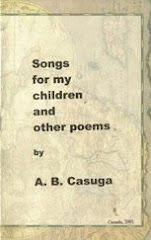
ALBERT B. CASUGA, a Philippine-born writer, lives in Mississauga, Ontario, Canada, where he continues to write poetry, fiction, and criticism after his retirement from teaching and serving as an elected member of his region's school board. He was nominated to the Mississauga Arts Council Literary Awards in 2007. A graduate of the Royal and Pontifical University of St. Thomas (now University of Santo Tomas, Manila. Literature and English, magna cum laude), he taught English and Literature (Criticism, Theory, and Creative Writing) at the Philippines' De La Salle University and San Beda College. He has authored books of poetry, short stories, literary theory and criticism. He has won awards for his works in Canada, the U.S.A., and the Philippines. His latest work, A Theory of Echoes and Other Poems was published February 2009 by the University of Santo Tomas Publishing House. His fiction and poetry were published by online literary journals Asia Writes and Coastal Poems recently. He was a Fellow at the 1972 Silliman University Writers Workshop, Philippines. As a journalist, he worked with the United Press International and wrote an art column for the defunct Philippines Herald.

Tuesday, September 24, 2013

CHRISTUS ERECTUS


CHRISTUS ERECTUS

Atop a hill overlooking a harbour
of boats only the rich can afford,
He presides as a statue of the man
on Golgotha who was nailed to a tree

for denying Caesar's dominion over all
that moves in the streets of Jerusalem.

Isn't it a grand irony for him to preside
over the realms of the wealthy even as
the poor on the other side of the hill
wail for their daily bread where none
could be broken to nurture the hungry?

Christus Erectus, on the Nicaraguan hill,
how far have you come down from that tree
to raise your fingers in peace where there
is nothing but violence and greed? You
have come a long way from the Hill of Skulls
to tower over this pilgrim's photo-outlook
indicating the blessings first for the rulers.

How your resurrection has become a tourist
spectacle in some bricks and stones! Still.
I pray that my wobbling knee could still
make it down the hill like those drunken
praetorians who made off with your robe,
while I make off with mementoes of stones.
 

---ALBERT B. CASUGA

 (In Nicaragua at the Shrine of the Divine Merciful Redeemer. San Juan Sud, Nicaragua.)

Sunday, September 15, 2013

WHERE BEAUTY IS, HE WILL BE THERE


WHERE BEAUTY IS, HE WILL BE THERE

(For Bayani de Leon, Friend, Poet, and Music Maker+ 1942-2013)

 
1. Palaver on a Football Field

You said: “I shall be like cellar wine,
I will never grow stale unto dotage.
Like light, the energy in my music
will lift me up beyond all drivel
and the smallness of all that is dark
in these joyless catacombs of the ugly.
Wherever beauty is, I will be there.”

We got you drunk, while drinking
was good, and gin got you singing
sans podium sans baton sans sense
where words were the only balls
we kicked around, knowing nothing
about why all that verdant expanse
would be wider than our classrooms,
its kicking brutes even bigger heroes
than us, or was this their university?
Schools exist only for football teams.

When we staggered out into the night,
you introduced yourself to a femme
du nuit outside the gate: “I am a Hero
Of Lions”, and we chorused: So are we,
All, all heroes filled with cheap rum.
“Wherever beauty is, I will be there,”
You trolled. You got stuck there, too.

2. After All Those Years…

Imagine if all of us were caterpillars,
all inching toward that one branch
or leaf whence we spread our wings
to carry out a bounden duty of flitting
from one rose garden to a hillock
smothered by a rainbow of pansies:

Would we race to the highest branch
and shed our cocoon shackles quickly
to fulfill this raison d’etre of spreading
beauty where it is scarce or now gone?
Imagine if all that we lived for were a
task as gleeful as this godlike whimsy.

Would we not scale beyond this boot,
and swing beyond this silken thread?
Or tear through bramble or grappling
gossamer webs that drag us down
even as we crawl toward sunlit fronds
to spread our wings and get beauty done?

3.  Our Troth

Wherever beauty is, we will be there,
And if our troth be true, we will all
Be stuck there, too, spinning webs
of words, music that will outlive us all.


—ALBERT B. CASUGA

September 15, 2013
Mississauga, Ontario, Canada

Saturday, August 31, 2013

THE DOTARD POEMS


THE DOTARD POEMS


“I an old man,/ A dull head among windy spaces./ …I have lost my passion: why should I need to keep it/ Since what is kept must be adulterated?/…Tenants of the house,/ Thoughts of a dry brain in a dry season.”---T. S. Eliot, Gerontion, 1920
 

1. HIS E-MAIL FROM SOMEWHERE

Dotard Poem #1.  Love song in his dotage. He thought he was lonely; took his IPAD and sent himself an email.

You read me lines before you left.
Love tames all that is wild, you said.

I know I am finally done with running,
but I have nowhere to go. I can’t find you.

On the G-mail, Yahoo, what have you,
I risk being exposed as a scam scumbag.

I, too, am ill, and I have nothing to leave
except palpable feelings of your touch.

I have become wealthy with these tender,
not pounds nor guineas, but all this gentle

currency that has long lost its value: Love,
love for the wild heart and the wild times.


2. CLOSING SWINGING DOORS


Dotard Poem #2. He told himself in a Remind Me Note on the fridge: "Forgot to forget; should have closed the door last night. Afraid will forget again tonight, and she will be back yelling. 'Shut the damn doors.' Ah, furgedabawteeet!" The dotard stayed awake all night instead. Can one close swinging doors? So, he wrote a poem to remind himself to forget what is left to forget. Okay?

There is just the urgent need now to run
quickly away from the swinging door
that will impale him needlessly to walls

closing down on him even as he spreads
his new-found wings to rise beyond all
this debris of meaning, love’s carrion,

when that is all gone, all abandoned, all
forgotten as just the drivel of cripples
who would not think of shutting doors

whence come the vultures of unfeeling
ennui, numb hearts still beating, still
blubbering about how lonely it will be

before the eager beaks have garroted
their brittle necks straining to grumble
a futile prayer that this visit is too brief.

3. GRASS ON MY BACK


Dotard Poem # 3. What was her name again? She came down the hill, I think, and all I wanted was to catch a whiff of dry sweat on her back. Damn it, if I could only remember her name, I'd write her a love poem. Or a letter. Or just an email. Facebook maybe. My hometown? On the tip of my tongue.

"La muerte no llega con la vejez, sino con el olvido."---Gabriel Garcia Marquez*

We will climb that hill again, won’t we?
There is a misplaced pagoda up there now,
a lookout we would have claimed our nook

When you were but a ticklish sweetheart
of a flirt, and I a wild-eyed swain waiting
for some summer breeze to blow your skirt

off your glistening legs moistened by heat
that became your lame excuse to giggle
as you shook my hands off your bare back:

O, they are sticky, you protested coyly then,
but when was the last time we laughed like
innocent lovers hiding from vile mongers

fearful that we could not wrap each other
into trembling arms as we rolled on grass
under the ancient acacia guarding the hill?

*Death does not arrive with old age, but with oblivion.
 

4. DRUTHERS
 

Dotard Poem #4. There was a time I could write any borracho under the table, I mean drink under the bridge. Is that the bromide? But whatever for? I cannot recall how and when I wrote this note on a rough, brown paper bag of music and a pack of metaphors. Did I say music? Meta…what? Oh, I meant a pack of brew. Give it all back. Return them to senders. I am done.


(Or Send Back to Sender)

If he had his druthers, he’d rather not be given:
too little time for too much to give back on.
A keen eye to see both sides of a magic coin?
Be a magistrate then, look for the right and just.
Or a poet who sees both sides of a wall. Or mirror.
Why not a jihadist who slays both good and evil
for a master who will not see any evil or any good?

And snow now melts faster than it could fall?
What ever for? He’d rather flakes all blew back
to whatever skies they’ve fallen from, too late
anyway for the grandkids who prayed as hard
as the grumbling Imam now hoarse with his
praying at the muezzin. What’s a hillock for
if it is not snowbound for their tobogganing?

He will not suffer the little ones to miss their
winter sleigh. On the other hand, this could be
a wayward winter storm giving back a late wallop
for having been given a welter of clouds and a clash
of heat and cold. Someone sent him a throne of words:
he built cathedrals of thought no one understood.

It’s poetry, mon ami! He said it’s worth a shrug.
Like cold tea.


5. SILENCE: A NOISY FINITUDE

Dotard Poem #5. This is the way my world ends, not with a bang but with a silence, a whimper calling attention to a noisy finitude. Tata, for now, but I shan't forget to forget those whose time has come to walk out the door. Closing the windows and doors now. If only I could find the locks.

This is the way the world ends/Not with a bang but a whimper. ---From “The Hollow Men” by T.S. Eliot

By sundown, they will be gone, like long shadows
on my porch walls. All the fierce singing done,
what remains is the quiet murmur of the bourn.
Its stream will not return, nor will the swallows.

But while they flitted from tree tops to broken
perches, did they not cry out their bravest songs?
These are our elm trees, these are our willows,
we pieced our homes here together, we roosted.

At the bluffs, we find the woods edge muted now.
Soon, even the cackling gulls will dive a final swoon,
catch the last crayfish lost on boulders left bare
by ebbing tide that must also leave its quiet shore.

It is troths like these that will not last, nothing
endures. The silence can only become a whimper,
the roar riding on the waning wind, a stifled bang
calling attention to a lonely end of a noisy finitude.


---ALBERT B. CASUGA
Mississauga, August 31, 2013


Bottom of Form


Bottom of Form
Friday, August 30, 2013

SILENCE: A NOISY FINITUDE


SILENCE: A NOISY FINITUDE

This is the way the world ends/Not with a bang but a whimper. ---From “The Hollow Men” by T.S. Eliot

By sundown, they will be gone, like long shadows
on my porch walls. All the fierce singing done,
what remains is the quiet murmur of the bourn.
Its stream will not return, nor will the swallows.

But while they flitted from tree tops to broken
perches, did they not cry out their bravest songs?
These are our elm trees, these are our willows,
we pieced our homes here together, we roosted.

At the bluffs, we find the woods edge muted now.
Soon, even the cackling gulls will dive a final swoon,
catch the last crayfish lost on boulders left bare
by ebbing tide that must also leave its quiet shore.

It is troths like these that will not last, nothing
endures. The silence can only become a whimper,
the roar riding on the waning wind, a stifled bang
calling attention to a lonely end of a noisy finitude.

---ALBERT B. CASUGA

Mississauga, August 30, 2013

Thursday, August 29, 2013

DRUTHERS


Dotard Poem 4.  There was a time I could write any borracho under the table, I mean drink under the bridge. Is that the bromide? But whatever for? I cannot recall how and when I wrote this note on a rough, brown paper bag of music and a pack of metaphors. Did I say music? Meta…what? Oh, I meant a pack of brew. Give it all back. Return them to senders. I am done.
 
DRUTHERS
 
(Or Send Back to Sender)

If he had his druthers, he’d rather not be given:
too little time for too much to give back on.
A keen eye to see both sides of a magic coin?
Be a magistrate then, look for the right and just.
Or a poet who sees both sides of a wall. Or mirror.
Why not a jihadist who slays both good and evil
for a master who will not see any evil in any good?

And snow now melting faster than it could fall?
What ever for? He’d rather they all blew back
to whatever skies they’ve fallen from, too late
anyway for the grandkids who prayed as hard
as the grumbling Imam now hoarse with his
praying at the muezzin. What’s a hillock for
if it is not snowbound for their tobogganing?

He will not suffer the little ones to miss their
winter sleigh. On the other hand, this could be
a wayward winter storm giving back a late wallop
for having been given a welter of clouds and a clash
of heat and cold. Someone sent him a throne of words:
he built cathedrals of thought no one understood.
It’s poetry, mon ami! He said it’s worth a shrug,
like cold tea.

—ALBERT B. CASUGA

Mississauga, August 29, 2013
 

Sunday, August 25, 2013

GOT YOU COVERED: A PARABLE ON THE SAND


Photo of Marie Clementine Casuga-Lalonde by Adele Casuga at Sauble Beach
 
 
GOT YOU COVERED: A PARABLE ON THE SAND
 

Soon, you just know, you’d cover the hole. Oh?
There was one other man, a saint of a dotard
Though, who chided a little lass much like you,
“Wee one, why are you pouring each little cup
From the sea into your small hole in the sand?”

Askance, she glanced at his worn friar sandals,
Looked coyly into his dark wizened face, his eyes
Burning with the sundown’s flame of colours,
Then muttered (like a mother upbraiding a son
Who climbed a dying oak tree to snatch a nest
He said he must save lest the unhatched eggs
Break before their time, but was told: Do not!):

“Wise, Sir, Good, Sir, I must empty this sea
Into this shore that Father might be spared time
Casting his ragged net to catch a meal Mother,
Sister, and Brother have piled stones for a stove
To cook on, before we leave for the town yonder
To bring offerings, fish and beans, to the temple.”

“But the ocean is just so vast, my innocent child,”
He hastened to say in the mien of most old men
Rather impatient about youthful impertinence,
“You will never in your lifetime ever empty a sea
Of its stream, nor could brave Noah in his Ark,
Not even when God sent that dove and rainbow.”

She stood up then, wrapping her windblown skirt
Around her spindly legs, and whispered to the wind:
“Nor could you, in your learned and entire lifetime,
Know why there must be a Father who sends a Son
With only a Fiery Spirit to spread Love and be killed.”

As you break into what abuelo calls your sonrisa
De los angeles, sonrisa de hermosura, sonrisa bella,
Hija, mia,*” you must be murmuring to the wind
Caressing you at Sauble: “I shall cover every hole,
Da-da, where you could stumble. Got you covered.”
 

---ALBERT B. CASUGA

Mississauga, August 25, 2013

 
*…sonrisa de los angeles,  , sonrisa de hermosura, sonrisa bella , hija mia…” (Trans: angel’s smile, smile of beauty, lovely smile, my little girl…”)


Photo of the Lalonde siblings romping in the sea by Adele Casuga


Friday, August 23, 2013

THE IMAM'S PRAYER


THE IMAM'S PRAYER

(For the Syrian Children Killed by Chemical Bombs)

Insha Allah,
 
my dear child, you will leave us pure
with a free heart; you perished in gaols
of hatred, unsated anger crying havoc
on all that must remain in this temple:
it will not crumble though madmen
crush them in the name of Country,
and Allah, in the name of all infants
slaughtered as lambs, innocents
paying ransom for the lost souls
of these jackals of doom, vile butchers
who would rather slit their throats
to shed tainted blood for Great Allah
than intone with the muezzin at dusk:

Allahu Akhbar                
Allahu Akhbar.
Allahu Akhbar.

---Albert B. Casuga
August 23, 2013, Mississauga


Thursday, August 22, 2013

LOOKING FOR LOST SEA SHELLS


LOOKING FOR LOST SEA SHELLS

(For Cloclo, Loulou, and Momo)

1.  At the Flowerpot Island

It was strange while they gawked at it:
A wall fencing the sea in as moat manqué,
Or is it a battle bastion cutting land off
Where the meadows met with the mist
Cloaking this hunting ground at sunrise?

Did cannons roar atop these lime stones
When, in stealth, tall ships sought shelter
From the roaring waterspout howlers,
Leeward wind that kept even the brave
In their teepees and the hunted in lairs?

Are sundown tales of weeping mothers
Clutching their limp, bloodied infants
Slumber stories here, like roaming ghosts
Peeking into tents watching the wee ones
Snuggle deep into a mother’s embrace?

Did the dogs of war prowl these shores
Some time when God, grain, and gold
Were chattel peddled, if not coveted,
By conquering intruders from beyond
Who decreed suns never set in empires?

2. Looking for Seashells

There is nothing in that crevice or cranny,
Little one, you will not find lost sea shells
Buried there; they have been reclaimed
By the sea, like a mother who will not trust
Anyone who slays children in their sleep.

Elsewhere, while you dream of waterslides
And moonlit beaches, sand caves, sunsets,
And laughter among the dunes of Sauble,
Lads and lasses, mothers and fathers, too,
Shall not wake up to another misty morning.

Before bedtime, after another sundown ,
My wee ones, look long and hard at the sea,
Ask her gently to lend back some sea shells.
You will return with bright flowers in them.

 
---ALBERT B. CASUGA
August 22, 2013, Mississauga

 
Toronto Star Front Page

Wednesday, August 21, 2013

HUMMINGBIRD DREAMS


HUMMINGBIRD DREAMS


(For Marie Clementine at Sauble Beach)
 

Before long, the lullaby of the ebbtide
Would have lulled her, and the sundown
Swoon of the seagulls diving leeward
Becomes sights and sounds of another day.

Eventide catches her cuddling her doll,
Dancing on the sand all done for now:
“Goodnight, little stars, in the blanket sky,
Be good, be bright, be my light by-and-by.”
 
She wraps her ragdoll into a threadbare
Shawl left loose on a bare sunburnt back.
“Goodbye, sea, goodbye, sun, goodbye, all,
Let me sing our song until sleep shall call.”
 
She will not walk by moonlight, starlight
Being her appointed fireflies, like campfire
Fairies flitting from folded flowers to fire,
Quietly singing like little hummingbirds.


---Albert B. Casuga
August 21, 2013, Mississauga


 Photo by Adele Casuga

Tuesday, August 20, 2013

LITTLE SHADOWS AT SUNDOWN


LITTLE SHADOWS AT SUNDOWN

(For the Wee Ones at Sauble Beach)

 
There is where here is:
Do you hear the murmur
Of the seawaves laving this shore?
It is the whispered caress of a mother
Come upon her little ones’ romp
Among the sundown shadows.
Where the flushed horizon
Meets the sea, a father’s
Face gleams ruddy
With laughter’s heat
Still on his crinkled brow.

O, that this cacophony of sounds
Becomes the noise of a lifetime
This heart (from a distance)
Could hearken to, leap up to,
Velvety notes of a joie de vivre
That this place was built for,
Made of, remembered by:

Is this not, after all, the paradise
He thought was lost in time past
Visited now upon his dotage
When he hankers for joy,
A little life left while there is time?

The little shadows taunt the sea
To reach their limbs. Gleeful,
Their now surprised screams,
When touched at last, are drowned
By whimper of the ebbtide waves
That has turned to gentle laughter.
 

---ALBERT B. CASUGA

August 20, 2013, Mississauga